
Republic Policy | Governance. Institutions. Public Policy.
The debate over creating new provinces in Pakistan has once again exposed a fundamental confusion in the country’s political and administrative thinking: the failure to distinguish between the crisis of federalism and the crisis of governance.
A few days ago, Interior Minister Mohsin Naqvi was asked about progress on the creation of new provinces. Against the backdrop of political uncertainty in Khyber Pakhtunkhwa, including the reported imposition of Governor’s Rule and questions surrounding the provincial government, the future of the proposed administrative changes has become increasingly uncertain. Naqvi responded that the process was advancing, with documentation and other formalities under way, and that new administrative units would be created.
But the central question is not simply whether Pakistan should create more administrative units. It is what kind of units the country needs—and what problems they are expected to solve.
Pakistan faces two distinct institutional challenges. The first is a crisis of federalism; the second is a crisis of governance. Treating them as one problem, and expecting a single administrative rearrangement to resolve both, is a fundamental policy mistake.
The crisis of federalism concerns the distribution of constitutional authority between the federation and its constituent units. It is rooted in the imbalance between centralised administrative structures and the federal principles on which the state is constitutionally organised. Pakistan’s provinces have constitutional identities and responsibilities, yet their administrative systems have historically remained heavily influenced by a centralised, unitary bureaucratic culture.
Addressing this crisis requires more than drawing new boundaries. It requires professionalising the civil service, establishing a credible and constitutionally appropriate administrative structure, and ensuring that federal and provincial institutions operate within their respective jurisdictions. A federation cannot function effectively when its administrative architecture consistently pulls authority towards the centre.
The crisis of governance, however, is different. It concerns the distance between citizens and the institutions responsible for delivering public services. Its remedy lies in meaningful devolution of political, administrative and financial authority to the lowest effective tier of government.
This is where local government becomes indispensable.
Pakistan’s political governments have repeatedly demonstrated reluctance to empower elected local institutions. Local governments are often treated as subordinate administrative arrangements rather than as an essential constitutional and democratic tier of governance. Elections are delayed, institutions are weakened, and financial powers remain concentrated at provincial headquarters. As a result, citizens are left with limited influence over decisions that directly affect their daily lives.
Creating additional administrative units without strengthening local government could deepen this problem rather than solve it. Every new province or administrative unit would require its own institutional structure, while the question of whether authority would genuinely reach citizens would remain unanswered. More administrative headquarters do not automatically produce better governance.
There is also a more fundamental distinction that Pakistan’s policymakers must recognise: new federating units are not the same as new administrative units.
A new federating unit should be created through a constitutional and political process, with a clearly defined share of authority within the federation. An administrative unit, by contrast, is primarily a reorganisation of the state’s territorial management. The two arrangements have different constitutional implications and serve different institutional purposes.
Pakistan’s debate should therefore move beyond the assumption that dividing existing provinces into smaller administrative units will resolve the country’s federal imbalance. If the objective is to strengthen federalism, the discussion must concern the creation of new federal units—not merely administrative divisions designed and controlled through the existing centralised structure.
Equally, the creation of new federal units must not become an excuse to postpone local government reform. Each federating unit must establish empowered local institutions, supported by predictable financial transfers, meaningful administrative authority and democratic accountability. Otherwise, power may simply move from Islamabad to provincial capitals, or from existing provincial capitals to new ones, without reaching the people.
The policy framework is straightforward: reform the civil service to address the crisis of federalism; devolve political, administrative and financial authority to local governments to address the crisis of governance; and create new federating units through a constitutional process where the case for them is established.
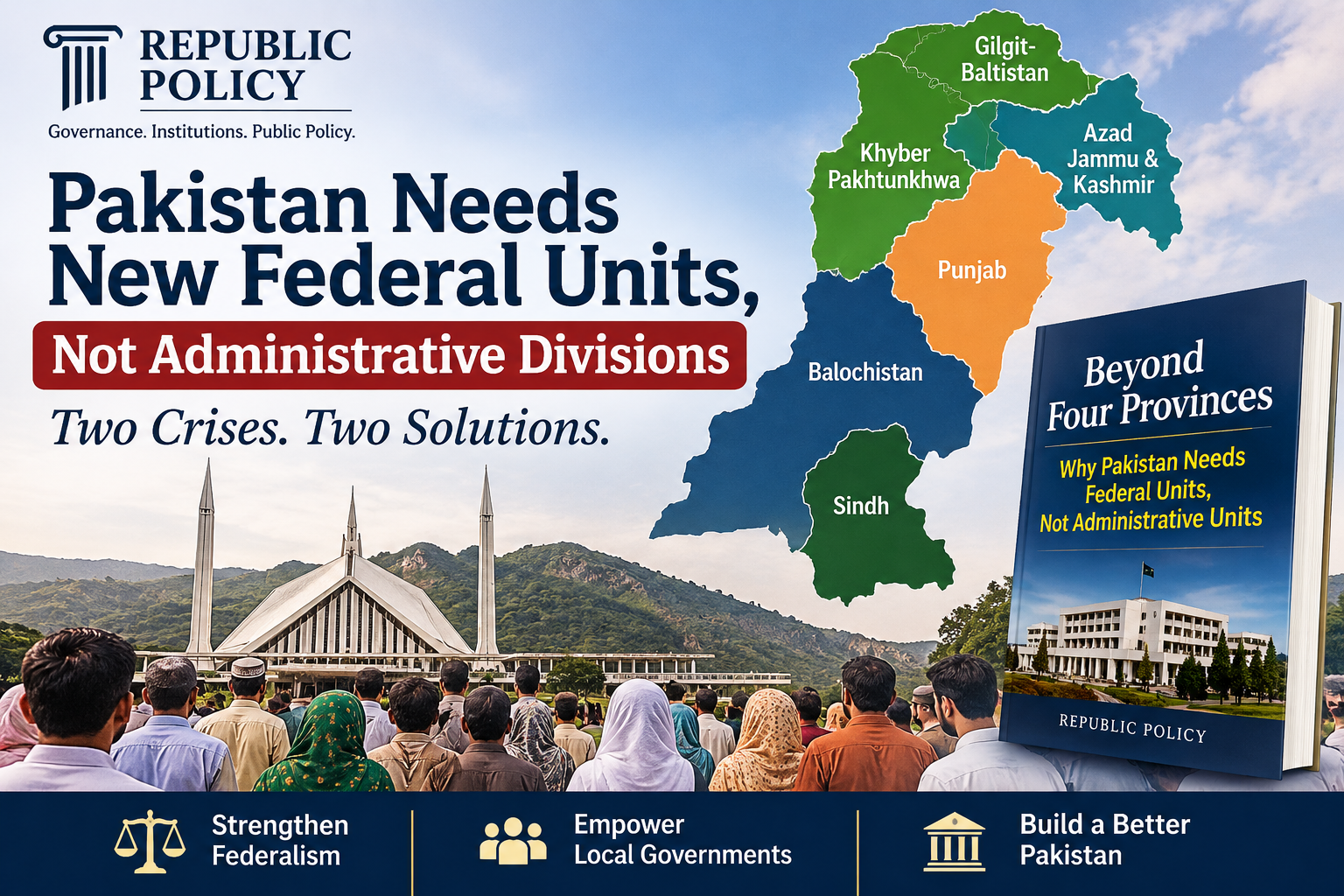
Republic Policy has consistently advanced this distinction in its book, Beyond Four Provinces: Why Pakistan Needs Federal Units, Not Administrative Units. The argument is that Pakistan requires a serious reconsideration of its federal architecture, not another exercise in administrative redistribution that leaves the underlying concentration of power intact.
The country needs a debate based on constitutional design, institutional capacity and democratic accountability—not political announcements or boundary-making alone.
Pakistan does not need smaller centres of centralised power. It needs a stronger federation, professional civil services and empowered local governments. The distinction between federalism and governance is where meaningful reform must begin.
Order the book: Beyond Four Provinces: Why Pakistan Needs Federal Units, Not Administrative Units
WhatsApp: 0341-4222501
Slideshow
Slide 1 — Two Crises, Two Solutions
Pakistan faces a crisis of federalism and a separate crisis of governance. They require distinct reforms.
Slide 2 — The Federalism Crisis
Centralised bureaucratic structures continue to challenge the balance between the federation and its constituent units.
Slide 3 — The Governance Crisis
Political, administrative and financial authority remains concentrated, weakening democratic government at the local level.
Slide 4 — Local Government Matters
New administrative boundaries cannot replace empowered local institutions and meaningful devolution.
Slide 5 — Federal Units, Not Administrative Units
Creating new federating units is a constitutional question, not simply an exercise in territorial administration.
Slide 6 — A Practical Reform Agenda
Professionalise the civil service, strengthen federalism and devolve authority and resources to local governments.
Slide 7 — Read the Republic Policy Argument
Beyond Four Provinces: Why Pakistan Needs Federal Units, Not Administrative Units.
Get Our Books: 0341-4222501