
REPUBLIC POLICY | OPINION & ANALYSIS
The rise of solar power is transforming global energy economics. For Pakistan, the real challenge is no longer generating affordable electricity but reforming the institutions, policies and infrastructure that determine how electricity is produced, distributed and consumed.
The global energy transition has reached a remarkable turning point. Solar power, once dismissed as an expensive alternative dependent on government subsidies, has overtaken nuclear energy in worldwide electricity generation. What appeared technologically ambitious only a decade ago has become an economic reality. More importantly, this transformation is being driven not merely by environmental commitments but by the fundamental economics of electricity production.
According to data compiled by the energy think tank Ember and analysed by the BBC, solar electricity generation narrowly surpassed nuclear output in 2025. During the twelve months ending September 2026, solar produced approximately 13 percent more electricity than nuclear power. A technology that contributed barely one percent of global electricity a decade earlier is expected to account for nearly ten percent in 2026.
These figures reveal something far more significant than the success of renewable energy. They demonstrate how technological innovation, competitive markets and consumer choices can transform entire economic sectors faster than governments and established institutions anticipate.
For Pakistan, the implications are profound.
When Economics Becomes More Powerful Than Policy
The extraordinary expansion of solar energy has been made possible by a dramatic decline in production costs. Improvements in manufacturing efficiency, technological innovation and economies of scale have transformed solar panels into increasingly affordable products.
China’s manufacturing industry has played a decisive role in this transformation. Large-scale production has reduced international prices, making solar electricity economically attractive even in countries with limited financial resources.
Dave Jones, co-founder of Ember, has described solar technology as “offensively cheap”. The expression captures the extraordinary change in energy economics: a relatively inexpensive panel can produce electricity for several decades without requiring continuous fuel purchases.
This distinction matters enormously.
Conventional electricity generation frequently depends on recurring expenditures for imported fuels, transportation and maintenance. Solar installations require substantial initial investment, but their operating costs are comparatively low.
Consequently, electricity consumers are increasingly making decisions based on economic calculations rather than environmental considerations alone.
The solar revolution demonstrates that technological change becomes particularly powerful when financial incentives and public needs move in the same direction.
Pakistan’s Solar Transformation Is a People’s Revolution
Pakistan offers one of the most compelling examples of this development.
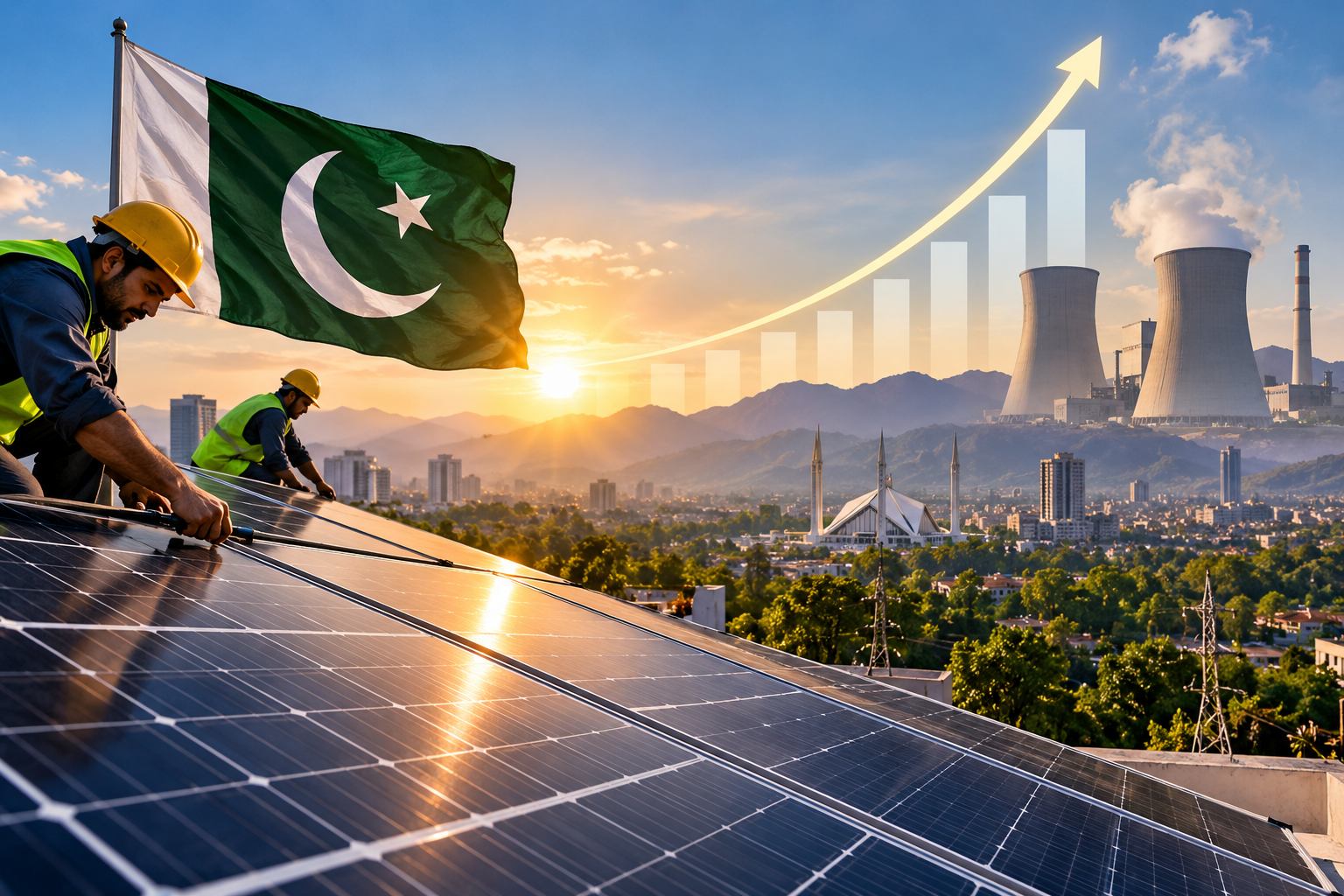
In 2019, solar energy contributed less than two percent of the country’s electricity generation. Its share has since reportedly increased to approximately 24 percent, reflecting an extraordinary transformation in the national energy landscape.
Yet the most remarkable feature of Pakistan’s solar expansion is not simply its speed. It is the identity of those driving it.
Unlike traditional power projects developed through government planning, sovereign guarantees and large financial arrangements, Pakistan’s solar revolution has largely emerged from individual economic decisions.
Households, farmers, shopkeepers and industrial enterprises have invested their own resources in solar installations because conventional electricity has become increasingly expensive and, in some areas, unreliable.
This represents an important shift in the relationship between citizens and the energy system.
Consumers who previously depended almost entirely on centralised electricity suppliers are becoming electricity producers themselves.
They are responding to economic incentives that policymakers have frequently failed to address.
Pakistan’s solar experience therefore raises a fundamental question: why have ordinary citizens demonstrated greater responsiveness to changing energy economics than the institutions responsible for national energy planning?
The Crisis of Pakistan’s Electricity Governance
Pakistan’s electricity difficulties cannot be understood exclusively through the availability of generation capacity.
The country has long struggled with structural weaknesses involving electricity distribution, transmission constraints, financial inefficiencies, tariff design and the recovery of power-sector costs.
Expensive electricity has encouraged consumers to reduce their dependence on the national grid. However, declining grid consumption creates additional complications for distribution companies that must continue maintaining networks and meeting financial obligations.
This creates a difficult economic cycle.
As financially capable consumers install solar systems, they purchase less electricity from conventional suppliers. The fixed costs of the electricity network, however, do not disappear.
If these costs are recovered through higher tariffs on remaining consumers, electricity can become even less affordable for households and businesses unable to invest in solar technology.
Such an outcome would create a serious problem of economic fairness.
The solution cannot simply be to discourage solar adoption or protect inefficient institutional arrangements.
Instead, Pakistan needs a regulatory framework that recognises distributed electricity generation as a permanent feature of the energy economy while ensuring that network costs are recovered transparently and fairly.
The purpose of energy policy should be to provide affordable and reliable electricity, not to preserve outdated business models.
Solar Power Alone Cannot Solve the Energy Crisis
Despite its enormous potential, solar electricity has limitations.
Its production depends on sunlight, while electricity demand continues during evenings, nights and periods of cloud cover.
Battery storage is helping overcome this challenge. Declining battery prices have made it increasingly practical to store daytime electricity for later consumption.
In sunny regions, solar installations combined with batteries can already compete economically with newly constructed fossil-fuel power plants.
Nevertheless, large-scale energy storage, seasonal variations and transmission requirements remain important challenges.
Pakistan must therefore avoid replacing one form of poorly coordinated energy planning with another.
An effective electricity system requires a combination of renewable generation, dependable grid infrastructure, storage technologies, flexible generation capacity and institutions capable of coordinating them.
Solar panels can produce inexpensive electricity. They cannot independently guarantee the stability of an entire national electricity network.
That responsibility belongs to the broader energy system.
The World Is Moving Beyond Traditional Energy Models
Pakistan’s experience is part of a wider international transformation.
China leads global solar deployment, while the United States continues expanding installations despite political disagreements over renewable energy.
India has experienced substantial solar growth, and millions of Australian households now generate electricity through rooftop systems.
Across Africa, consumers are increasingly turning towards solar installations as alternatives to expensive diesel generators and unreliable conventional networks.
These developments reveal that the energy transition is no longer dependent exclusively on international climate agreements.
It is increasingly driven by affordability, accessibility and the desire for greater energy independence.
Meanwhile, technological innovations such as agricultural solar installations, floating solar farms and advanced photovoltaic materials are expanding the possibilities of renewable electricity.
The International Energy Agency expects global solar generation to approximately double between 2025 and 2030.
The direction of technological development is becoming unmistakable.
Pakistan Needs Institutional Reform, Not Merely More Solar Panels
The central lesson for Pakistan is that technological progress cannot substitute for institutional reform.
The country requires a comprehensive reassessment of electricity governance, including the financial structure of distribution companies, tariff policies, transmission investment and the regulatory treatment of household electricity generation.
Energy planning must become more transparent, economically rational and responsive to technological developments.
Public institutions should facilitate innovation rather than treat it as a threat to established administrative arrangements.
Equally important, electricity policy must protect consumers who cannot afford private solar installations. An equitable transition requires reliable grid services and fair pricing for everyone, not merely those with sufficient resources to invest independently.
Pakistan must also develop a coherent strategy for battery storage, modern electricity networks and the integration of decentralised power generation.
These reforms demand political commitment and administrative competence.
The real obstacle is no longer the absence of affordable technology. It is the ability of institutions to adapt.
The Future Belongs to Countries That Adapt
Solar power’s emergence as a larger global electricity source than nuclear energy represents a historic technological achievement. Yet its deeper significance lies in the transformation of economic power and consumer choice.
For Pakistan, solar energy presents an opportunity to reduce dependence on imported fuels, improve industrial competitiveness and make electricity more affordable.
However, these benefits will remain incomplete without reforms that address the structural weaknesses of the national power sector.
Pakistan does not merely need an energy transition. It needs a transition in energy governance.
The solar revolution has already demonstrated that citizens and markets can respond rapidly when technology becomes affordable. The question now is whether Pakistan’s political, administrative and regulatory institutions can demonstrate the same capacity for change.
The future of electricity will not be determined by the number of solar panels installed alone, but by the quality of the institutions responsible for managing the system around them.