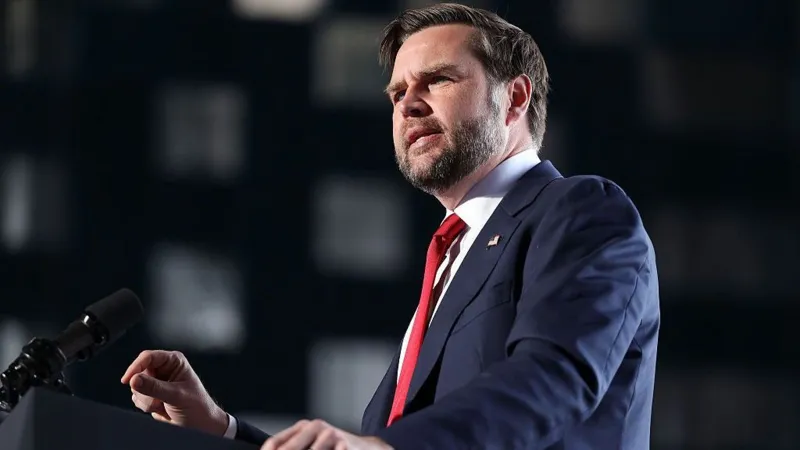

The US vice-president says the war, rising living costs and inflation drove former Trump supporters towards Democrats. His remarks expose growing divisions within the Republican Party as investors respond to signals that the conflict may not escalate further.
WASHINGTON: US Vice-President JD Vance has directly blamed the war with Iran for the Republican Party’s sweeping losses in the midterm elections, arguing that the administration’s military intervention and its economic consequences alienated voters who had supported Donald Trump in 2024.
In his first major public assessment of the defeat, Vance said on Wednesday that the war was the central reason Republicans had lost control of Congress. His remarks placed the conflict at the heart of the party’s post-election debate and highlighted growing pressure on the Trump administration to explain the political and economic costs of its military campaign.
“The reason we lost is the war,” Vance wrote in a lengthy post on X. “The president himself said so last night.”
The vice-president’s statement followed Trump’s own acknowledgement that the conflict had contributed to the Republican defeat. However, while the president continued to defend the decision to launch attacks against Iran, Vance’s comments suggested that the party could not understand its electoral losses without confronting public opposition to the war.
The political consequences were reflected in financial markets shortly after Vance’s remarks. International oil prices fell sharply, with Brent crude declining by more than eight per cent to around $95 a barrel on Wednesday afternoon. US benchmark West Texas Intermediate also dropped by more than eight per cent to approximately $88 a barrel. Both benchmarks reached their lowest levels in more than two months.
The market reaction indicated that investors were reassessing the risk of a wider Middle East conflict and interpreting the new political circumstances in Washington as potentially reducing the likelihood of further escalation involving Iran.
Voters who backed Trump shifted to Democrats
Vance said he had consulted pollsters to understand the scale of the Republican defeat. According to his account, the problem was not simply that Republican voters had stayed away from polling stations. Instead, a significant number of people who had supported the Trump-Vance ticket in the 2024 presidential election had voted for Democrats in 2026.
He described this shift as a central warning for the Republican Party.
“The main problem is that many people who voted for Trump/Vance in 2024 voted for Democrats in 2026,” he wrote.
Vance identified three major sources of voter dissatisfaction: the war with Iran, the rising cost of living and inflation, and the United States’ relationship with Israel, which receives billions of dollars in annual American assistance.
His remarks suggest that the Republican setback was not driven by a single issue. Rather, voters were responding to a combination of foreign policy decisions and domestic economic pressures that had affected their everyday lives.
The vice-president placed particular emphasis on the war, challenging Republicans who believed the military campaign justified its political consequences.
“If you’d like to argue it was worth it, that losing the Senate for the next six years was worth it, then do so,” he wrote. “Argue it was a worthwhile cost to pay.”
He added that, whether party members agreed or disagreed with his assessment, an honest discussion of the election result had to begin with the reasons voters had turned against Republicans.
The message was significant because it came from the vice-president himself, rather than from an opposition politician or an independent critic of the administration. It brought the debate over the war into the Republican leadership’s own assessment of its electoral performance.
A growing debate over the cost of the war
Vance has long expressed reservations about American military intervention overseas. His latest comments have therefore attracted attention not only as an explanation of the election result but also as a possible indication of how he intends to position himself within the Republican Party.
Political observers cited in the report believe the vice-president may be seeking to distance himself publicly from an unpopular conflict, particularly as he is viewed as a potential Republican presidential contender in 2028.
The war has created a difficult political situation for the administration. Trump has defended the military action as necessary, but the conflict has also contributed to higher energy costs and increased pressure on American households.
For voters already concerned about inflation, rising fuel prices have made the consequences of the war more immediate. The cost of gasoline is particularly politically sensitive in the United States, where changes in fuel prices are closely felt by households and businesses.
Vance acknowledged that the Republican Party would face internal disagreements over the reasons for its defeat. He warned that there would be considerable infighting and competing explanations, but urged party members to focus on rebuilding rather than allowing the dispute to consume them.
He also referred to concerns raised by a pollster he respected, who believed the party’s economic messaging had not been sufficiently effective towards the end of the campaign. Vance said that criticism was probably justified.
His comments point to a broader challenge for Republicans: the party must determine whether its losses were primarily the result of opposition to the Iran war, dissatisfaction with economic conditions, weaknesses in its campaign strategy or a combination of these factors.
Trump stands by his decision
Trump responded to Vance’s assessment on Wednesday, describing it as largely accurate while maintaining that the war had been necessary.
The president said he would not have changed his decision regarding the conflict.
His response reflected the tension at the centre of the Republican debate. Trump has acknowledged that the war contributed to the election losses, but he has not accepted that the military decision itself was mistaken.
Earlier, in an interview with Fox News following Tuesday’s election results, Trump said voters supported his approach towards Iran but were unwilling to accept the short-term economic consequences, particularly higher gasoline prices.
He also argued that Republicans would have won easily if he himself had been on the ballot.
The comments suggest that Trump views the election result partly as a failure to persuade voters to tolerate the economic costs of his foreign policy. Vance, by contrast, has argued that the party must recognise the extent to which the war itself damaged its support.
That difference could become important as Republicans debate their future direction and the political leadership of the party beyond Trump’s presidency.
Oil markets react to political signals
Financial markets responded sharply to Vance’s remarks, with both major oil benchmarks recording substantial declines.
Brent crude, the global benchmark, fell by more than eight per cent to approximately $95 a barrel. West Texas Intermediate, the US benchmark, declined by a similar margin to around $88.
Despite the fall, Brent remained almost 50 per cent higher than it had been a year earlier, underlining the extent to which the conflict had affected global oil prices.
Investors appeared to interpret the vice-president’s comments, together with the changed political balance in Washington, as reducing the prospects of a major escalation involving Iran. Expectations about the future course of the conflict can influence oil prices because traders take account of possible disruptions to production, transport routes and global supplies.
The decline did not necessarily mean that the risks to energy supplies had disappeared. Rather, it reflected a reassessment of the likelihood of further escalation in light of the political signals emerging from Washington.
The oil market’s reaction also demonstrated how domestic political developments in the United States can influence global commodity prices. As the world’s largest economy and a major participant in international energy markets, changes in American foreign policy expectations can have consequences far beyond its borders.
Inflation remains a major political concern
The economic pressure associated with the war has become a central issue for American households.
Prices rose by 3.7 per cent in the year to September, with fuel and energy costs contributing to the increase. The figures reinforced public concerns about the cost of living at a time when the administration was defending its military policy towards Iran.
Exit polls indicated the depth of that concern. Nearly 80 per cent of voters said inflation had caused them financial hardship, while 60 per cent blamed Trump’s policies for the rising cost of living.
These findings help explain why economic conditions became such a powerful issue during the midterm campaign. Even voters who supported the president’s broader political agenda could become dissatisfied when higher prices affected their household budgets.
For the Republican Party, the challenge is particularly serious because affordability was central to Trump’s political appeal. His administration had promised to improve economic conditions, but the combination of inflation and higher energy costs weakened that message.
The Democrats used these concerns to argue that the administration’s policies were making everyday life more expensive. Their electoral gains suggest that the issue resonated beyond their traditional voter base.
A difficult choice for the Republican Party
Vance’s intervention has opened a difficult debate about the relationship between foreign policy and domestic political support. The Republican Party must now consider whether it can continue defending the war without addressing the economic consequences that voters have associated with it.
The vice-president’s call for party members to return to the work of “saving our country” was also an appeal to prevent the post-election dispute from becoming a prolonged internal conflict. Yet the disagreement over the Iran war is not merely a question of campaign messaging. It concerns the administration’s military strategy, the cost of its decisions and the extent to which voters are willing to bear those costs.
The Republican defeat has given Democrats control of Congress and placed the administration under greater political scrutiny. It has also created a new environment in which the president’s decisions on foreign policy will face opposition from both outside and within his own party.
For Vance, the immediate task is to explain the electoral setback while maintaining his position within an administration whose central foreign policy decision he has identified as the main reason for defeat. For Trump, the challenge is to defend the war while responding to voters who have expressed deep dissatisfaction with its economic consequences.
The coming months will show whether the Republican Party treats the election result as a warning to reconsider its approach towards Iran or primarily as a failure of political communication.
One point, however, is already clear: the war has become more than a foreign policy issue. It has emerged as a defining question for the Republican Party’s political future, exposing the cost of military decisions in the lives of ordinary voters and the difficulty of sustaining public support when international conflict feeds directly into domestic economic pressure.