
ANTALYA: Prime Minister Shehbaz Sharif has highlighted Pakistan’s rapid expansion of rooftop solar power at the COP31 climate summit in Türkiye, describing it as a citizen-led energy transformation driven by the search for affordable electricity and a more predictable energy future. Addressing an international gathering of leaders and policymakers, he said Pakistan had added nearly 22 gigawatts of rooftop solar capacity in just two years, calling the development a quiet revolution led by ordinary people rather than a conventional government programme.
The prime minister made the remarks during a high-level dialogue titled 35 by 35: Powering the Future, which focused on the transition towards greater electrification and a low-carbon global economy. Delegations from nearly 200 countries have gathered in the Mediterranean city of Antalya as governments face mounting pressure to reduce greenhouse gas emissions, strengthen energy security and respond to increasingly severe climate impacts.
Shehbaz said Pakistan fully supported the 35-by-35 Global Electrification Pledge, under which participating countries aim to increase electricity’s share of total final energy consumption to approximately 35 per cent by 2035. He presented Pakistan’s solar expansion, nuclear power development and emerging electric-vehicle market as evidence of the country’s efforts to transform its energy system.
However, his address also highlighted a central difficulty confronting developing economies: the transition to cleaner energy requires substantial investment in infrastructure, electricity networks and storage facilities. Without affordable financing and access to technology, the expansion of renewable energy may not translate into a stable and inclusive energy system.
Citizens drive Pakistan’s solar expansion
The most striking figure in the prime minister’s address was the addition of nearly 22 gigawatts of rooftop solar capacity within two years. He described the expansion as a response by ordinary citizens seeking affordable electricity and greater certainty in their energy supply.
The rapid adoption of solar power reflects the growing importance of decentralised electricity generation in Pakistan. Households and businesses increasingly see rooftop solar as an alternative to dependence on conventional electricity supplies. The development has also changed the national energy debate, bringing household investment and consumer choices into a transition previously discussed mainly through government projects and large power-sector investments.
This expansion presents an important opportunity for Pakistan. Greater use of solar energy can reduce dependence on imported fuels, provide consumers with additional energy options and support the country’s efforts to lower emissions. It also demonstrates that citizens can become active participants in the energy transition rather than merely its intended beneficiaries.
Yet the scale of rooftop solar adoption also raises questions about the capacity of the existing electricity system to accommodate a rapidly changing pattern of generation and consumption. Solar panels generate electricity according to sunlight availability, while household and industrial demand continues throughout the day and night. A modern electricity system must therefore be capable of managing changing supply patterns, maintaining reliability and integrating different sources of power.
The challenge is no longer simply to encourage people to install solar panels. It is to build the infrastructure and regulatory arrangements necessary to make a decentralised energy system work efficiently.
Grid investment and storage remain critical
Shehbaz acknowledged these challenges in his address, warning that the momentum behind clean energy could not be sustained without adequate financing. He emphasised the need to expand electricity grids, develop storage capacity and make new technologies affordable.
These requirements are particularly important for Pakistan. A substantial increase in solar generation creates new demands on transmission and distribution networks. Electricity must be transported efficiently, supply and demand must be balanced, and storage solutions must help maintain reliability when solar generation declines.
Without appropriate investment, the benefits of expanding renewable capacity may be constrained by weaknesses in the wider power system. Grid modernisation and energy storage should therefore be treated as essential components of the transition rather than secondary projects to be considered after renewable generation has expanded.
The prime minister said Pakistan would require approximately $138 billion by 2035 for low-carbon power, with another $50 billion needed to replace coal with solar energy. These figures illustrate the scale of the investment challenge facing the country. They also underline why domestic resources alone may be insufficient to finance the transition at the required pace.
He called for concessional capital and the transfer of affordable technologies, arguing that international financing must move at the speed of countries’ climate ambitions. Developing economies, many of which are already carrying substantial debt burdens, cannot be expected to undertake expensive energy transitions without accessible financial support.
The question of climate finance is consequently central to the negotiations at COP31. Developing countries argue that wealthier nations, which bear a greater historical responsibility for greenhouse gas emissions, should provide adequate financial assistance to help poorer economies adapt to climate impacts and move towards cleaner energy.
Nuclear power and electric mobility in the transition
The prime minister also referred to Pakistan’s nuclear energy programme, recalling the recent inauguration of a key section of Chashma-5, the country’s seventh nuclear power plant. The project is expected to add 1,200 megawatts to the national energy mix.
He presented the development alongside the expansion of renewable energy as part of Pakistan’s broader effort to increase cleaner electricity generation. The address also referred to the government’s plans for electric mobility, particularly through the newly drafted automobile policy.
Pakistan aims to make 30 per cent of its new vehicles electric by 2030. According to Shehbaz, the proposed policy seeks to encourage this transition through incentives, including lower tariffs. He also stated that future government buses and motorcycles would be electric.
The prime minister said that, for the first time, more than one in every ten motorcycles sold in Pakistan during the current year was electric. He described the trend as evidence that the transition towards electric mobility was gaining momentum.
The shift towards electric vehicles could reduce dependence on petroleum products and support cleaner urban transport. However, its long-term success will depend on affordable vehicles, charging infrastructure, reliable electricity and an effective policy framework. The expansion of electric transport must be supported by improvements in the power system; otherwise, a change in vehicle technology alone will not resolve the wider energy and environmental challenges.
Shehbaz also stated that clean sources now accounted for nearly 55 per cent of Pakistan’s energy mix. The figure formed part of his presentation of the country’s progress towards a cleaner energy system.
The international debate over electrification
COP31 is taking place against a difficult international climate and economic background. Negotiators from nearly 200 countries are discussing ways to increase electricity’s share of global energy consumption and accelerate the transition away from fossil fuels.
The 35-by-35 proposal seeks to raise electricity’s share of total final energy consumption to 35 per cent by 2035, from slightly more than one-fifth at present. Its supporters argue that electrification can reduce emissions from transport, buildings and industry by replacing direct fossil-fuel consumption with electricity.
However, the proposal has also attracted criticism because increasing electrification does not automatically guarantee lower emissions. The climate benefits depend significantly on how the additional electricity is generated. If countries continue to rely heavily on coal, oil and gas to produce electricity, the environmental gains from electrification may be limited.
The distinction is important. A global electrification target must be accompanied by a credible strategy for expanding clean power generation and reducing dependence on fossil fuels. Otherwise, the world may change the form in which energy is consumed without sufficiently changing its carbon intensity.
United Nations Secretary-General António Guterres warned world leaders that the international response to climate change remained inadequate. He said rising emissions, increasing temperatures and worsening climate-related disasters were placing the world on a dangerous path. He urged governments to accelerate the transition towards clean energy rather than surrender to the scale of the challenge.
Guterres also linked fossil-fuel dependence to economic insecurity, observing that three-quarters of humanity live in countries that import fossil fuels and remain exposed to price shocks beyond their control. Recent conflicts and disruptions to energy exports have reinforced the vulnerability of economies dependent on imported petroleum.
The United States, the world’s largest historical emitter, has skipped the climate talks for the second consecutive year following President Donald Trump’s withdrawal from international climate cooperation after returning to office in 2025. The absence of major political leadership from some of the world’s largest economies has added to concerns about the strength of the global climate response.
Climate finance remains the unresolved question
Financing disputes have already complicated the negotiations at COP31. Developing countries are pressing for stronger commitments from wealthier nations to support climate adaptation and the transition towards cleaner energy. Discussions have included demands for greater adaptation finance and a platform to address how developed countries should provide financial assistance.
African countries are also seeking progress towards tripling adaptation finance, which would help vulnerable economies fund measures such as coastal protection and drought-resistant agriculture. Environmental organisations have criticised the reluctance of developed countries to make stronger commitments on these issues.
The dispute reflects a persistent disagreement over climate responsibility. Developing countries argue that they should not be expected to carry the full financial burden of a crisis to which industrialised economies have contributed disproportionately over time. For countries facing high debt, limited fiscal space and urgent development needs, access to affordable climate finance is not simply a diplomatic demand; it is a practical requirement for implementing climate policies.
Pakistan’s own financing estimates, presented by Shehbaz, illustrate the scale of this challenge. The country must simultaneously modernise its energy infrastructure, expand low-carbon generation, replace coal-based capacity and strengthen its resilience to climate-related disasters.
Pakistan’s climate diplomacy and regional engagement
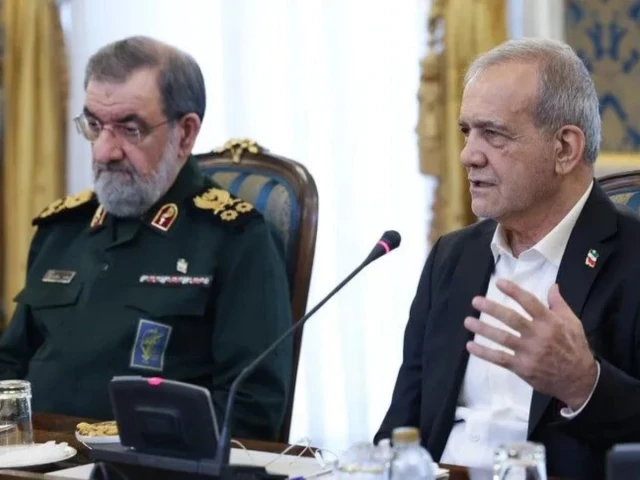
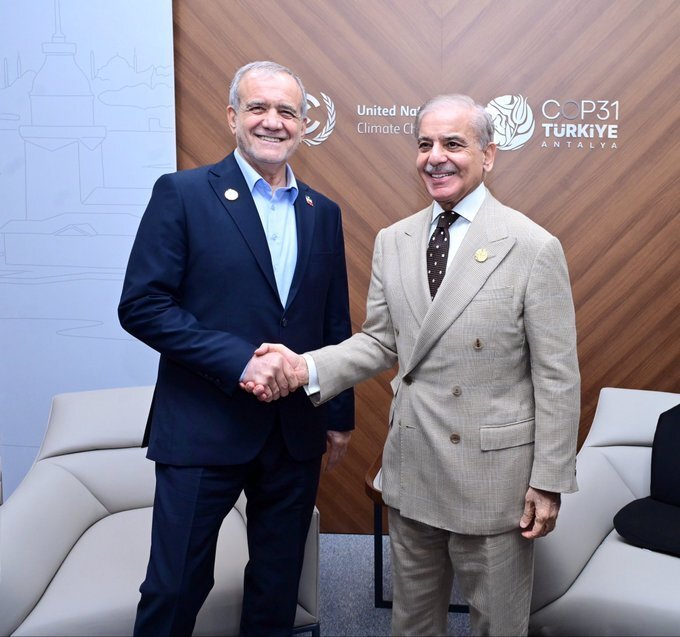
Alongside his address, the prime minister held meetings with several international leaders. He met Iranian President Masoud Pezeshkian and discussed bilateral relations, regional developments and efforts to promote peace. Shehbaz said dialogue, restraint, de-escalation and sustained diplomacy remained essential to lasting stability, reaffirming Pakistan’s role in diplomatic efforts building on the Islamabad memorandum of understanding.
He also met Kuwait’s Prime Minister Ahmad Al-Abdullah Al-Ahmad Al-Sabah, with discussions covering trade, investment, energy, development cooperation and people-to-people relations. The two leaders welcomed the recent ratification of the Pakistan-Kuwait defence agreement.
Other engagements included meetings with Bangladesh’s Prime Minister Tarique Rehman, Palestinian Prime Minister Mohammad Mustafa, Saudi officials, Syrian President Ahmed al-Sharaa, Organisation of Islamic Cooperation Secretary-General Ismail Ould Cheikh Ahmed and World Bank President Ajay Banga. In his conversation with the Palestinian prime minister, Shehbaz reaffirmed Pakistan’s solidarity with the Palestinian people.
According to the Prime Minister’s Office, a Pakistan Pavilion has also been established at the summit venue, with 54 events planned on different themes. The Foreign Office said Pakistan would use the conference to highlight its solarisation efforts, renewable energy expansion, disaster preparedness and early-warning systems, while calling for predictable and accessible climate finance.
From solar expansion to energy-system reform
Pakistan’s rooftop solar expansion is a significant development, but the country’s energy transition cannot be measured by installed capacity alone. Its success will depend on whether the power system can integrate decentralised generation, maintain reliable supply, provide affordable electricity and reduce dependence on imported fossil fuels.
The government must therefore connect its renewable energy ambitions with practical reforms in transmission, distribution, storage, regulation and financing. The growing role of citizens in electricity generation also requires policies that recognise the changing relationship between consumers and the national grid.
At COP31, Shehbaz presented Pakistan’s solar expansion as evidence that a major energy transition is already underway. The next challenge is to ensure that this citizen-led momentum becomes a foundation for a more resilient and economically sustainable energy system.
The prime minister’s appeal for international climate finance reflects a wider reality: countries cannot be expected to deliver ambitious climate targets without the resources and technology required to achieve them. The transition must reduce emissions without imposing unsustainable costs on households and developing economies.
Pakistan’s experience offers an important lesson. Public demand can accelerate technological change, but lasting transformation requires capable institutions, modern infrastructure and consistent policy. The solar revolution has begun; turning it into a reliable national energy transition will require the next stage of reform.