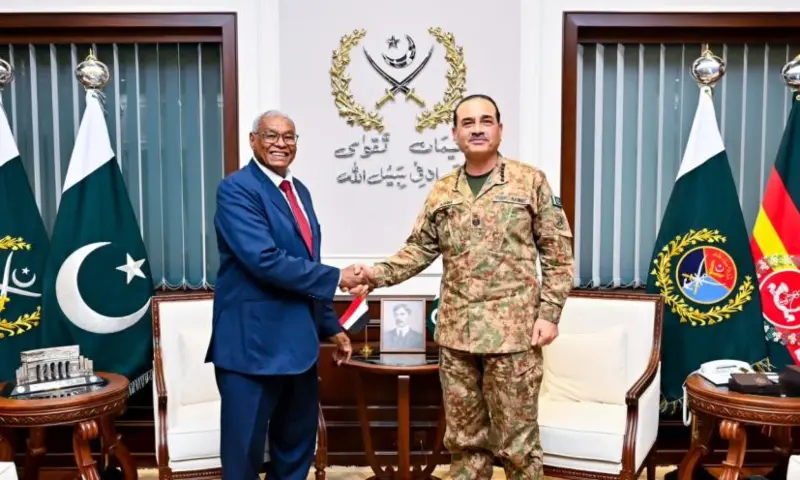

Islamabad’s high-level meetings with Sudanese officials signal a renewed effort to strengthen bilateral relations, with security, counterterrorism, institutional cooperation and economic ties featuring prominently on the agenda.
Pakistan has moved to strengthen its diplomatic and security engagement with Sudan following a series of high-level meetings between senior Sudanese officials and Pakistan’s political and military leadership. Discussions have focused on expanding bilateral cooperation in security, counterterrorism, institutional development, trade and investment, while Islamabad has reiterated its support for Sudan’s sovereignty, unity and territorial integrity.
On Friday, Chief of Defence Forces (CDF) and Chief of Army Staff Field Marshal Asim Munir met Sudan’s Interior Minister, Lieutenant General (Police) Babiker Samra Mustafa Ali, at General Headquarters (GHQ) in Rawalpindi. The meeting took place during the Sudanese minister’s visit to Pakistan, according to a statement issued by Inter-Services Public Relations (ISPR).
The discussions covered matters of mutual interest, changing regional and international security dynamics, and opportunities to expand cooperation between the two countries. Both sides reaffirmed their commitment to strengthening bilateral relations, particularly in security, counterterrorism and institutional cooperation.
According to ISPR, the visiting minister appreciated Pakistan’s contribution to regional peace and stability and acknowledged the longstanding fraternal relationship between the two countries. Field Marshal Munir, in turn, expressed Pakistan’s desire to deepen engagement with Sudan and emphasised the importance of close cooperation in addressing shared security challenges.
The meeting reflects the security dimension of a broader diplomatic effort to reinforce relations between Islamabad and Khartoum at a time when Sudan continues to face a devastating internal conflict and an exceptionally severe humanitarian emergency.
Political leadership reinforces diplomatic commitment
The military-level engagement followed a meeting earlier on Friday between the Sudanese interior minister and Deputy Prime Minister and Foreign Minister Ishaq Dar at the Ministry of Foreign Affairs. The discussions reinforced the political and diplomatic dimension of Pakistan’s engagement with Sudan.
According to the Foreign Office, Dar reaffirmed Pakistan’s consistent support for Sudan’s sovereignty, unity and territorial integrity. He underlined the importance Islamabad attached to its relationship with Khartoum and expressed the country’s commitment to strengthening the longstanding ties between the two nations.
The Sudanese minister appreciated Pakistan’s support and continued solidarity with his country. He also emphasised the historic relationship between the two states and Sudan’s interest in expanding cooperation across areas of mutual concern.
Minister of State for Interior Tallal Chaudhry also attended the meeting.
These discussions suggest that Pakistan’s engagement with Sudan is not confined to military or security matters. Rather, Islamabad appears interested in developing a broader relationship that brings together diplomatic coordination, institutional cooperation and economic engagement.
Prime minister highlights economic opportunities
The Sudanese delegation’s visit also included a meeting with Prime Minister Shehbaz Sharif on Thursday at the Prime Minister’s House. A delegation led by Lieutenant General Ali discussed bilateral relations with the prime minister, who reiterated Pakistan’s commitment to its longstanding and friendly ties with Sudan.
According to the Prime Minister’s Office, Shehbaz Sharif expressed Pakistan’s desire to see Sudan emerge from its current crisis as a peaceful, stable and prosperous country. He also emphasised the importance of strengthening trade and investment relations between the two countries.
The prime minister identified agriculture, defence and education, among other sectors, as areas offering considerable potential for bilateral cooperation. His remarks point towards an effort to extend relations beyond traditional diplomatic and security contacts and establish stronger economic connections.
For Pakistan, closer engagement with Sudan could provide opportunities to develop commercial relationships and explore cooperation in sectors where both countries have relevant interests. However, translating these opportunities into tangible outcomes will require sustained diplomatic engagement, institutional coordination and a realistic assessment of the conditions on the ground.
The Sudanese interior minister thanked the Pakistani government and people for providing humanitarian and medical assistance during difficult circumstances. He also appreciated Pakistan’s support for international efforts aimed at restoring peace and security in Sudan.
The expression of gratitude highlights an important dimension of Pakistan’s relationship with Sudan: its support during a period of prolonged conflict and humanitarian suffering.
Sudan’s deepening humanitarian emergency
The diplomatic engagement comes as Sudan continues to experience one of the world’s most severe displacement crises. The conflict erupted in April 2023 when fighting broke out between the Sudanese Armed Forces and the paramilitary Rapid Support Forces (RSF). The confrontation emerged from a power struggle involving the proposed integration of the two forces as part of a planned transition towards civilian rule.
More than three years into the conflict, its consequences extend far beyond the battlefield. Millions of people have been forced from their homes, essential infrastructure has been damaged and access to basic services remains severely disrupted.
According to the figures cited in the report, approximately 8.6 million people remain displaced within Sudan, while more than 4.6 million have crossed international borders in search of safety. Although over 5.2 million people have returned to their areas of origin, many have found their homes, infrastructure and essential services destroyed or severely damaged.
These figures illustrate the scale of the challenge facing Sudan. Displacement on this scale places enormous pressure on neighbouring countries, humanitarian organisations and already fragile public institutions. The destruction of infrastructure and disruption of essential services also make recovery considerably more difficult, even where displaced populations are able to return.
The crisis therefore requires more than an immediate reduction in hostilities. A sustainable resolution will depend on restoring political stability, rebuilding state institutions, protecting civilians and creating conditions for a credible transition towards civilian governance.
Beyond diplomatic assurances
Pakistan’s recent meetings with Sudanese officials demonstrate a willingness to maintain close relations with Khartoum during a particularly difficult period. The repeated emphasis on sovereignty, territorial integrity, security cooperation and economic engagement provides a broad framework for future bilateral relations.
Nevertheless, the effectiveness of this engagement will ultimately depend on practical outcomes. Cooperation in counterterrorism and institutional development will require clearly defined priorities, sustained communication and mechanisms through which commitments can be implemented. Similarly, opportunities in agriculture, defence, education, trade and investment will need to be translated into concrete initiatives.
For Islamabad, the challenge is to balance its traditional diplomatic relationship with Sudan with a constructive approach to the country’s ongoing crisis. Support for Sudan’s sovereignty and unity can be accompanied by diplomatic efforts that encourage peace, stability and an inclusive political settlement.
For Sudan, stronger international partnerships may help address immediate institutional and humanitarian pressures, but lasting recovery will depend primarily on ending the conflict and restoring a functioning political and administrative order.
The meetings in Rawalpindi and Islamabad have reaffirmed the political goodwill between the two countries. The next step is to convert that goodwill into sustained cooperation capable of contributing to regional stability and Sudan’s eventual recovery.
Republic Policy | Governance. Institutions. Public Policy.