
Islamabad backs stronger international action against the Houthis while calling for a Yemeni-led political settlement, as divisions among Security Council members expose the diplomatic difficulties of containing the conflict and preventing further regional escalation.
WASHINGTON: Pakistan has called for an immediate and unconditional end to Houthi attacks on Saudi Arabia, reaffirming its support for the kingdom’s sovereignty and security as the United Nations Security Council renewed targeted sanctions against individuals and entities threatening peace and stability in Yemen.
The Security Council adopted the resolution by consensus on Thursday, extending the targeted asset freeze and travel ban imposed under its Yemen sanctions regime until November 14, 2027. It also renewed the mandate of the Panel of Experts monitoring the sanctions until December 15, 2027, while seeking to strengthen restrictions on the Houthis’ access to components and chemicals used in manufacturing drones and missiles.
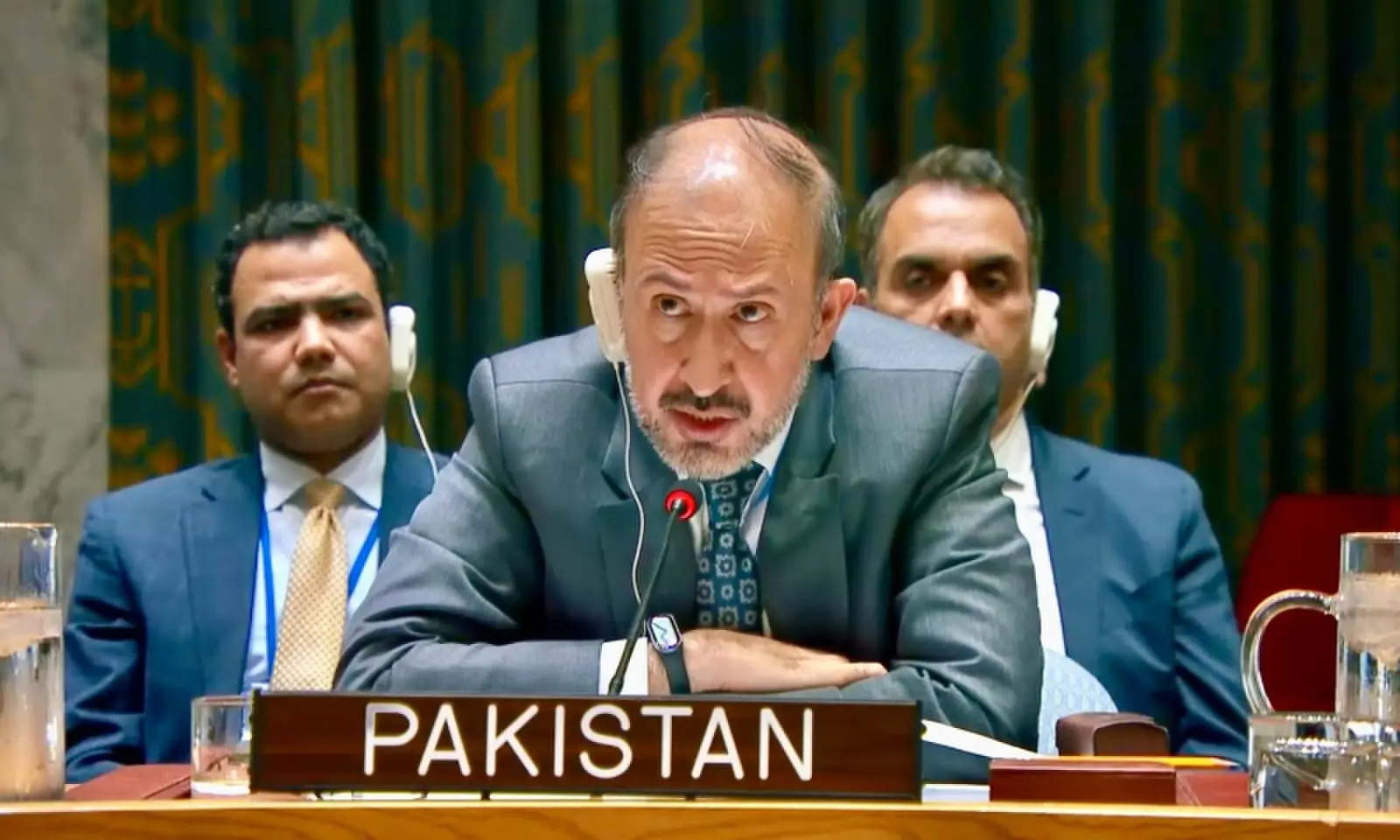
Pakistan’s position, articulated by its Permanent Representative to the United Nations, Ambassador Syed Haider Shah, combined strong support for Saudi Arabia with a call for a negotiated settlement that respects Yemen’s sovereignty, independence, unity and territorial integrity.
The statement reflects Islamabad’s attempt to maintain two interconnected diplomatic priorities: standing firmly with Saudi Arabia against cross-border attacks while supporting a political process capable of ending Yemen’s prolonged conflict.
Addressing the Security Council after Pakistan voted in favour of the resolution, Ambassador Shah condemned the continued Houthi attacks against Saudi Arabia and expressed solidarity with its leadership and people.
“Consistent with the United Nations Charter and international law, we support its legitimate right to defend its territory and protect its citizens and residents,” he said, demanding an immediate and unconditional cessation of the attacks.
He also emphasised that accountability for individuals and entities threatening Yemen’s peace and stability was essential to creating conditions for lasting peace.
Security Council seeks to restrict Houthi weapons production
The renewed sanctions framework seeks to address a growing challenge identified by UN monitors: the Houthis’ increasing ability to manufacture weapons locally using commercially available components and precursor chemicals.
According to the information presented to the Security Council, the group has maintained and expanded its military capabilities through smuggling networks and the diversion of equipment intended for civilian use. This has gradually reduced its dependence on externally supplied weapons and military materials.
The resolution therefore seeks to strengthen international scrutiny of the supply chains supporting Houthi missile and drone production.
The Council tasked its members with deciding by January 11, 2027, what measures should be adopted to prevent the group from acquiring specified components and materials. The decision will draw on a list prepared by the Panel of Experts.
The issue is strategically important because modern weapons manufacturing increasingly depends on commercially available technologies and materials that can serve both civilian and military purposes. Restricting access to such items requires cooperation among states, customs authorities, shipping companies and international monitoring bodies.
The resolution also expanded the responsibilities of the Panel of Experts, asking it to examine revenues generated by the Houthis through their control of important economic sectors in Yemen and recommend measures to prevent those funds from being diverted towards military activities.
This provision recognises that the conflict is sustained not only through weapons supplies but also through financial networks and control over economic resources.
The Council further reaffirmed that the arbitrary detention of United Nations, diplomatic and humanitarian personnel by the Houthis could constitute grounds for additional sanctions.
The provision followed the death in Houthi custody of Mohammad El-Shami, a Yemeni employee of the UN Human Rights Office who had been detained since June 6, 2024. His family was informed only recently that he had died more than a month before the notification.
The case has added to international concerns over the safety of humanitarian and diplomatic personnel working in Yemen, where access restrictions and insecurity have repeatedly obstructed relief operations.
Diplomatic disagreements behind the unanimous vote
Although the resolution was ultimately adopted by consensus, negotiations exposed significant differences among Security Council members over how strongly the international community should characterise and respond to Houthi activities.
Britain initially sought to restore language explicitly describing the Houthis as a terrorist group, a designation that had appeared in previous sanctions resolutions since 2022. However, it abandoned the proposal after Russia objected, arguing that such language could complicate political negotiations.
Bahrain, supported by the United States, also sought to reintroduce the designation, but the proposal was not included in the final text.
China, backed by Russia, raised objections to the proposed list of dual-use items and the expansion of the Panel of Experts’ mandate.
These disagreements reflect a broader dilemma confronting the Security Council. While members share concerns about attacks on civilians, regional security and commercial shipping, they remain divided over the appropriate balance between sanctions, diplomatic pressure and political engagement.
Yemen’s Ambassador to the United Nations, Abdullah Al-Saadi, welcomed the Council’s condemnation of Houthi actions but expressed disappointment that members had not agreed on stronger language.
He argued that the absence of explicit terminology did not absolve those supporting the group of responsibility. He also accused the Houthis of using starvation as a weapon of war and called for an end to their longstanding siege of Taiz.
The negotiations demonstrate that consensus on renewing sanctions does not necessarily translate into agreement on the political strategy required to resolve the conflict.
Pakistan advocates a Yemeni-led political settlement
Pakistan supported the resolution but stressed that sanctions and security measures must ultimately contribute to a broader political settlement.
Ambassador Shah called for an inclusive process under United Nations leadership, emphasising that any sustainable agreement must be Yemeni-owned and Yemeni-led.
He reaffirmed Islamabad’s support for Yemen’s sovereignty, independence, unity and territorial integrity, while expressing Pakistan’s readiness to assist international efforts aimed at restoring peace and addressing the country’s humanitarian suffering.
This position is significant because Yemen’s conflict cannot be understood solely as a confrontation between the Houthis and the internationally recognised government. It has evolved into a complex political and military crisis involving domestic factions, regional powers, competing territorial interests and external security concerns.
A durable settlement will therefore require more than the weakening of one armed group. It will need an inclusive political framework capable of addressing the distribution of power, national institutions, economic resources and the grievances of different Yemeni communities.
Pakistan also raised concerns about the implementation of sanctions, emphasising that the Panel of Experts must operate strictly within the Security Council’s mandate.
Ambassador Shah called for professionalism, impartiality and consistency in the panel’s work, arguing that these principles were necessary to strengthen its credibility and effectiveness. He also appreciated Britain’s constructive role in negotiating the resolution.
The emphasis on institutional credibility is important. Sanctions regimes depend on reliable information, transparent procedures and consistent implementation. If monitoring bodies are perceived as politically selective or operating beyond their authorised mandate, their legitimacy and effectiveness can be weakened.
A conflict with regional and maritime consequences
The renewed diplomatic action comes amid a deterioration in Yemen’s security environment.
The Houthis seized the capital, Sanaa, in 2014, triggering a military intervention by a Saudi-led coalition in March 2015 in support of Yemen’s internationally recognised government.
A United Nations-brokered truce in 2022 largely froze the conflict and reduced large-scale hostilities. However, the latest escalation has disrupted that relative calm, with Houthi missile and drone attacks targeting Saudi territory and Riyadh conducting airstrikes in Yemen.
The attacks have reportedly threatened Saudi airports, ports and oil installations, raising concerns about the security of critical infrastructure.
The consequences extend beyond the immediate parties to the conflict. Yemen occupies a strategically important position near the Bab el-Mandeb Strait, which connects the Red Sea with the Gulf of Aden and serves as a major route for international maritime trade.
Any sustained escalation in this area could disrupt commercial shipping, increase insurance and transportation costs and place additional pressure on global supply chains.
The security of the Red Sea is therefore not simply a regional concern. It has implications for international trade, energy transportation and the economic interests of countries dependent on maritime commerce.
For Pakistan, developments in Yemen and the wider Red Sea region carry particular significance because of its economic and strategic links with the Gulf, its relationship with Saudi Arabia and its interest in maintaining stable international trade routes.
Sanctions alone cannot deliver peace
The Security Council’s decision to renew sanctions demonstrates continuing international concern over the Houthis’ military activities and the risks they pose to Yemen and neighbouring countries.
However, the effectiveness of sanctions will depend on their implementation. Restrictions on weapons components and precursor chemicals require coordinated enforcement, credible monitoring and cooperation among states. Financial measures must also address the networks through which military activities are funded.
At the same time, sanctions cannot substitute for political negotiations. Yemen’s prolonged conflict has weakened public institutions, damaged infrastructure, disrupted economic activity and contributed to one of the world’s most severe humanitarian emergencies.
A sustainable settlement must restore functioning national institutions, protect civilian populations, facilitate humanitarian assistance and create a political arrangement capable of accommodating Yemen’s diverse constituencies.
The Security Council resolution therefore represents an important diplomatic step, but not a solution to the underlying conflict.
Pakistan’s position captures this distinction. Its condemnation of attacks against Saudi Arabia is unequivocal, while its call for an inclusive, Yemeni-led political process recognises that lasting stability cannot be imposed through military pressure alone.
The challenge now is to translate diplomatic consensus into effective action: prevent further attacks, protect international shipping, ensure accountability for violations and revive a credible political process.
For Yemen, the ultimate measure of international engagement will not be the duration of sanctions or the number of resolutions adopted. It will be whether the country can move away from armed confrontation towards political stability, economic recovery and the restoration of public institutions.
For the wider region, preventing another escalation will require all parties to recognise that the security of Saudi Arabia, the sovereignty of Yemen and the stability of vital maritime routes are interconnected interests.