
The United States has unveiled an expanded sanctions push aimed at cutting off Iran’s economic lifeline, stopping short of its most severe possible measures but putting the world on notice to halt business dealings with Tehran.
Treasury Secretary Scott Bessent warned that countries continuing to trade with Iran risk being pushed out of the dollar-based global financial system, and has previously called for cooperation from China, which has been the largest buyer of Iranian oil for years. The US blockade of Iran’s ports, reimposed in mid-July, has already sharply curtailed the flow of Iranian crude to China.
Experts say Washington remains cautious about triggering Chinese retaliation, particularly given expected talks next month between Donald Trump and Chinese leader Xi Jinping, with any restrictions on China’s exports of critical minerals seen as an especially sensitive flashpoint.
How Much Oil Does China Buy From Iran?
In the early weeks of the conflict, China’s imports of Iranian crude barely moved, slipping from 1.57 million barrels a day in February to 1.47 million in March, according to Kpler ship-tracking data. Since then, imports have fallen sharply. After the US renewed its blockade on Iranian ships and ports in July, following the collapse of an earlier ceasefire deal, shipments dropped to 785,000 barrels a day in June, the lowest level since February 2023, before ticking up slightly to 823,000 in July. Provisional data for August shows intake falling again, to 534,000 barrels a day.
Who Are the Chinese Buyers?
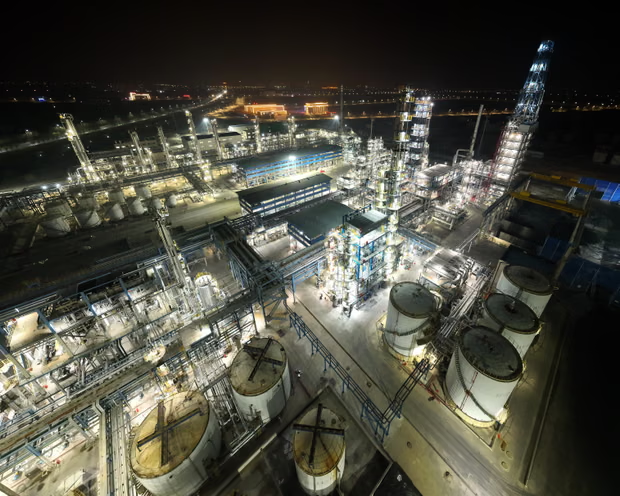
China’s independent “teapot” refineries have been the primary buyers of Iranian crude, drawn by the steep discounts typically offered compared to mainstream oil. These smaller refiners survive by sourcing cheap crude wherever available and converting it into petrol and diesel for surrounding provinces. China’s major state-owned refiners, by contrast, have avoided Iranian oil since 2019, when the US reimposed sanctions on Tehran, wary of losing access to the dollar-based international financial system, a risk the teapots, focused on the domestic market, are willing to accept.
Iranian oil delivered to China has long been relabeled as Malaysian, and more recently Indonesian, in origin, and is typically settled in Chinese currency through a tightly controlled network of hard-to-trace intermediaries, according to refinery sources and traders familiar with the trade.
Have Previous US Sanctions Been Effective?
Washington has intensified efforts to curb Chinese purchases of Iranian oil since Trump returned to office last year, targeting mostly smaller Chinese refiners and other participants in the supply chain, with some disruptive effect. The US Treasury has also warned two larger Chinese banks they could face secondary sanctions if Iranian funds are found moving through their systems, though it has stopped short of formally designating them.
In April, Washington sanctioned the Hengli Petrochemical refinery in Dalian, along with roughly 40 shipping firms and vessels, accusing Hengli of purchasing billions of dollars’ worth of Iranian oil as part of a broader effort to curb Tehran’s oil revenue; Hengli has denied the allegation. Historically, however, sanctions alone have done little to meaningfully slow the overall flow of Iranian oil into China. Asked about the Chinese banks on Monday, Bessent said: “We want to make clear here today that no one is above the reach of US sanctions.”
What Have China and Iran Said?
China’s foreign ministry said sanctions and pressure tactics are unhelpful and that Beijing would do what is necessary to protect its own interests, reiterating its rejection of unilateral sanctions and calling instead for a diplomatic and political resolution.
Iranian Economy Minister Ali Madanizadeh told state television that neither China nor Russia had “accepted” the new US measures, predicting other countries would resist them as well. “Naturally, the enemies intend to launch an economic terrorist attack on us, but we also have our own tools and know how to play the game,” he said.