
MAHABALESHWAR, India — Nestled in the Western Ghats at an elevation exceeding 1,000 meters, the cool, misty, light-soiled plateau of Mahabaleshwar accounts for roughly 85% of India’s total strawberry production. Yet despite its status as the nation’s berry capital, Indian growers remain exposed to severe climate vulnerabilities and total reliance on foreign plant genetics.
Now, a dual movement of radiation-mutation breeding and high-tech vertical hydroponics is seeking to transform the country into a global strawberry superpower.
High Stakes and Imported Genetics
For local smallholders, strawberry cultivation is a high-risk gamble. Because strawberry plants are replaced every season rather than grown from seed, farmers must purchase young saplings from specialized nurseries annually—an outlay of around $2,500 for a modest 1.5-acre plot.
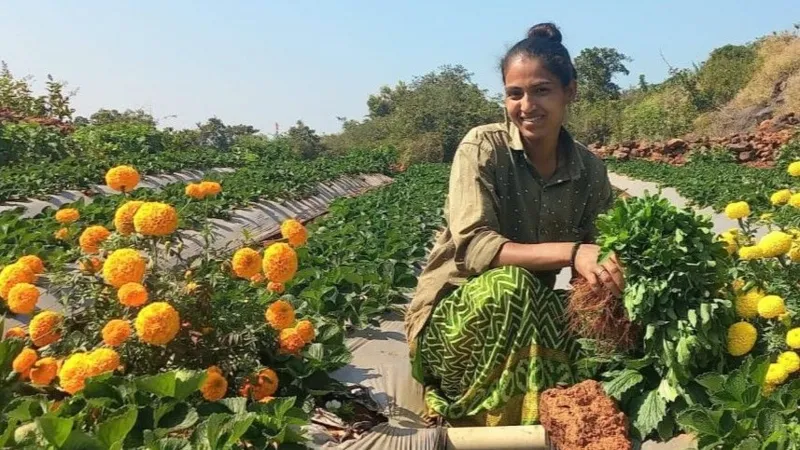
“If the season goes well, you can earn double your investment,” says local farmer Sheetal Danavle. “But if you have a field full of strawberries and sudden heavy rains hit, the entire crop is ruined and we have to bear massive losses.”
Unseasonal rains have become a recurring threat, hitting Maharashtra during the peak harvest window between November and January.
Compounding the problem is India’s lack of domestic plant genetics. Developing commercial-grade varieties takes 10 to 15 years of breeding and patenting in Western laboratories, forcing Indian propagators to import certified mother plants from California, Florida, Italy, and Spain.
Once cleared by government quarantine, these mother plants serve as living engines. “A single imported mother plant shoots out runners to yield an average of 20 daughter plants—with advanced growers pushing that to 30 or 40,” explains Nelson Sequeira, founder of Tara Farms Fresh, a licensed propagator.
Sequeira’s nursery operates with precise, high-tech systems: plants are suspended off the ground in split industrial gutters packed with coconut-husk coco-peat substrate, supported by micro-climate fogging and automated drip-irrigation.
Nuclear Breeding for Climate Resilience
To break dependence on foreign cultivars, researchers at the Mahatma Phule Krishi Vidyapeeth (MPKV) agricultural university have partnered with the Bhabha Atomic Research Centre (BARC).
Using controlled, low-dose gamma irradiation on plant tissues, scientists are inducing stable genetic mutations to fast-track the development of India’s first indigenous strawberry variety.
“The goal is to develop a climate-resilient cultivar that matches the large size and firm texture of foreign varieties while natively tolerating Indian heatwaves,” says Dr. Darshan Shashank Kadam, Assistant Professor of Horticulture at MPKV.
While a fully indigenous, heat-tolerant variety remains 10 to 15 years away, MPKV is helping farmers in the interim by standardizing planting schedules, growth regulators, and climate-specific fertilizer regimes.
Hydroponics and High-Tech Scaling
On the commercial front, larger agribusinesses are eliminating weather risks altogether through soil-less hydroponic farming.
Ketan Yashwant Sodha, founder and CEO of Berry Fresh Agrotech, transitioned away from traditional open-field farming in 2022 after years of crop destruction caused by unseasonal winter rains.
“Soil is forgiving; hydroponics does not forgive,” Sodha admits, noting early financial losses during his trial phase. “If you make a mistake today, you wake up tomorrow to a disaster.”
After testing 19 global varieties—including rare Japanese and Dutch lines—Sodha mastered a system using semi-open polyhouses and strictly metered irrigation (limiting each plant to 75 ml of water daily) to produce hyper-concentrated sugars and intense aromatics. His team monitors crop health by conducting regular laboratory “blood work” on plant leaves and stalks to tune nutrient uptake.
The controlled environment allows Berry Fresh Agrotech to produce strawberries year-round, breaking free from the traditional winter window as the company prepares to scale up