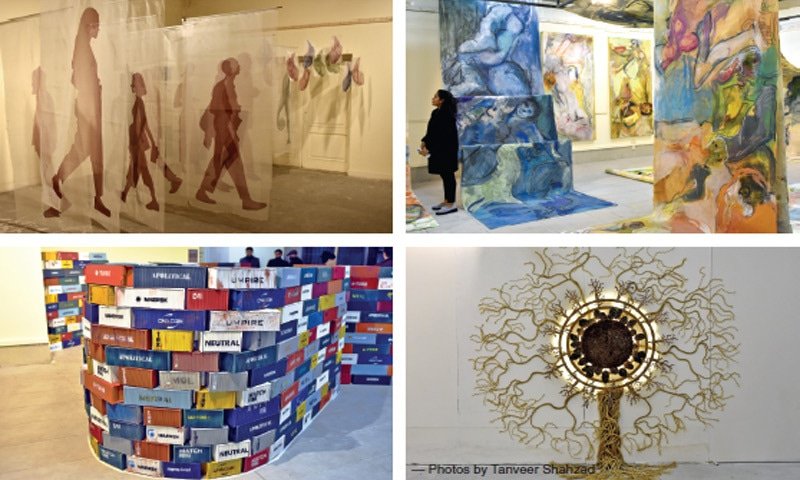

An exhibition bringing together the works of artists Fatima Khalid and Imran Gul has opened at Sanat Initiative, exploring the changing relationship between identity, memory, perception, and everyday life.
Titled Between Being and Becoming, the exhibition opened Tuesday evening and brings together two distinct artistic practices examining how people understand themselves and the world around them. While Gul uses highly detailed graphite drawings to transform ordinary subjects into striking visual experiences, Khalid draws on mythology, surveillance, and contemporary realities to examine ideas of self and society.
“Every artist has a baggage of what the subject matter should be. If you try to get out of the baggage of a subject, what do you have left? You only have a technique, a language,” Gul said. His works in the exhibition include figurative drawings and still-life compositions rendered through hyper-realism, made particularly demanding by the fact that all the drawings were produced using a single 2B pencil. “A simple pencil is used by everyone. But if you take it to an extreme, how far will it go?” he said.
The highly detailed works require considerable time and concentration, pushing familiar boundaries of drawing and raising questions about the difference between a sketch and a finished artwork. For Gul, though, the technical precision is ultimately rooted in something more basic: observation. “For me, art is observation. The way you observe the world, in your senses, that is art,” he said. He believes everyday life contains details people often overlook, but which can acquire new significance when carefully observed and reproduced. “The things we don’t see in our daily lives, we mostly miss the details,” he said. “If you capture it in a highly detailed frame, it becomes a very big thing.”
Alongside Gul’s hyper-realistic works, Khalid’s practice approaches the exhibition’s themes through a different visual language, reflecting an engagement with mythology, contemporary realities, and systems of surveillance, exploring how these forces shape perceptions of identity and society. Khalid participated in a virtual artist residency with Nexus Art Space in collaboration with I.E Art Projects in Dubai in 2024, and in 2026 was nominated for the Salama bint Hamdan Emerging Artist Fellowship in Abu Dhabi.
Together, the two artists offer contrasting approaches to the idea of “becoming,” one through the meticulous observation of the visible world, the other through questions surrounding memory, mythology, and the forces that remain less visible. For Gul, art does not necessarily require a predetermined philosophy. “You don’t need any philosophy to do art,” he said. “When you do art, you become a philosopher.”
Founded in early 2014, Sanat Initiative aims to explore the relationship between art, artists, and society through active partnerships with curators, galleries, art fairs, and museums worldwide. Sanat Gallery provides artists with a platform for ground-breaking projects, promoting experimental and innovative streams of thought in art, while Sanat Residency, drawing on the resources available in Karachi, hosts visiting artists seeking to develop projects that respond to new contexts and experiences, broaden their horizons, or conduct research.