
Pakistan’s climate minister highlights the vulnerability of historical sites and shared civilisational heritage, calls for regional dialogue based on diversity, mutual understanding and evidence-driven engagement.
NEW DELHI: Federal Minister for Climate Change and Environmental Coordination Dr Musadik Malik has warned that climate change poses a growing threat to civilisation, cultural heritage and historic landmarks, urging greater recognition of the environmental risks facing humanity while addressing the first Shanghai Cooperation Organisation (SCO) Civilisational Dialogue Forum in New Delhi.
Speaking at the forum on Saturday, Malik said climate change was not merely an environmental challenge but a threat to the historical and cultural legacy of societies, putting centuries-old monuments, archaeological sites and heritage landscapes at risk.
The minister also emphasised the importance of recognising cultural diversity and shared civilisational histories across the region, arguing that Pakistan’s identity had evolved through centuries of interaction among different communities, traditions, languages and civilisations.
He said Pakistan’s heritage could not be understood through a single historical narrative, as its cultural identity reflected influences from the Indus Valley and Gandhara civilisations, Central Asia, Persia and the Arab world.
Malik described cultural diversity as a defining feature of civilisation, comparing it to a bouquet of flowers whose beauty emerged from the presence of different colours and varieties rather than uniformity. He said communities should be able to preserve their identities while remaining open to cultural exchange and dialogue.
Delhi’s History Reflects Multiple Civilisational Influences
Referring to Delhi’s historical evolution, Malik said the city’s heritage had been shaped by successive communities and rulers, including those who arrived from outside the region and contributed to its architectural, cultural and historical development.
He said archaeological research was uncovering Delhi’s past layer by layer, with each layer representing different periods, communities and historical influences. Rather than declaring one period or cultural influence the sole authentic representation of the city’s history, he argued that all of them should be recognised as part of its civilisational heritage.
The minister referred to Delhi’s Old Fort, saying its history reflected contributions from rulers of different backgrounds. He noted that Humayun, who had Central Asian roots, laid the foundations of the fort, while Sher Shah Suri, his rival, also became an important part of its historical legacy.
Malik said the region’s cultural and historical connections extended far beyond contemporary political boundaries, linking Pakistan with Bukhara, Samarkand, Persia, Arabia and other parts of Central Asia.
He also highlighted Taxila’s historical significance as an important centre of learning and referred to the presence of Buddhist, Hindu and other religious communities across the region. Gandhara’s Buddhist art and architecture, he said, had travelled across Central Asia and reached China, demonstrating how cultural traditions moved between societies over centuries.
Pakistan’s languages, literature and poetry also reflected these connections, according to Malik, who said cultural traditions had developed through interaction, exchange and the blending of influences from different regions.
Cultural Dialogue Should Embrace Diversity
The minister said civilisational dialogue should not be interpreted as an effort to make societies culturally identical or require communities to abandon their identities. Instead, its purpose should be to create space for different traditions, perspectives and historical experiences to coexist and interact.
He argued that meaningful dialogue was possible precisely because people held different identities and viewpoints. Where everyone shared the same perspective, the need for dialogue would be limited; its real value emerged when communities engaged with differences through mutual respect.
Malik said Pakistan’s cultural heritage was a gift that should be shared with humanity, adding that the country should remain open to people, traditions and ideas from different backgrounds.
The SCO Civilisational Dialogue Forum, he said, provided an important multilateral platform for participating countries to discuss their shared historical experiences, cultural traditions, geography and civilisational connections.
He described regional cultural engagement as particularly important for countries such as Pakistan, India, China, Russia and Central Asian states, whose historical links were reflected in archaeological discoveries and longstanding interactions among their populations.
Bilateral Meetings With Tajikistan and Iran
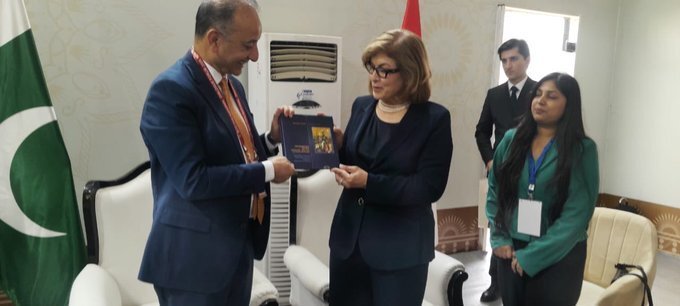
On the sidelines of the forum, Malik also held separate bilateral meetings with Tajikistan’s Minister of Culture Sattoriyon Amonzoda and Mohammad Mahdi Imanipour, president of Iran’s Islamic Culture and Relations Organisation.
According to the Pakistan High Commission in India, both meetings focused on engagement on the sidelines of the first SCO Civilisational Dialogue Forum, providing an opportunity to strengthen cultural relations and regional interaction.
The meetings reflected Islamabad’s efforts to use multilateral platforms to promote cultural cooperation and maintain engagement with regional countries amid wider geopolitical tensions.
Malik Urges Evidence-Based Regional Dialogue on Terrorism
A day earlier, Malik had called for a broader regional mechanism to address terrorism and security challenges, cautioning against reducing multilateral discussions to individual incidents or Pakistan-India bilateral disputes.
Responding to questions from Indian media about allegations concerning Pakistan’s approach to terrorism, the minister said he was attending a multilateral forum and wanted its proceedings to remain focused on constructive regional engagement.
He said the challenges facing South Asia and its neighbouring regions extended beyond bilateral disputes, citing security concerns involving Iran, Central Asia and Afghanistan.
Malik said Pakistan did not wish to present itself merely as a victim of terrorism, but wanted a transparent process through which allegations could be examined and evidence presented.
He stressed that both Pakistan and India should provide verifiable evidence when accusing each other of supporting terrorism, arguing that an impartial mechanism could help restore confidence and identify workable solutions.
The minister said Pakistan had suffered significant losses in terrorism, with thousands of people killed, and insisted that transparency was essential to resolving security disputes and building mutual trust.
Rather than allowing regional dialogue to become an exchange of accusations, he said participating countries should use available multilateral forums to address broader challenges through structured engagement and evidence-based discussions.
Shared Heritage Beyond Political Boundaries
Malik earlier described the SCO forum as an important opportunity for regional countries to reconnect with their shared history, geography, cultures and civilisational heritage.
He said historical and cultural connections transcended contemporary geographical and political boundaries, with archaeological discoveries providing evidence of centuries of interaction among communities across the region.
The minister emphasised that civilisational dialogue did not require uniformity but recognition of diversity, adding that the shared heritage of regional countries could serve as a foundation for mutual understanding.
His remarks at the forum combined a warning about the climate-related risks facing historical heritage with a broader appeal for cultural coexistence and regional cooperation.
As climate change increasingly threatens historic sites and fragile cultural landscapes, Malik argued that protecting civilisation’s heritage and encouraging dialogue among societies should remain interconnected priorities.
The SCO Civilisational Dialogue Forum, he said, offered participating countries an opportunity to exchange perspectives, recognise their shared historical experiences and strengthen connections that extend beyond contemporary political divisions.