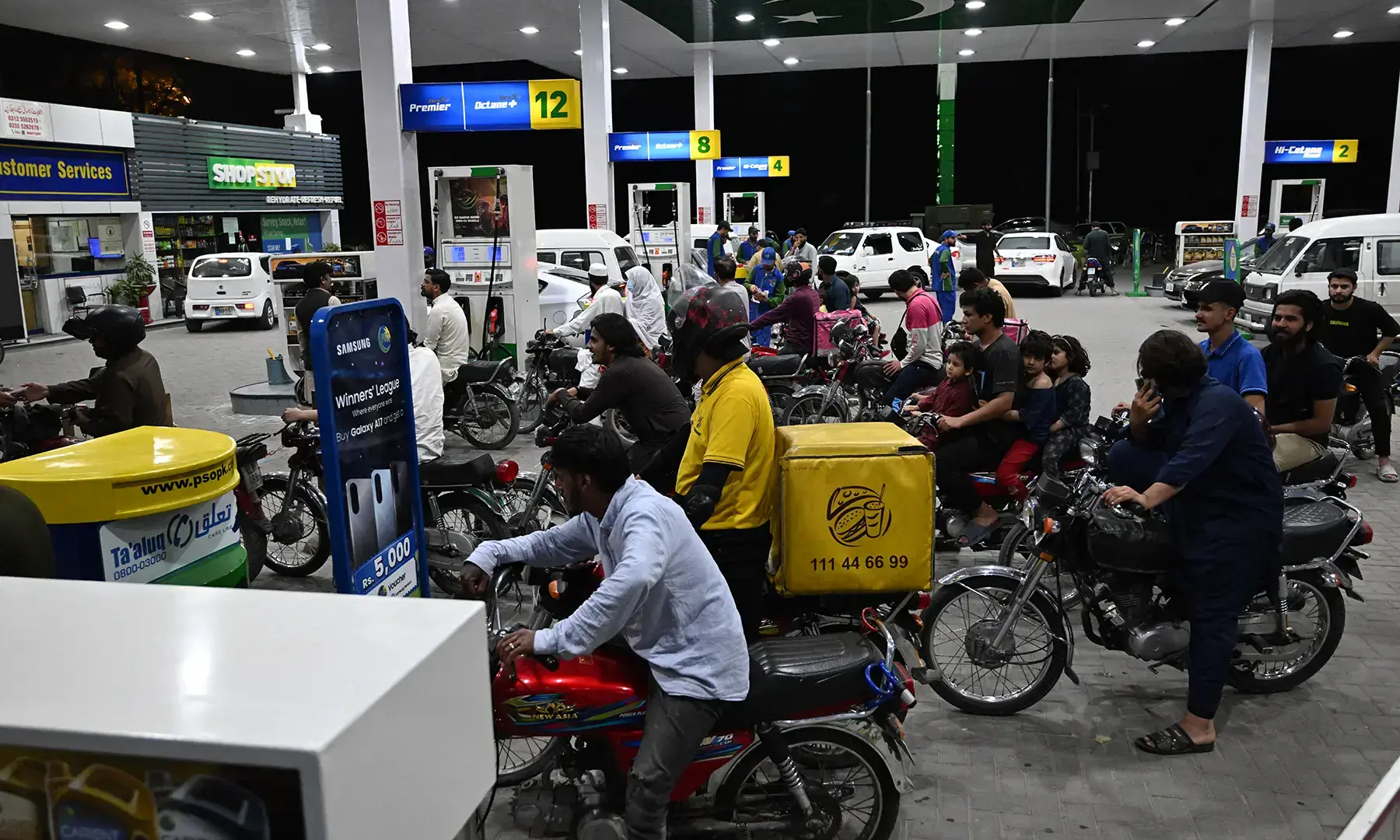

ISLAMABAD: The Ministry of Finance has rejected reports suggesting that the petroleum development levy (PDL) has become the central component of Pakistan’s programme with the International Monetary Fund (IMF), describing the claim as misleading and arguing that the programme covers a much broader range of fiscal and structural reforms.
Pakistan’s current IMF arrangement comprises a $7 billion Extended Fund Facility (EFF) and a $1.1 billion Resilience and Sustainability Facility (RSF).
The ministry issued the clarification in response to a report claiming that the Finance Ministry had placed the petroleum levy at the heart of the IMF programme despite there being no explicit IMF requirement prescribing its rate. The report further linked the government’s reliance on the levy with higher inflation, unemployment, poverty and weak economic growth.
The Finance Ministry disputed that assessment, saying Pakistan’s fiscal strategy under the programme extends well beyond petroleum taxation and includes Federal Board of Revenue (FBR) revenue mobilisation, expansion of the tax base, provincial taxation and rationalisation of government expenditure.
IMF Programme Has Broader Revenue Strategy, Ministry Says
According to the ministry, the programme for fiscal year 2026-27 places particular emphasis on generating additional revenues and improving the FBR’s performance rather than depending solely on petroleum-related taxation.
It acknowledged that the PDL is one of the government’s revenue instruments but said portraying it as the centrepiece of the IMF programme significantly exaggerates its importance.
The ministry also challenged the assertion that the IMF programme contains no conditions relating to petroleum levy pricing, calling such an interpretation technically narrow and potentially misleading.
Although the programme does not prescribe a single permanent headline rate for the petroleum levy, the ministry said published IMF documents contain specific provisions concerning petroleum pricing and levies.
These include regular adjustments to align domestic fuel prices with international prices. The RSF also contains a reform measure introducing an additional carbon levy through the existing PDL framework.
The ministry therefore maintained that petroleum pricing is part of the mutually agreed IMF programme rather than a fiscal policy developed independently by the Finance Division.
Ministry Rejects Linking PDL Alone With Inflation and Weak Growth
The Finance Ministry also rejected attempts to attribute inflation, unemployment, poverty and low economic growth primarily to the petroleum levy.
It described such reasoning as analytically incorrect because broad macroeconomic outcomes cannot be attributed to a single fiscal measure.
According to the ministry, Pakistan’s inflation and economic growth are shaped by several domestic and international factors, including geopolitical developments, global and domestic commodity prices, exchange-rate movements, monetary conditions, fiscal imbalances, external financing constraints and international economic shocks.
Finance Ministry Responds to Concerns Over Control of IMF Negotiations
The ministry also addressed claims that the Finance Division had maintained tight control over the design and negotiation of the IMF programme, allegedly contributing to problems involving agricultural commitments and an excessive emphasis on fiscal stabilisation.
The issue emerged in connection with Planning Minister Ahsan Iqbal’s statement that he had recommended to the prime minister that a Planning Commission representative should be included in the team negotiating with the IMF.
The Finance Ministry maintained that Pakistan’s arrangement with the IMF is a whole-of-government programme rather than one belonging exclusively to the Finance Division.
It said the EFF and RSF contain reforms and commitments involving numerous federal and provincial institutions.
These include the Finance Division, Planning Commission and Ministry of Planning, Ministry of Energy, provincial governments, FBR, State Bank of Pakistan and other relevant institutions.
According to the ministry, the departments concerned participate in and lead technical discussions, including the setting of benchmarks falling within their respective areas of responsibility.
IMF Programme Not Limited to Fiscal Targets
The ministry also rejected the suggestion that Pakistan’s IMF programme is focused only on fiscal figures and numerical targets.
It said macroeconomic stabilisation is intended to create the conditions required for sustainable and inclusive economic growth.
According to the ministry, published IMF documents cover growth-oriented structural reforms, social protection, governance, energy-sector efficiency, climate resilience and measures aimed at reducing economic distortions.
It added that the latest IMF staff report described policy discussions as focusing on accelerating reforms to support stronger economic growth while protecting vulnerable households.
Fiscal Stability and Economic Growth Are Interconnected
The ministry argued that fiscal stabilisation should not be viewed separately from economic growth.
Pakistan entered the IMF programme with limited fiscal and external buffers and substantial financing requirements, it said. Restoring fiscal sustainability, rebuilding foreign exchange reserves and reducing refinancing risks were therefore necessary to create conditions for durable private investment and economic expansion.
According to the ministry, documents relating to the IMF’s third review recorded that fiscal consolidation helped reduce macroeconomic imbalances and demand pressures while contributing to lower inflation, stronger external-sector stability, reserve accumulation and a recovery in overall economic growth.
Ministry Highlights Social Protection Measures
The Finance Ministry also rejected the impression that fiscal consolidation had been pursued without measures to protect vulnerable sections of society.
It said the government supported explicit spending floors and commitments for social protection under the IMF programme.
The ministry cited the latest targeted fuel subsidy programme as another measure intended to assist vulnerable households through temporary, targeted and fiscally sustainable support rather than broad subsidies that could create substantial liabilities for the government.
It further said sovereign debt was closely connected with fiscal imbalances and maintained that debt growth during the previous financial year had been restricted to its lowest level in two decades.
Agricultural Reforms Involve Provincial Governments
The ministry also clarified that commitments concerning agriculture are not the exclusive responsibility of the Finance Division.
Agricultural income taxation, for example, falls constitutionally and administratively within the jurisdiction of provincial governments.
Implementation of such reforms therefore necessarily requires provincial participation.
The ministry argued that assessments of IMF-related reforms should distinguish between the Finance Division’s role in coordinating the overall programme and the constitutional and administrative responsibilities assigned to federal ministries, provincial governments and other institutions.
Debate Should Focus on Moving From Stability to Sustainable Growth
Concluding its response, the Finance Ministry said a clear distinction should be maintained between its responsibility for coordinating Pakistan’s overall IMF programme and the policymaking, legislative and implementation responsibilities of the respective federal and provincial authorities once benchmarks have been agreed with the IMF.
It argued that the central policy question should not be framed as a choice between economic stabilisation and growth.
Instead, the ministry said the focus should be on how Pakistan can move from stabilisation towards sustainable economic growth without recreating the fiscal and external imbalances that have repeatedly forced the country to return to IMF stabilisation programmes.