
Pakistan and Kyrgyzstan committed on Wednesday to lifting bilateral trade to $200 million within two years, sealing the pledge alongside a broader package of agreements spanning defence, education, health, science, agriculture, and connectivity.
The trade deal was finalized in Bishkek as Prime Minister Shehbaz Sharif wrapped up a three-day state visit, according to the Prime Minister’s Office. Sharif explained that the two countries had originally drafted a softer memorandum around the same $200 million figure, but that he pushed instead for something with real teeth, a binding commitment rather than a statement of intent. He said Kyrgyz President Sadyr Zhaparov embraced the suggestion on the spot, and the two sides finalized the agreement at the airport just before Sharif’s departure, aiming to grow trade nearly thirteenfold from its current $16 million baseline.
Speaking earlier alongside Zhaparov, Sharif outlined plans for a detailed roadmap of practical steps: steadily expanding trade volumes, streamlining trade mechanisms, launching joint investment ventures, deepening industrial ties, and encouraging direct contact between the two countries’ business communities. He acknowledged that current trade figures fell well short of the strength of the underlying relationship, calling connectivity the linchpin of a broader vision to knit South and Central Asia closer together economically. He welcomed a newly signed transit trade agreement expected to smooth logistics and unlock fresh regional connectivity opportunities.
On energy, Sharif pointed to renewed commitment from both sides to move forward with the long-discussed CASA-1000 project, alongside a newly formed working group dedicated to electricity, hydropower, renewables, energy infrastructure, and modern technology. He also highlighted the new sister-city partnership linking Osh and Lahore, framing both as historic cities whose landmarks carry deep cultural weight.
Security cooperation ran through much of the discussion as well, with both governments pledging closer collaboration against terrorism, extremism, and other shared security threats. Sharif said Pakistan intends to keep working alongside Kyrgyzstan at the UN and other international bodies, calling the country Pakistan’s most valued partner in Central Asia, and extended a formal invitation for Zhaparov to visit Pakistan in return.
For his part, Zhaparov said that amid growing global instability, nurturing friendship and expanding practical cooperation had taken on new urgency. He identified economic ties as a core pillar of the relationship going forward, with both sides agreeing to grow trade volumes, diversify the goods being exchanged, and draw in fresh investment. He pointed to pharmaceuticals, agriculture, energy, light manufacturing, tourism, the digital economy, and virtual assets as areas ripe for joint projects, and noted that Pakistan’s ports give landlocked Kyrgyzstan a valuable gateway to South Asian and global markets.
Joint Statement
A joint statement issued by both leaders captured a wide-ranging exchange on bilateral relations and regional affairs, describing the talks as warm and productive, reflecting deep political trust between the two governments. Both sides were instructed to follow through consistently on commitments made during high-level visits, strengthen the operational role of the Kyrgyz-Pakistan Intergovernmental Commission on Trade, Economic, Scientific and Technical Cooperation, and improve coordination among relevant institutions.
The statement also flagged the importance of the Kyrgyz-Pakistan Joint Business Council in fostering direct private-sector ties, with both leaders agreeing to back its work on trade, investment, and industrial collaboration. A joint tourism working group was tasked with identifying concrete cooperation opportunities, including joint marketing of tourism offerings and closer engagement between the two nations’ tourism sectors. Both leaders also reaffirmed shared interest in deepening defence ties.
Agreements Signed
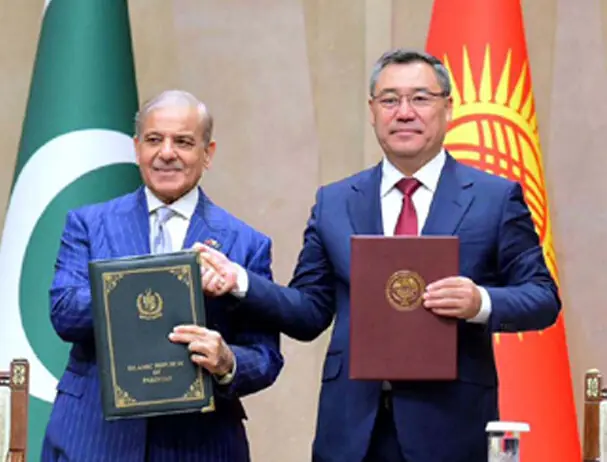
Ahead of the joint briefing, the two leaders observed a formal exchange of pre-signed documents. Deputy Prime Minister and Foreign Minister Ishaq Dar, part of the accompanying delegation, said the visit produced 17 separate bilateral agreements in total, including a diplomatic cooperation framework between the two foreign ministries covering 2026-27.
The remaining agreements touched on research partnerships, transit trade, science and technology cooperation, extradition arrangements, mutual legal assistance in criminal matters, and joint efforts against narcotics and precursor chemical trafficking. Kyrgyzstan’s health ministry signed a medical education agreement with the Pakistan Medical and Dental Council, while the two education ministries signed a separate pact covering education, climate change, and academic research. Additional agreements addressed the Lahore-Osh sister-city partnership, postal and e-commerce cooperation, business-to-business ties, and collaboration across security, education, environmental, and technology sectors.