
Turkish Foreign Minister Hakan Fidan said Saturday he believed Egypt could join the newly signed defence pact between Turkiye, Pakistan, and Saudi Arabia once several technical issues are resolved.
“Egypt is already our natural partner on all issues. I believe that at the next stage, Egypt will also be among us in the alliance. We already act toward one another as if we were alliance members. There are a few technical issues. Once these are implemented, there is no reason for Egypt not to be part of it,” he told Turkiye’s state-run Anadolu news agency.
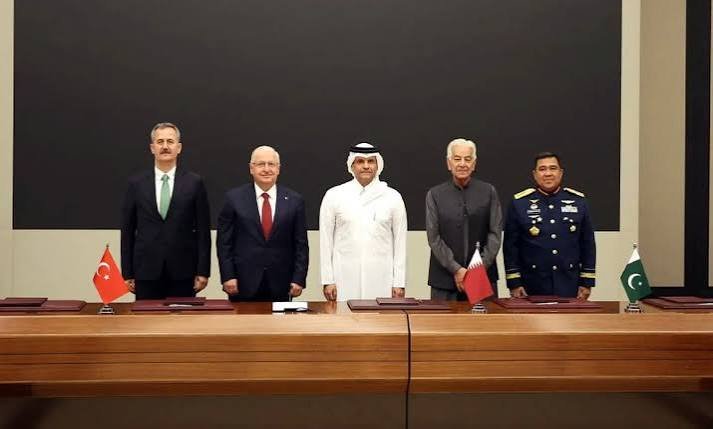
The Makkah Joint Defence Agreement, signed Friday in the Saudi city of Makkah, is designed to strengthen collective deterrence among its three founding members, empowering them to treat an attack against any one state as an attack against all three.
Fidan said other countries have also expressed interest in joining, though founding members have been debating how such expansion should proceed. Some interested countries asked not to be named, he said, adding that the preferred model would keep Turkiye, Saudi Arabia, and Pakistan as the three core founding states, responsible for setting the alliance’s principles, standards, and long-term structure, while other countries could join with the approval of the founding members. “Under our president’s vision, we should not remain limited to three countries. We should grow,” Fidan said.
He added that the initiative extends beyond the traditional definition of the Middle East given Pakistan’s involvement, with the country’s geographic position lending the pact a broader regional perspective.
‘Same as NATO’s Article 5’
Fidan said the pact is technically equivalent to NATO’s Article 5 mutual defence clause, under which an attack on one member is treated as an attack on all, obligating allies to take necessary action, including potentially military force, in response. While the Makkah pact carries the same core stipulation, Fidan explained its text sets out general commitments whose practical implementation would depend on discussions and decisions by relevant bodies. A country under attack would need to formally request assistance and specify the type of support required, ranging from intelligence and logistics to ammunition or military units, depending on the scale of the threat. The signatories, he said, would then decide through consultation the degree, form, and format of support to provide, though no country would be treated as a threat unless a member state is actually attacked.
Fidan said the alliance is not directed against Iran or any other country, but functions as a general pledge to support the security of its signatories. He noted that discussions on the initiative began before the current war environment, at a time when there was no US-Israel war on Iran, with other regional countries also involved in the talks that led to the agreement. He described the signatories as countries without expansionist ambitions. “They are countries concerned with their own borders, their own problems and their development, and, if possible, they want to contribute positively to their environment through good relations and good neighborliness,” he said, adding that while the three countries differ in style and capacity, together they naturally form a defence-oriented rather than offensive organisation. “It is not an approach of going on the offensive and saying, ‘Let’s do this or that together.’ Therefore, unless it is attacked by a country, whether from inside or outside the region, this alliance cannot have any dispute with any country. But, of course, the power composition we have put forward will make a constructive contribution to regional stability,” he said, calling the pact the “most important step” toward bringing lasting stability to the region.
How Will the Alliance Function?
According to Fidan, the pact will operate under a political and military committee comprising foreign and defence ministers along with chiefs of general staff, structured similarly to NATO. This committee would translate the leaders’ vision into concrete decisions, while a secretariat would be established to implement them. “At the first committee meeting, ministers would likely present proposals to the leaders on the establishment, structure and functioning of the secretariat, as well as its initial tasks,” he said, noting the pact would cover a broad range of military areas, including interoperability between differing military structures, joint training, mutual support, logistics, threat assessments, intelligence sharing, and defence industry cooperation.
The committee would meet at set intervals throughout the year, with a permanent secretariat to be established in Saudi Arabia; its structure and additional units would be worked out through further discussions among members. Fidan said joint exercises and training would be essential to establishing interoperability. “Because after a while you will see that when you find yourselves in a common combat scenario, how your weapons systems and communications systems will communicate with one another and how they will be compatible are important issues. These are the things that will be done after the secretariat is established,” he said, adding that common standards, analyses, and assessments would also need to be developed.