
Abdul Haseeb Khan
There is something deeply troubling about a government that sets targets it cannot meet, misses them by a catastrophic margin, and then sets the same impossible targets all over again. This is not ambition. It is denial. And nowhere is this institutional self-deception more visible, or more damaging, than in Pakistan’s cotton sector.
The Pakistan Cotton Ginners’ Association has once again sounded the alarm, and the numbers it points to are damning. The Federal Committee on Agriculture recently announced a cotton production target of 9.6 million bales for the 2026-27 crop year. The announcement was made even as the outgoing year closed with actual production of just 5.6 million bales against a target of 10.2 million. Pakistan missed its cotton target by nearly half. The response from the planners was not introspection. It was another ambitious number. Another aspiration dressed up as a plan.
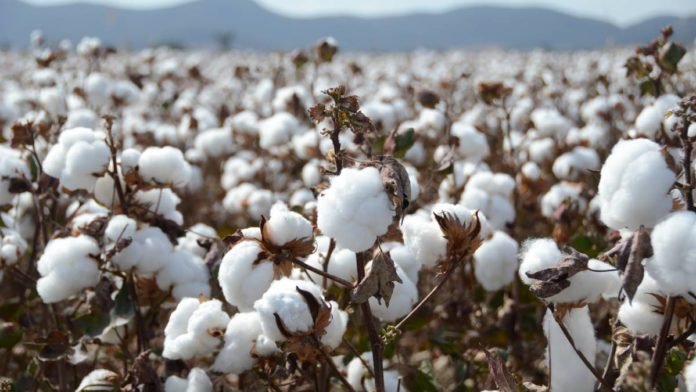
This is not a one-year anomaly. The seasons of 2022-23, 2023-24, and 2024-25 all told the same story: targets set in conference rooms that never materialised in the fields. Each year, output has fallen to levels that would have been unthinkable a generation ago. Pakistan once produced 14 to 15 million bales annually at its peak. Today, the country barely crosses five million. That is not a temporary dip. That is a structural collapse unfolding in slow motion, season by season, bale by bale, while the people responsible for reversing it continue to announce targets rather than solutions.
The Ginners’ Association has been clear about what this habit of overestimation actually costs. When projections are divorced from ground reality, the entire value chain suffers. Cotton importers trying to assess supply gaps, textile exporters calculating their raw material needs, traders making pricing decisions: all of them rely on official data to plan ahead. When that data is fabricated optimism rather than honest assessment, the uncertainty radiates outward, distorting markets, misallocating resources, and eroding the trust that a functioning agricultural economy requires. Pakistan’s cotton projections are not prepared using satellite-backed assessments or serious stakeholder consultation, both of which are standard practice in cotton-producing countries that have actually remained competitive. They appear to be produced by institutions that would rather look confident than be accurate.
The target for next year envisions a jump of nearly four million bales over actual current output. That is not a stretch goal. It is a fantasy, and it will remain a fantasy as long as the structural problems destroying the cotton sector are left untouched.
Begin with the seed. Pakistani cotton farmers are overwhelmingly dependent on substandard Bt seed that has long since lost its efficacy against evolving pest pressures. Yields are stagnant partly because the biological foundation of the crop has been allowed to deteriorate. Recent policy moves to permit cottonseed imports after decades of restriction represent a belated acknowledgement of this reality, but belated is the operative word. Procedural delays have pushed the arrival of imported seed to the tail end of the sowing season, making it functionally useless for the current year. And even when better seed arrives, it faces years of tightly controlled trials before commercial approval can be granted. Farmers will not see meaningful benefit any time soon. The system moves at the pace of bureaucratic caution while the crisis moves faster.
Then there is mechanisation, or rather its near-total absence. Cotton picking in Pakistan remains an overwhelmingly manual operation. This is not a pastoral preference. It is a consequence of a farming economy that has not been supported with the investment and infrastructure needed to modernise. Manual picking introduces higher contamination levels into harvested cotton, degrading fibre quality and reducing the premium Pakistan’s cotton can command in international markets. The efficiency losses compound year after year. Mechanisation requires capital, extension services, and genuine policy commitment. None of these have arrived in sufficient measure.
But the single most destructive force eating away at Pakistan’s cotton base is sugarcane. This is the factor that receives the least honest attention in policy discussions and carries the most devastating consequences. Sugarcane is a water-intensive crop that has been steadily encroaching upon the traditional cotton belts of Punjab and Sindh, driven by short-term returns that make sense to individual farmers but represent an economic catastrophe at the national level. Land that once produced cotton, the raw material that anchors Pakistan’s entire textile export industry, is now growing sugarcane for a market already drowning in surplus. Pakistan currently holds approximately 1.5 million tonnes of excess sugar. There is no economic case for expanding sugarcane production. There is certainly no case for displacing cotton to do so.
The situation in Rahim Yar Khan tells the story with particular sharpness. This district once produced as many as 1.8 million bales of cotton annually. It was a cornerstone of Pakistan’s agricultural identity in the Punjab. Today, that status is eroding as sugarcane advances and cotton retreats. Plans to establish new sugar mills in southern Punjab, including in areas near Rahim Yar Khan and along the Punjab-Sindh border, threaten to accelerate this destruction. The Ginners’ Association has written to the Prime Minister, the Army Chief, and the Chief Justice of the Supreme Court, urging that these mills be stopped. Whether anyone with actual power will act on these appeals is uncertain, given the outsized political influence that the sugar industry has historically wielded in Pakistan’s corridors of power. The sugar lobby is not a minor inconvenience to agricultural reform. It is one of its principal obstacles.
What Pakistan needs is not another target. It needs enforceable crop zoning that places cotton-growing areas under legal protection from displacement by sugarcane. It needs credible seed reform that delivers improved varieties to farmers in time for them to plant, not in time for another year’s trials. It needs mechanisation support that reduces contamination and improves efficiency. And it needs an honest accounting of how two decades of policy neglect turned a 14-million-bale industry into a five-million-bale catastrophe.
The credibility of Pakistan’s agricultural planning is on the line. More importantly, so is the export economy that depends on cotton as its foundational raw material. Target-setting without reform is not governance. It is theatre, and Pakistan’s cotton farmers have been the audience of that theatre for far too long.