

Naeem Afzal
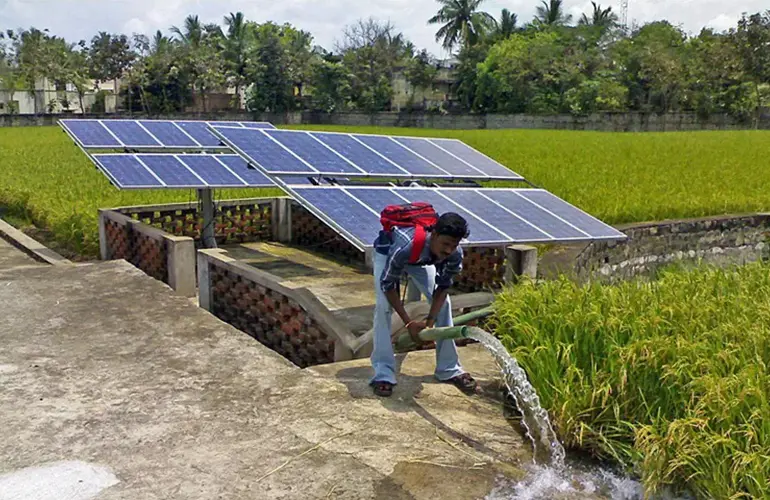
Something remarkable has happened in Pakistan, and it happened without a plan. No ministry designed it. No five-year strategy announced it. No donor conference funded it. Ordinary people, tired of crushing electricity bills and endless load-shedding, simply climbed onto their roofs and fixed the problem themselves. From the industrial estates of Faisalabad to the smallest villages of Punjab, the rooftops of Pakistan are turning blue with solar panels. This is a revolution, and it was brought by the people.
Consider a scene from rural Punjab. A young man married a few months ago. In his home, beside the carefully stored silver utensils of the dowry, stands a new 340-watt solar panel. Villagers say that in modest weddings families once gave a motorbike or household goods. Now they give a solar panel and an air cooler. It has become customary. When a solar panel enters the dowry, it is no longer a technology. It is a social institution.
The reason is simple arithmetic. A household where three families live under one roof runs a water motor, a washing machine and an iron. The bill arrives at fifteen or eighteen thousand rupees. Food must be bought, children must be educated, debts must be paid. Such a family cannot afford the grid. So the young man plans to cover every inch of his roof with panels within a month or two. He wants everything in his home to run on the sun. Millions of Pakistanis share his wish.
Industry has moved even faster. Large textile mills that export cloth across the world have been installing solar for years. Their machines consume enormous power, and while the sun shines, much of it now comes from the roof. Kohinoor Textile Mills is one such example. It plans more panels and is now preparing industrial-scale battery storage so that the sun’s energy can run its looms after dark. Its management makes a point worth repeating. It is easy to say that the state should do everything, but the state today does not have the resources. Not every failure can be blamed on the government. Some work we must do ourselves.
That sentence captures the spirit of this transition. Pakistanis did not wait. When the grid became expensive and unreliable, when outages stretched for hours each day, people searched for alternatives. At the same moment, Chinese solar panels became dramatically cheaper. Imports surged. Now battery imports are rising too, which means dependence on the national grid will fall further still.
But every revolution carries a shadow, and this one is no exception. The danger has a name: the utility death spiral. It works like this. When people leave the grid for solar, fewer consumers remain to pay for it. The grid’s costs do not shrink. Power plants, transmission lines and capacity payments must still be paid for. So those costs are spread over a smaller base, and tariffs rise. Higher tariffs push more people towards solar. They too leave the grid. The cycle repeats and deepens. According to the report, in just two years, consumers leaving the grid have shifted a burden of more than 500 million dollars a year onto those who remain.
Who are those who remain? They are the poor who cannot afford panels. They are the renters who do not own a roof. They are the small shopkeepers in congested bazaars where no sunlight falls. The solar revolution, left unmanaged, could become a transfer of cost from the comfortable to the vulnerable. In its worst form, energy experts warn, losses would keep growing until the state power companies became white elephants, kept alive only by pouring in public money. A country that already spends heavily on circular debt cannot afford another bottomless pit.
So Pakistan stands at a crossroads. One road leads to a model the world will study for decades, a successful energy transition driven from below, cleaner, cheaper and more resilient. The other road leads to a cautionary tale of how not to manage such a transition. Every researcher, every energy expert and the government itself has an interest in choosing the first road.
The government insists it is not alarmed. Officials argue that the grid is not disappearing anywhere in the world, so there is no reason it should disappear in Pakistan. They say the growth of solar has already been built into their planning, that purchase prices of electricity will not rise over the coming decade, and that the rush to leave the grid has slowed. They also admit something important: they cannot slow the solar wave, and they have never tried. The only thing that can slow it is a grid that offers competitive prices. The state, in other words, must compete with the sun.
That is the right instinct. Fighting solar with taxes, penalties or bureaucratic hurdles would be a historic mistake. It would punish citizens for solving a problem the state failed to solve. Instead, the grid must reinvent itself. It must become cheaper, smarter and more reliable. It must welcome rooftop solar as a partner, buying surplus power at fair rates and selling stable power at night. It must renegotiate the expensive capacity contracts that make every unit costly. It must modernise distribution, curb theft and end the inefficiency that drives honest consumers away. A grid that offers value will keep its customers. A grid that offers only bills will lose them.
There is a larger lesson here about governance. Pakistan’s people have shown more initiative than its institutions. They saw the problem, found the solution and paid for it themselves. The state’s task now is not to lead from the front, because the people are already ahead. Its task is to follow wisely, to manage the consequences and to protect those left behind.
The sun has risen over Pakistan’s rooftops. It will not set again. The only question is whether the state will rise with it.
The best-selling books of Republic Policy Think Tank, including the landmark book The Bureaucratic Coup, are available at Vanguard Books, Liberty Books, Readings, Kitab Sarai, Sang-e-Meel, Saeed Book Bank Islamabad, National Book Foundation, and others across Pakistan. Contact for home delivery: +92 341 4222501.