
Team Republic Policy
An Evaluation Report by Republic Policy Think Tank
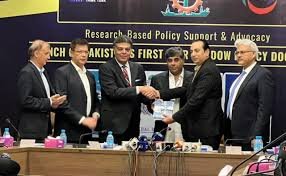
Pakistan’s economic discourse has long suffered from a fundamental structural deficiency: the absence of credible, research-driven alternatives to official policy. Governments announce budgets. Parliaments rubber-stamp them. The media debates them briefly. And the cycle of fiscal mismanagement, IMF dependence and structural stagnation continues largely undisturbed. It is against this dismal backdrop that the Economic Policy and Business Development think tank’s launch of Pakistan’s first-ever Shadow Policy Documents deserves not merely acknowledgement but genuine appreciation. EPBD has done what few institutions in Pakistan have attempted with this degree of comprehensiveness — it has produced an alternative framework, grounded in research, covering taxation, budgeting, economic survey methodology and a five-year development vision. This is serious intellectual work, and Pakistan needs more of it.
Republic Policy Think Tank commends EPBD for this initiative unreservedly. Research-backed policy alternatives are not a luxury in a country facing Pakistan’s economic challenges. They are a necessity. The existence of a credible shadow framework creates the conditions for informed public debate, legislative scrutiny and executive accountability. When think tanks produce work of this quality, they perform a democratic function that official institutions too often neglect. EPBD has raised the standard of what Pakistani policy advocacy can look like, and that contribution deserves to be recognised before any evaluation begins.
A particular word is warranted about EPBD’s Chief Executive Officer, Mr Ahmad Nawaz Sukhera, a retired civil servant of considerable distinction. His presence at the helm of this initiative is significant. Mr Sukhera brings to this work something that purely academic or private-sector economists rarely possess: an insider’s understanding of how government actually functions, where policy intent meets bureaucratic reality and why well-designed reforms so frequently fail at the implementation stage. His practical experience lends the Shadow Policy Documents a grounded quality that makes them more than theoretical proposals. They reflect an understanding of the state from within, and that perspective is invaluable in a reform context.
The proposals themselves are substantive and, in several important respects, well-directed. The diagnosis is accurate: Pakistan’s tax structure has become distorted, regressive and extractive, punishing documented sectors while rewarding informality. The recommendation to reduce corporate tax from 29 to 25 percent, withdraw super tax from non-banking sectors, and lower the income tax burden on salaried individuals from 35 to 20 percent addresses a genuine injustice. The salaried class in Pakistan has become the state’s most convenient revenue source precisely because it cannot hide. Relieving that burden while expanding the tax base to include retailers, vendors and merchants is the correct sequencing of reform.
The proposal to reduce withholding tax categories, gradually lower GST from 18 to 15 percent and abolish the non-filer category reflects sound administrative logic. The non-filer regime has created a formalised mechanism for purchasing exemption from civic obligation, and its abolition is long overdue. Similarly, the proposal to address the Rs5.7 trillion stuck in tax litigation through time-bound judicial decisions and reformed dispute resolution is not merely a fiscal recommendation. It is a rule-of-law imperative. A tax system that generates five-plus trillion rupees in unresolved litigation is not a tax system. It is a source of institutional paralysis.
The real estate proposals — reducing transaction taxes to a flat 0.5 percent and abolishing deemed income tax — are directionally sound, though they will require careful calibration to prevent the sector from reverting to its historic role as a vehicle for undocumented wealth rather than productive investment.
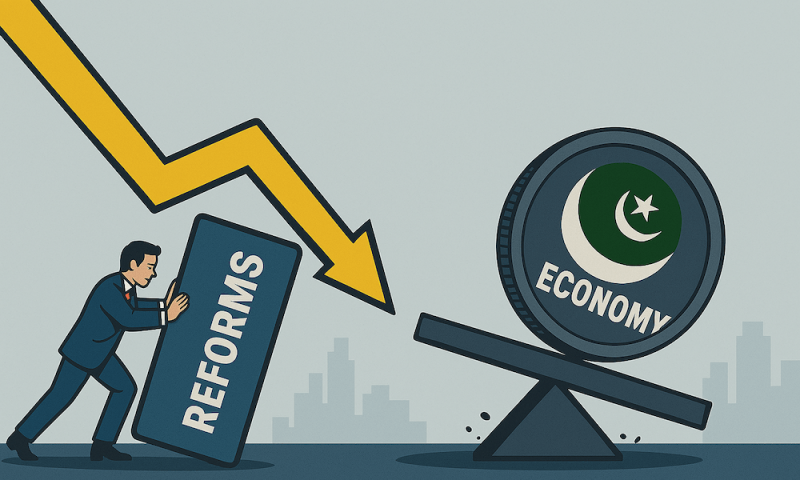
However, Republic Policy Think Tank must register a fundamental observation that no reform package, however technically meritorious, can afford to omit: economic reform in Pakistan cannot succeed without political stability, and political stability cannot be manufactured outside the parliament. This is not a peripheral point. It is the central point. Pakistan has accumulated decades of well-designed reform proposals that have either never been implemented or have been reversed within electoral cycles because the political conditions for sustained policy commitment did not exist. Reforms require legislative ownership, cross-party consensus on fundamentals and a parliamentary culture that treats economic policy as a matter of national rather than partisan interest.
Republic Policy Think Tank has consistently argued that parliament is the correct arena for economic reform — not the IMF board room, not the finance minister’s press conference and not the civil bureaucracy’s internal working committees. Reforms that originate in and are owned by the legislature carry a legitimacy and durability that technocratic proposals, however excellent, simply cannot achieve on their own.
This brings us to a specific recommendation that EPBD’s initiative makes newly urgent: Pakistan must institutionalise pre-budget open debates as a standard feature of its democratic process. The practice of presenting a budget as a fait accompli, debated cursorily in the National Assembly and passed along party lines, is a democratic failure. Before any budget is finalised, there must be structured, publicised consultations involving parliamentarians from all parties, academic economists, civil society organisations, business chambers and, crucially, media platforms capable of bringing these debates to the broader public. EPBD’s Shadow Documents provide exactly the kind of alternative framework that such debates require. Imagine a National Assembly standing committee on finance engaging seriously with EPBD’s shadow budget alongside the government’s own proposals. That is what democratic economic governance looks like.
Beyond taxation, Pakistan’s economic revival demands a broader architecture of reform. Federalism must be made functional, with the 18th Amendment implemented in letter and spirit rather than selectively undermined. Rule of law must be restored as the operating principle of economic life — no investor, domestic or foreign, commits capital to an environment where contracts are uncertain and judicial processes interminable. Good governance requires merit-based civil service appointments, depoliticised regulatory bodies and public institutions that serve citizens rather than patrons.
EPBD has started an important conversation. That is not a small achievement in a country where the space for serious policy debate has consistently narrowed. Republic Policy Think Tank urges the government to engage with these proposals with the seriousness they deserve, urges parliament to adopt pre-budget deliberation as institutional practice, and urges fellow researchers and institutions to respond, critique and build upon this work. The debate has begun. What Pakistan needs now is the political will to let it lead somewhere.