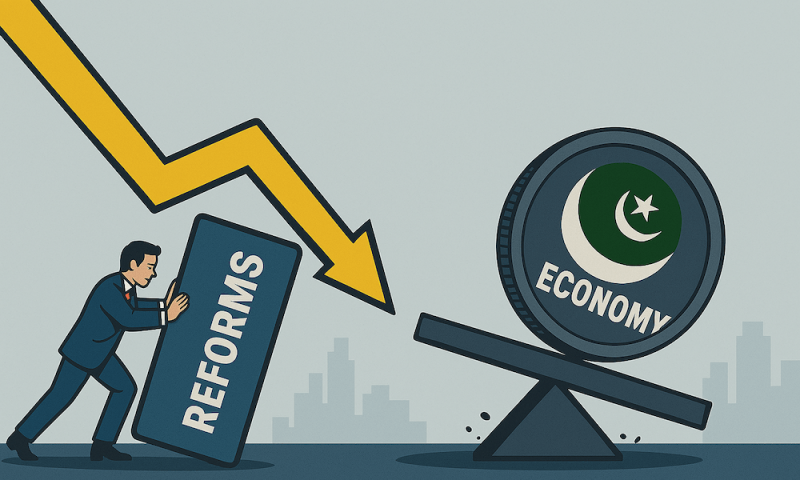

Pakistan’s economic dysfunction is not incidental. It is rooted in a poor structure of incentives, originating from the extractive nature of the political economy of taxation, and sustained due to geopolitical handouts. The long-term remedy lies in the implementation of structural reforms.
Firstly, the economic thinking in Pakistan is still stuck in the era of the sixties. Our policymakers see “development” in big and shiny projects and infrastructure-related spending. They focus on the hardware and neglect the software of the economy. Modern economics is nothing but transactions: exchange of goods, ideas, etc. Successful countries facilitate transactions, while unsuccessful countries block transactions through regulatory sludge and controls.
Secondly, the poor economic development has roots in the poor governance structure of the country. The World Bank, in its policy notes, Pakistan@100, argues that Pakistan ranks poorly among regional peers on the Rule of Law, strong institutions, and other good governance indicators. In the words of Woodrow Wilson, economic forces respond to the incentive structure of good governance. “Running a constitution is harder than framing a constitution.”
Thirdly, pervasive corruption and rent-seeking practices sit at the heart of economic underdevelopment in Pakistan. The IMF, in its Governance and Corruption Diagnostic Report, calls corruption the cause for perpetuating rent-seeking patterns in the economy.
Fourthly, the political economy of taxation has blocked the expansion of the revenue base in real terms. The tax-to-GDP ratio is stuck at 10%, among the lowest in the region. The revenue base is constrained and getting coercive for compliant sectors. For instance, the agriculture sector contributes 23% to the GDP, employing 45% of its labor force, yet from its Rs 900 billion size, it contributes merely Rs 2-3 billion to the revenue pool, because Pakistan’s Parliaments are packed with agriculturalists who have blocked serious legislation in this regard. In the words of Ijaz Nabi, it is the political economy that has been the cause of the shrinking resource base, not the technical capacity of the FBR.
Fifth, Pakistan’s economic structure is deeply mired in a crisis of productivity. According to the World Bank, a Pakistani product or service is ten times less productive than the equivalent made in regional countries. In the words of Ijaz Nabi, “Pakistan consumes 95% of what it produces.” Consumption isn’t the serious problem; the problem is that we spend more than we earn. Pakistan’s exports have remained low-value-added products, earning only $30 billion in foreign exchange.
As one analyst puts it, “Pakistan earns more from its geopolitical position than exports.” In the words of Nadeem-ul-Haque of PIDE, fancy terms such as geopolitics or geoeconomics work as patronage distribution mechanisms. Long-term growth will result only from holistic reforms.
“Economic growth springs from better recipes, not just from cooking.” — Paul Romer
The Remedies
“One of the greatest mistakes is to judge policies and programs by their intention rather than their results.” — Milton Friedman
First, Pakistan must reform its civil service, because undertaking serious reforms requires a smart and efficient bureaucracy. Currently, bureaucratic inertia obstructs innovation and the emergence of new ideas in the economy. According to PIDE, regulatory sludge hinders the free flow of transactions by imposing NOC requirements, licenses, and unnecessary permissions. PIDE has calculated that there are 140+ regulatory agencies in the federal government alone and that this bureaucratic sludge costs the economy 6-7 billion dollars in GDP loss.
Second, through streamlining economic transactions, Pakistan must enhance the ease of doing business. Businesses don’t flourish in a vacuum; they operate in a holistic ecosystem shaped by institutional incentives. Nearly all investors, domestic and foreign, complain about red tape and a coercive permission culture, with effects visible in the declining trend of Foreign Direct Investment inflows. In a country of 240 million souls, FDI has shrunk to merely two billion dollars of the GDP.
Third, the government’s footprint has grown beyond limits. According to PIDE, the government controls 67% of the economy, a level of involvement some analysts term the potential cause behind market distortions, erosion of competitiveness, and distribution of rents. In the business world, organizations compete in markets and export products; in Pakistan, industries instead rely on government support and operate behind a strong wall of protections. To enhance productivity, scholars suggest Pakistan must introduce markets and let all organizations compete freely in regulated markets.
“The curious task of economics is to demonstrate to men how little they really know about what they imagine they can design.” — Friedrich Hayek
Conclusion
“Pakistan is not out of the woods yet.” Stabilization has morphed into stagnation. Pakistan does not need another reform package, another IMF program, or another donor’s advice. What Pakistan needs is a holistic structural change, led by the people through the act of parliament. As economist Paul Romer has rightly said, “A crisis is a terrible thing to waste.”