
Skip to content

Premium Content

  • Register / Login
  • Profile
  • Register / Login
  • Profile
Subscribe
  • Republic Policy
  • Law & Rules

    Admin Law

    Constitutional Law

    Civil Law

    Criminal Law

    Family Law

    International Law

    Others

  • Civil Services

    Civil Service Law

    Recruitment

    Appointment

    Promotion

    Enquiries

    Civil Services Reforms

    Litigation

    Others

  • Governance

    Legislature

    Executive

    Judiciary

    Others

  • Human Rights

    Fundamental Rights

    Civil & Political Rights

    Economic, Social & Cultural Rights

    Focused Rights

    Others

  • Politics

    Political Philosophy

    Political Economy

    International Relations

    National Politics

    Others

  • Literature

    Poetry

    Fiction

    Essays

    Others

  • Organization
اردو اخبار
اردو اخبار
  • Republic Policy
  • Law & Rules

    Admin Law

    Constitutional Law

    Civil Law

    Criminal Law

    Family Law

    International Law

    Others

  • Civil Services

    Civil Service Law

    Recruitment

    Appointment

    Promotion

    Enquiries

    Civil Services Reforms

    Litigation

    Others

  • Governance

    Legislature

    Executive

    Judiciary

    Others

  • Human Rights

    Fundamental Rights

    Civil & Political Rights

    Economic, Social & Cultural Rights

    Focused Rights

    Others

  • Politics

    Political Philosophy

    Political Economy

    International Relations

    National Politics

    Others

  • Literature

    Poetry

    Fiction

    Essays

    Others

  • Organization
  • Blogs, Economic, Social and Cultural Rights
  • September 18, 2026
  • 8:54 pm

The Digital Age Has Changed the Meaning of Work

Picture of Desk

Desk

  • No
[post-views]
  • No
Join Our Whatsapp Channel
Print Friendly, PDF & Email

Naeem Afzal

In this age of technology, the nature of work has changed. Digital technology has transformed not only how we work, but also where we work and, more importantly, when we stop working.

Today, I was thinking about my own working life. The office where I work, for example, does not really need a physical location anymore. Much of the work we do while sitting in the office can also be done from home. We work through WhatsApp, phones, Instagram and other digital tools. We are no longer completely dependent on offices, buildings or traditional working spaces.

No doubt, these technologies have made our lives easier. They have liberated work from physical locations. They have allowed us to work from almost anywhere. In many ways, they have freed us from the traditional limitations of work.

But this is only one side of the picture.

The other side is more troublesome. It particularly concerns those of us who study the humanities and think about technology from a social and humanistic perspective.

Technology has liberated work from the office. But, at the same time, it has brought the office into our homes.

Before the digital age, there was a clearer boundary between work and personal life. A person worked for certain hours. When he left the office, he left his work there as well. He came home. He spent time with his family and his wife. He could watch a series, read a book or listen to music. He could simply do what he wanted. Work was part of his life, but it was not his whole life.

Now, the situation is different.

A person may work in an office from ten in the morning until six in the evening. He closes the office and comes home. Technically, his working day is over. But is he really free?

His work comes home with him.

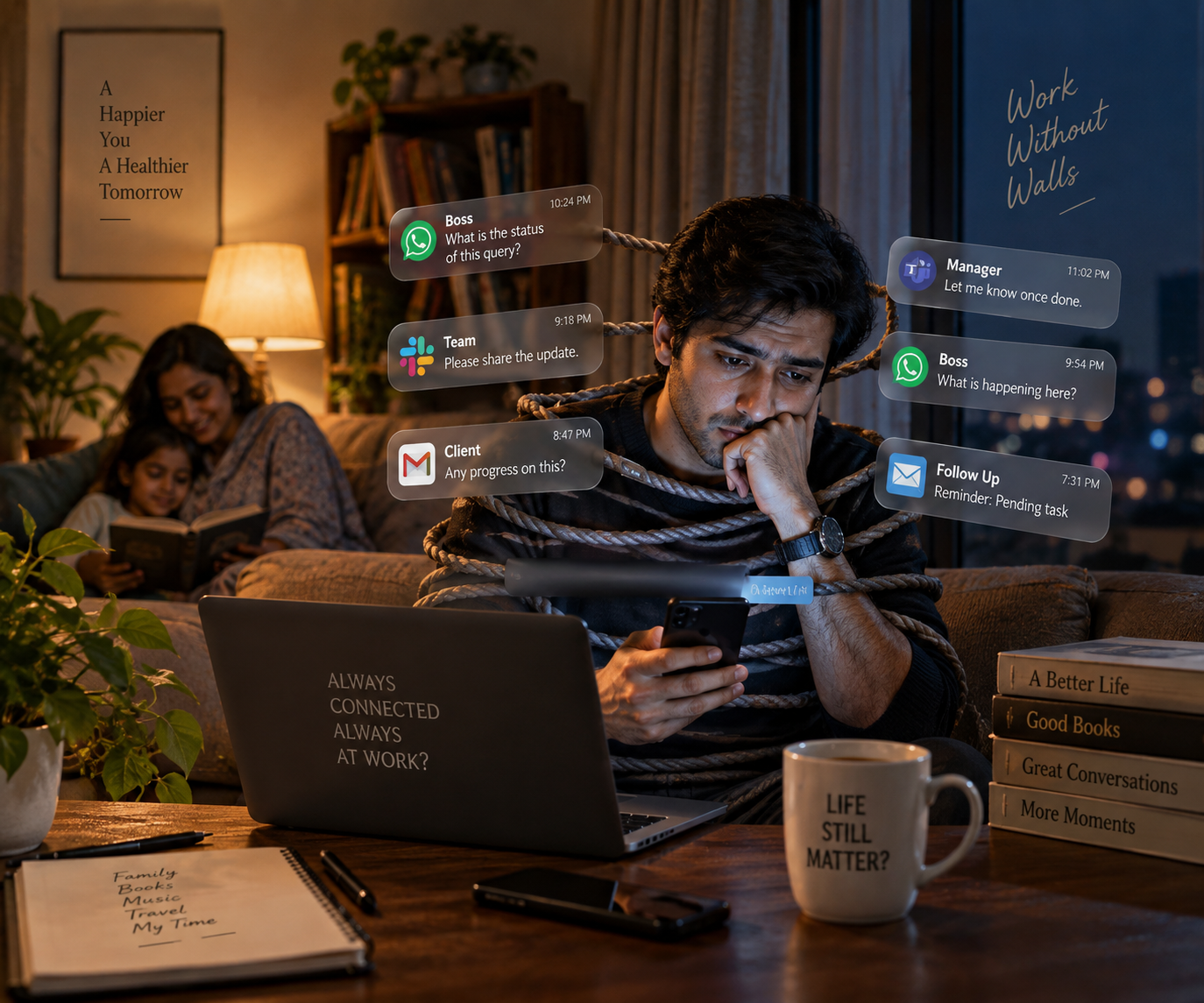
It comes through WhatsApp. It comes through his phone. A message from the boss arrives: What is the status of this query? What is happening here? Has this work been completed?

Of course, he can still watch a movie. He can still sit with his family. He can read a book or listen to music. But somewhere, psychologically and mentally, he is still stuck at work. He is not completely free. Something remains in his mind. Something is always waiting for him.

This has disturbed the balance between personal life and working life. People have free moments, but even in those moments they are not really free. The body may have left the office, but the mind has not.

And this is the contradiction of our digital age.

Technology, on the one hand, is liberating us from physical restrictions. It is making our lives easier. It is allowing us to move beyond traditional offices, buildings and working arrangements. But if we study the same technology from a humanistic perspective, we find something very different.

The technology that is liberating us is also imprisoning us.

The prison is simply less visible. There are no walls. There are no physical chains. Instead, there are invisible ropes that keep us connected to work everywhere we go.

We are always connected. We are always available. We are always somewhere at work.

And somewhere in this endless connection between work and technology, the boundary between working and living is disappearing.


Leave a Comment Cancel Reply

Your email address will not be published. Required fields are marked *

Search the Blog

Suggestion

Urban Air Pollution: Structural Drivers and Systemic Remedies

Desk

In Defense of Gen Z. And a Word of Caution for Them Too

Desk

LABOR COSTS OF POOR PLANNING

Desk

India’s ‘Cockroaches’ Are Fighting Back

Desk

Role of Universities in the Age of AI

Desk

THE FOUNDATIONS OF MODERN CHINA

Desk

Thoughtless Medieval Taxation

Desk

Litigation Culture to Law-Abiding Society

Desk

A crisis is a terrible thing to waste.

Desk

Shadow Policies, Real Stakes: Evaluating EPBD’s Reform Blueprint for Pakistan

Desk
Latest Videos
[youtube-feed feed=2]

Support our Cause

"Republic Policy Think Tank, a team of dedicated volunteers, is working tirelessly to make Pakistan a thriving republic. We champion reforms, advocate for good governance, and fight for human rights, the rule of law, and a strong federal system. Your contribution, big or small, fuels our fight. Donate today and help us build a brighter future for all."

Quick Links

  • Home
  • News
  • Editorial
  • Op Ed columns
  • Opinions
  • Analysis
  • Blogs

For Submission of Articles

  • E-mail: editor@republicpolicy.com
  • E-mail: coeditor@republicpolicy.com

Contact Details

  • Contact No: 03014243788, 04236309547
  • E-mail: info@republicpolicy.com
  • Lahore Office: 208, 2nd Floor National Tower Egerton Road
  • Islamabad Office: Zafar qamar and Co. Office No. 7, 1st Floor, Qasim Arcade, Street 124, G-13/4 Mini Market, Adjacent to Masjid Ali Murtaza, Islamabad
Facebook Instagram Twitter Whatsapp Youtube Icon-linkedin Created with Fabric.js 3.5.0
  • Organization
  • Contact Us
  • Submission Guidelines
  • Terms & Conditions
  • Privacy & Policy
اردو اخبار

Copyright © 2026 Republic Policy

| Developed and managed by Abdcorp.co

  • English
  • اردو
  • English
  • اردو