
A calm look at how four generations of young Indians have protested and what Gen Z can learn from the Boomers, Gen Xers & Millennials
Because of the nature of my work, I am blessed to spend a great deal of time with young people. The readers of the Shiva Trilogy and the Ram Chandra Series were, for the most part, Millennials. Then came a wave of Gen Z readers, and lately even some Gen Alphas, especially since I released my first children’s book, Dhruv-Tara & the Great Indian History Quiz. So I get to talk with the young. More importantly, I get to listen to them. And I learn.
Naturally, many of them have been asking me about the recent protests. Not just the examination issues, which I wrote about in an earlier piece, but the protests themselves. The rude words. The videos of clashes, students and police officers alike bloodied and hurt. And yes, the language, some of it genuinely startling. One saw clips of protestors using cuss words of the kind that impute, shall we say, deeply inappropriate intimate relations between certain women and the male members of their own families. I will admit to a small, old-fashioned confusion when some of those using such words also described themselves as feminists or allies of feminists. Consistency, one felt, had briefly stepped out for a cup of tea.
But let me get to the real question, because it is being asked with some passion: Is there something particularly wrong with Gen Z? Are they, as some are claiming, a uniquely un-Indian, uniquely disrespectful, and unruly generation?
I have thought about this a good deal. And my answer, backed by data rather than nostalgia, is a clear no. In fact, I want to do something that may surprise readers on both sides. I want to defend Gen Z. And then, precisely because I am fond of them, I want to offer them some hard advice.
Let me attempt, as always, a calm discussion.
Two camps among older Indians, and both are wrong.
Broadly, I have noticed two camps among older Indians commenting on these protests, and I think both have got it wrong.
The first, often of a rightward disposition, insists that the language and conduct of these young people are somehow alien to Indian culture, a foreign contamination. To which I would gently say, “Have you forgotten what we were like when we were in college?” (I am a Gen Xer, so my college days were all the way back in the 1990s.) In fact, I remember my hostel days—we used to have gaali wars, where we would ritually insult other wings of the hostel! Some of those gaalis would have the Gen Z kids turn crimson with embarrassment. I am not defending bad language. And I myself certainly prefer polite manners as far as possible, even if one is saying harsh truths. I am simply noting, as a matter of plain fact, that colorful abuse is not a Gen Z invention. It has been around for a long time, practiced with gusto across every generation. To pretend that our young now have uniquely coarse tongues is to have a very short, and very convenient, memory.
The second camp, often of a leftward disposition, has swung to the opposite extreme. They speak of these protests as though democracy itself had been asleep for decades and has only now, thanks to these brave youngsters, been gloriously reborn. The street, they suggest, is where the real India lives, and these kids have finally shown the timid older generations how it is done. Really, now? This is calculating flattery dressed up as praise, and it is just as unhelpful as the scolding. It burdens young people with a mythology, and it quietly encourages them toward exactly the kind of escalation that history shows will hurt them most. To the young Gen Z, do protest for your demands, but avoid becoming cannon fodder for an older uncle’s failed fantasies of an armed revolution. But more on this later.
Now, let me offer a third view. One that neither demonizes these kids nor romanticizes them. One that simply looks at the record.
Let us judge by the precedents.
If we are going to declare that Gen Z is particularly un-Indian or unconstitutional, then intellectual honesty demands we compare them against something. And the obvious something is: how did the other living generations behave when they were young and full of fire driven by raging hormones?
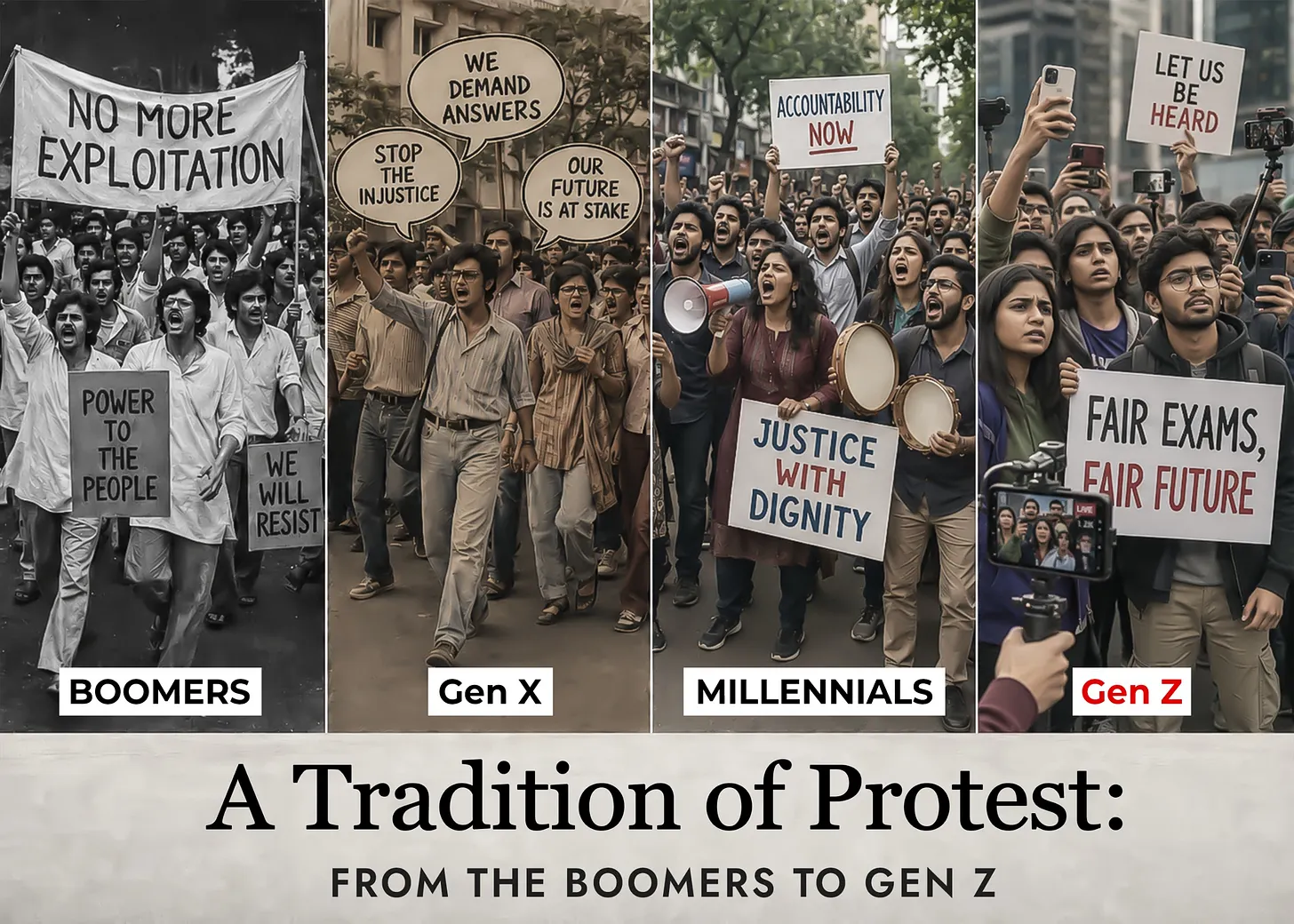
There are four generations we can reasonably examine. The Boomers, the Gen Xers (my own cohort), the Millennials, and Gen Z. Gen Alpha is still too young to be marching anywhere except to protest if their mother makes karela (bittergourd) for lunch; BTW, friendly piece of advice from me, eat the karela – I suffered a lot in trying to refuse it.
Let us take the 4 generations in turn, honestly, and see how the young of each generation actually conducted themselves.
I promise you, the comparison is not flattering to us older folk.
The Boomers: the generation of the armed rebellion
Let us begin with the Boomers, broadly those who were of college and young-adult age from the late 1960s through the early 1980s.
This generation drove the most violent phase of protests by college kids in the history of our Republic. Particularly, violent left-wing extremism.
Of course, we must be careful, because this is where lazy commentary goes wrong, and I want to be precise. The great tragedy of Left-wing extremism in India, Naxalism, began in 1967, in a village called Naxalbari in West Bengal, when the Boomers were young. That first spark was indeed lit in their time. And we should be accurate about the scale: the horrific peak of Naxalite violence, when it spread across what came to be called the “red corridor,” came decades later, in the 2000s, sustained by younger cadres who were not Boomers at all. By 2006, a Prime Minister as sober as Dr. Manmohan Singh would call it the single greatest internal security threat the country had ever faced. At its height it touched a third of India’s districts. Tens of thousands died over the decades; hundreds of thousands were displaced.
So I will not commit the error of blaming one generation for the whole bloody arc of Naxalism, which is a multi-generational tragedy. But I will say this plainly: the ideological seed of full-blown armed rebellion against the Indian State, the fantasy that the barrel of a gun could deliver justice, was substantially a product of the radical politics of that Boomer-era youth. And you simply cannot get more unconstitutional than picking up a rifle and declaring war on your own republic. Whatever one thinks of today’s students, they are not remotely in this territory. Not even close.
But it was not only the far Left. This was also the era of the JP Movement of the mid-1970s, of student agitations in Bihar and Gujarat, and of the great churn that ultimately collided with the Emergency. Some of the protests were noble; the resistance to the Emergency was genuinely heroic. But a great deal of that period was marked by a level of disorder, street power, and armed rebellion against the Indian State that makes the present moment look positively mild.
The Gen Xers: my own generation, and we were no angels.
Now to my own cohort, the Gen Xers, of college age from roughly the mid-1980s to 2000.
Were there protests? Were there violent ones? Oh yes. Maybe not as violent as our Boomer predecessors, but the Gen Xers did get violent too. Let me list a few, and I will not spare my own generation.
There was the Mandal agitation of 1990, when the implementation of OBC reservations brought upper-caste students onto the streets in fury. The defining, tragic image of that time was a young man named Rajeev Goswami, a Delhi University student who set himself on fire in September 1990. He survived, terribly burned, and died years later in 2004, having never fully recovered. His act triggered a wave of copycat self-immolation attempts; by many accounts more than 150 young people attempted it, and dozens died of their burns. Note the awful particularity of this specific agitation: these young protestors turned the violence inward, upon themselves. It was desperate and it was tragic, but they were not trying to kill others.
There were also agitations by landed peasant castes (in effect, small zamindars) seeking inclusion in OBC lists. There were the great religious mobilizations, on one side supporting the Ram Janmabhoomi movement and on the other opposing reforms in personal laws to give Muslim women increased rights, each of which brought enormous, sometimes volatile crowds into the streets. There was the Assam Movement, which I will come back to, because it holds a lesson.
And then there were the two that turned genuinely, horrifically violent: the Khalistan movement in Punjab and the insurgency in Kashmir. The Khalistani terror killed thousands of Hindus and also thousands of Sikhs who refused to support the separatists, besides, of course, the many who died in the battles between the security personnel and militants. The Kashmiri terror killed tens of thousands over the years, Kashmiri Muslims and security personnel alike, and produced one of the great unhealed wounds of our republic, the ethnic cleansing of the Kashmiri Pandit community from their ancestral homeland.
Now, I must add an honest and important caveat here. Both the Khalistan and Kashmir insurgencies were substantially armed, funded, and fuelled by Pakistan. They were not simply “Gen X protests gone wrong.” They were, in significant part, a hostile neighbor weaponizing internal grievances. So it would be unfair to lay them purely at the door of my generation. But it would also be dishonest to pretend the young Gen Xers of that era were paragons of constitutional restraint. We were not. A great many of that period’s actions were far more unconstitutional and vastly more violent than anything today’s students have done.
So, fellow Gen Xers, now clutching our pearls at Gen Z: a little humility, please. We were louder, angrier, and bloodier than these kids.
The Millennials: the gentle generation
Then came the Millennials, of college age roughly from 2000 to the mid-2010s.
They are, in many ways, the sweetest of the four. They were mocked, a little unkindly, as “snowflakes,” for their earnestness, their political correctness, and their determination to be sensitive to everyone. But look at how they protested too. The great anti-corruption movement of 2011, led by the elderly Gandhian Anna Hazare, was built explicitly on hunger strikes and mass peaceful gatherings, self-consciously modelled on the freedom struggle. It was messy and imperfect, but it eventually helped produce changes and reforms to reduce corruption to some extent (nothing is ever perfect, but we cannot deny that some victories have been achieved in the battle against corruption). The other defining mobilization of that generation was the outpouring after the horrific Nirbhaya gang rape in Delhi in December 2012, when thousands of young people flooded India Gate demanding safety and dignity for women. That, too, produced real legislative change.
Yes, the police used water cannons and tear gas on occasion, and yes, there were ugly moments. India always has some agitation simmering somewhere; we are, let us admit it, a gloriously argumentative civilization. But the Millennials, for the most part, stayed within constitutional lines. Perhaps they had learned, consciously or not, from the terrible price the Boomers and Gen Xers had paid for going the other way.
And finally, Gen Z
Which brings us, at last, to Gen Z, who began entering their protesting years in the mid-2010s and whose examination agitation may well be the first genuinely large, student-led movement of their generation.
So how do they measure up? Looking at the conduct of the generations before them, they come off remarkably well. Compared to the Boomers, with their flirtation with armed leftist revolution, and compared to the Gen Xers, with our immolations and insurgencies, this generation is far less violent and far more within constitutional norms. There have been clashes and injuries on both sides, some stone-throwing, and some genuinely regrettable language. But there has been no armed uprising. No insurgency. No secessionist demand. No campaign of terror. A crowd of frightened, angry students demanding that their examinations be conducted honestly is simply not the same thing as an armed rebellion, and we do them a real injustice by pretending otherwise.
Were they perfect? Of course not. They are young. The very nature of that age, the surging hormones, and the need for speedy and immediate change make them volatile and emotional. But volatile is not the same as violent. And emotional is not the same as unconstitutional. I said as much in my earlier piece, recalling the wisdom of my late brother-in-law, the police officer Himanshu Roy, who had told me that student crowds must be handled with more care than any other, precisely because of their age.
So where, then, does all this talk of Gen Z being uniquely terrible come from?
I have a few theories.
Theory one: they are simply the first generation to be filmed
Here is what I think is the single most important, and most overlooked, point in this entire debate.
When the Boomers and the Gen Xers were young and doing genuinely wild things, there were no smartphones. There was no camera in every pocket. There was no social media on which a moment of stupidity could be flung across the country in ninety seconds. Our fist-fights, our foul mouths, and our idiocies, and I assure you there were many, are buried in time. There are no records of it anywhere. Nothing to embarrass us. They survive only in fading memories, and as the memories fade with age, so do the sins.
But every silly thing a Gen Z kid does is filmed. Often by their own friends. And then shared, and re-shared, and clipped, and captioned, and turned into a national talking point within a few hours. It genuinely does not matter that their cuss words may be milder than the ones my generation flung about with abandon. What matters is that theirs are recorded and distributed, and ours were not.
Now I know, many people tend to think that publicity of any kind is good. In fact, there is also a Sanskrit shloka about this:
घटं भिन्द्यात् पटं छिन्द्यात् कुर्यात् रासभरोहणम् ।
येन केन प्रकरेण प्रसिद्धः पुरुषो भवेत् ॥
For those who don’t know, this line is from a traditional genre of Sanskrit literature known as a Subhashita. Basically, it is about seeking fame through any means possible, even ridiculous and destructive ones. This approach might work in the Film industry or even in the world of Influencers, but outside of such worlds, this approach is really harmful for you personally over the long term. Short-term fame and a few thousand likes might sound exciting right now, but its long-term repercussions are often unforgiving. Even among Film actors & Influencers, there are just a handful out of tens of thousands who get popularity through such ways and actually make money. The vast majority face trolling and failure for the rest of their lives.
Remember, the internet never forgets.
This is not a small point. It is, I think, the whole point. We are not watching a more badly behaved generation. We are watching the first generation whose ordinary, age-appropriate misbehavior is captured in high definition and broadcast to millions.
The behavior is not worse. But the visibility is total.
Which leads me to my first, gentle piece of advice for these young Gen Z, and it applies far beyond protests. In a world where everything is filmed, you must be more careful than we older people ever had to be. Not because you are worse, but because the consequences of any lapse are permanently, publicly, and searchably worse. This is true at a protest. It is equally true in private life. Do not, for instance, allow yourself to be filmed doing something foolish because a boyfriend or girlfriend pressured you into it. When things go wrong, and the clip escapes, the price you pay can be brutal and lifelong. The camera does not forgive, and, I will repeat, the internet does not forget.
Theory two: outrage is now an industry.
The second reason Gen Z looks worse than it is: outrage has become profitable. A single provocative clip, stripped of context, generates clicks, follows, and revenue for whoever posts it, and for the armies of commentators who then perform their fury over it. The incentive structure of our entire social media ecosystem rewards the most inflammatory three seconds of a three-hour event. A generation that is, on the whole, protesting a genuine grievance in a largely restrained way gets represented to the nation by its five worst moments, because those five moments are the ones that pay some influencer.
None of this is Gen Z’s fault. But it is Gen Z’s problem. Which brings me to the advice I most want them to hear.
Now, some hard truths for the young
I have defended you, and I meant every word of it. But I am fond enough of you to also tell you some things you may not want to hear.
First: the Indian State looks soft, but it is not. This is the lesson written in the blood of the Boomers and the Gen Xers, and I beg you to learn it from their experience rather than repeating it. Our State can appear soft, accommodating, and even yielding at first. But when it concludes that its core authority is being challenged by unconstitutional force, it becomes very hard indeed. The Naxalite movement was ground down over decades. Brutally. The Khalistan insurgency was crushed. The Kashmir militancy was met with overwhelming force. And if you want the starkest example of all: in 1966 (some 60 years ago), the Indian State used its own air force to bomb Aizawl, in Mizoram, the only time in our history the air force has been used on our own civilian territory, when a movement there turned secessionist. I do not raise this to frighten you, and I want to be scrupulously clear: I am not saying anyone will be bombed, and nothing today is remotely in that category. I raise it to make a single point about the nature of our Indian State. This is not a feature of the present government. It has been true of the Indian State under every government since 1947: Congress, BJP, Janata Party, and others alike. Push the Indian State through constitutional means, and it can be remarkably responsive. Often, it is so responsive that the impression goes out that the Indian State is soft. But, if you push it through the “grammar of anarchy,” to use Dr. Ambedkar’s phrase, it will not end well for you. Once again, this is not a feature of any political party. This is a feature of the Indian State itself.
The romance of violent revolution is a trap. The people who glorify it are, almost always, not the ones who pay for it. Don’t become the cannon fodder for someone else.
Second, and following directly from that: beware those who would use your struggle for their own ends. This is the hardest thing I have to say, and I say it because it is the truest.
There is a certain kind of older person, and they exist across the political spectrum, who looks at a movement of passionate young people and sees not a cause to be helped but an instrument to be played. Some are entertainers or commentators who will amplify your protest and your suffering to burnish their own credentials and to build their own brand and, frankly, income. They will call your agitation the glorious rebirth of Indian democracy, which is nonsense, incidentally: India remains the one genuine, functioning democracy in our entire neighborhood, where power actually changes hands peacefully through the ballot, an achievement rarer than we admit and one for which we should credit our politicians across party lines. These cheerleaders do not benefit you. You benefit them.
And there is another kind, the veteran activist for whom protest is a permanent way of life, who will tell you that India’s problems will now be solved in the streets and not in Parliament or the courts. This is not merely wrong. It is dangerous. It is, in fact, the exact philosophy that gave us the disasters I catalogued above. The person who tells you the street is mightier than the ballot is inviting you to relive someone else’s failed revolution, at your expense, not theirs. When the FIRs are filed and the police verifications come around and the careers are quietly foreclosed, the movement’s leaders will have moved on to their next cause, and you will be alone with the consequences. I made this point in my last article with the sad case of a young activist in America, and I will not labor it. When Rajeev Goswami attempted self-immolation, he did not do it only for himself. He did it for many others like him. But when he passed away in 2004, the ones who had supported him during the agitation were not with him in his last moments. Other than his family, he was all alone. So please: do not let anyone spend your future to fund their fantasy.
Third: stay ruthlessly focused on what you actually want. And what you want is clear and entirely reasonable: an examination system that is honest and humane, and a job market that gives you a fair chance at a decent life. That is it. That is the prize. Everything that distracts from that prize, every viral insult, every escalation, every march that turns into a melee, every encouragement to violence, every seductive invitation to become a symbol in someone else’s grand narrative, moves you away from what you actually need.
And here is the good news: the focused, constitutional approach works. I know the cynics say otherwise, but look at the record. Under the pressure you have applied, a strict new anti-leak law has been passed, with serious jail time and heavy fines for those who cheat our children. A high-quality expert committee has been set up to overhaul the examination system. The government has moved to computer-based testing and has opened talks with students. A nationwide free online coaching ecosystem has been announced to help poor and middle-class students prepare for competitive exams without the financial burden of private coaching institutes. These are not nothing. These are the fruits of constitutional pressure, of you being loud and organized and lawful. Keep that pressure up. Keep watching the government so it does not get distracted or complacent. Send in your ideas, and I repeat my promise from last time to compile the best of them and carry them to the relevant ministry. That is how you win. Not by outshouting your opponents, but by outlasting them, within the rules, until they have no honorable choice but to fix what is broken.
The lesson the Assam students can teach you
Let me end with a story of a protest that actually worked, because I think it is the most useful thing I can leave you with.
In 1979, the students of Assam launched a mass movement over illegal immigration from Bangladesh. It ran for six long, painful years. There was real hardship and real tragedy; officially, 855 people are remembered as martyrs of that agitation. It was not perfect, and it was not always peaceful. But here is how it ended. In 1985, the student leaders sat across a table from the Government of India and signed the Assam Accord. And then, crucially, they did the most constitutional thing imaginable: they turned their movement into a political party, contested an election, and won. Their thirty-two-year-old student leader became the Chief Minister of the state.
That is the arc I want for you. Not the arc of the Boomer who took up a gun and spent his life in the forest, achieving nothing but ruin. Not the arc of the desperate young Gen Xer who set himself alight. But the arc of the Assam students, who took their genuine grievance, held their discipline, worked the system, and converted their protest into real, lasting, democratic power. And through that, it effected real change.
You Gen Zers are, as I keep insisting to anyone who will listen, not un-Indian or uniquely unruly. You are, in truth, gentler than the generations that came before you (outside of the Millennials, of course!), and you are braver than the cynics who mock you from the sidelines. You have a real grievance and every right to raise it.
So raise it. Loudly, passionately, and lawfully. Stay focused on the prize. Trust the ballot more than the barricade. And do not let the uncles of the Left or the Right spend your precious youth on their old, failed dreams.
You are our children. You are our future. And I, for one, have a great deal of faith in you.
All the very best in your protests. May you achieve everything you deserve. And may you achieve it wisely.