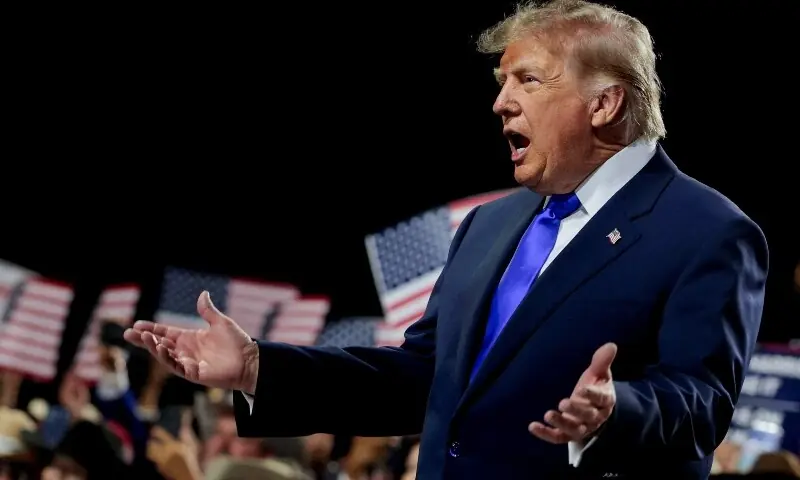

US President Donald Trump has promised a $5,000 “Trump dividend” to every American adult if Republicans retain control of Congress in November’s midterm elections, placing himself at the centre of his party’s campaign as it faces a difficult electoral contest.
Trump announced the proposal on Wednesday during the Republican Party’s first midterm convention in Dallas. He did not explain how the payments would be financed, implemented or legally authorised. With roughly 270 million adults in the United States, the plan could cost about $1.35 trillion.
During an hour-long primetime address, Trump described the first two years of his current presidency as “the greatest two years in the history of the presidency” and urged voters to treat the congressional elections as a referendum on his leadership.
“I’m asking you to pretend that I’m on the ballot,” he told supporters.
The strategy carries considerable political risk. Opinion polls indicate that Trump’s approval ratings have fallen significantly, while swing voters have shown growing concern over the cost of living and the continuing US war with Iran. Democrats also appear more motivated to vote as Republicans face the possibility of losing control of at least one chamber of Congress.
Trump nevertheless presented a Republican victory as essential to the country’s future, warning that Democratic control would reverse his administration’s policies. He also promised to campaign extensively in battleground states and congressional districts during the final eight weeks before the November 3 election.
The two-day Dallas convention underlined how closely Republican electoral prospects remain tied to Trump. Republican National Committee Chairman Joe Gruters informally described the gathering as “Trumpapalooza”, reflecting the event’s overwhelming focus on the president.
That dependence creates a dilemma for Republican candidates in competitive races. Some need to appeal to moderate and independent voters while also avoiding any confrontation with Trump’s loyal political base. Several Republicans facing strong Democratic challengers, including Representative Tom Barrett and Senators Dan Sullivan and Susan Collins, stayed away from the convention.
Others embraced the event. At least 16 candidates involved in competitive House and Senate contests were scheduled to speak. They included Texas Attorney General Ken Paxton, who is facing Democrat James Talarico in a closely contested Senate race, and Ohio Senator Jon Husted, who is running against former senator Sherrod Brown.
Despite Trump’s assertion that the 21,000-seat venue was “packed”, large sections of the upper seating area reportedly remained empty during his address.
Much of the convention focused on portraying Democrats as ideologically extreme. Republican speakers repeatedly attacked them over border security, transgender participation in women’s sports and other culturally divisive issues, with several describing Democrats as “socialists” or “communists”.
However, two issues consistently identified by voters as major concerns — the cost of living and the war with Iran — received comparatively less attention.
Trump defended his decision to attack Iran, arguing that military action was necessary to prevent Tehran from developing a nuclear weapon. He also predicted that oil prices would fall sharply once the United States won the war, which he said would happen soon.
The conflict, however, has continued for more than six months since the United States and Israel launched strikes against Iran. Analysts maintain that Iran’s nuclear programme has not been eliminated, while Tehran continues to deny that it is seeking nuclear weapons.
Some Republicans have acknowledged public unease over the conflict. Alabama state Representative Ernie Yarbrough said voters needed greater clarity about Washington’s objectives and how long the war might continue, reflecting concerns that the United States could become trapped in another prolonged conflict.
The convention also highlighted divisions within the Democratic Party. Democratic Senator John Fetterman made an unusual appearance through a prerecorded video introducing Republican Pennsylvania Senator Dave McCormick, whom he called his “great friend”. Fetterman also pledged to work with Trump to protect Pennsylvania’s steel industry. His participation came amid continuing disagreements between him and the Democratic Party’s progressive wing, although he has denied suggestions that he intends to leave the party.
With less than two months remaining before the elections, the political stakes are high. Republicans are attempting to energise a voter base that polling suggests is currently less enthusiastic about turning out than Democratic voters, while Democrats are seeking to capitalise on dissatisfaction over inflation, the Iran conflict and Trump’s declining approval ratings.
Trump’s $5,000 proposal now adds a dramatic economic promise to that campaign. But with no details yet provided on its financing, legal basis or implementation, the “Trump dividend” remains as much a political pledge as an economic policy.