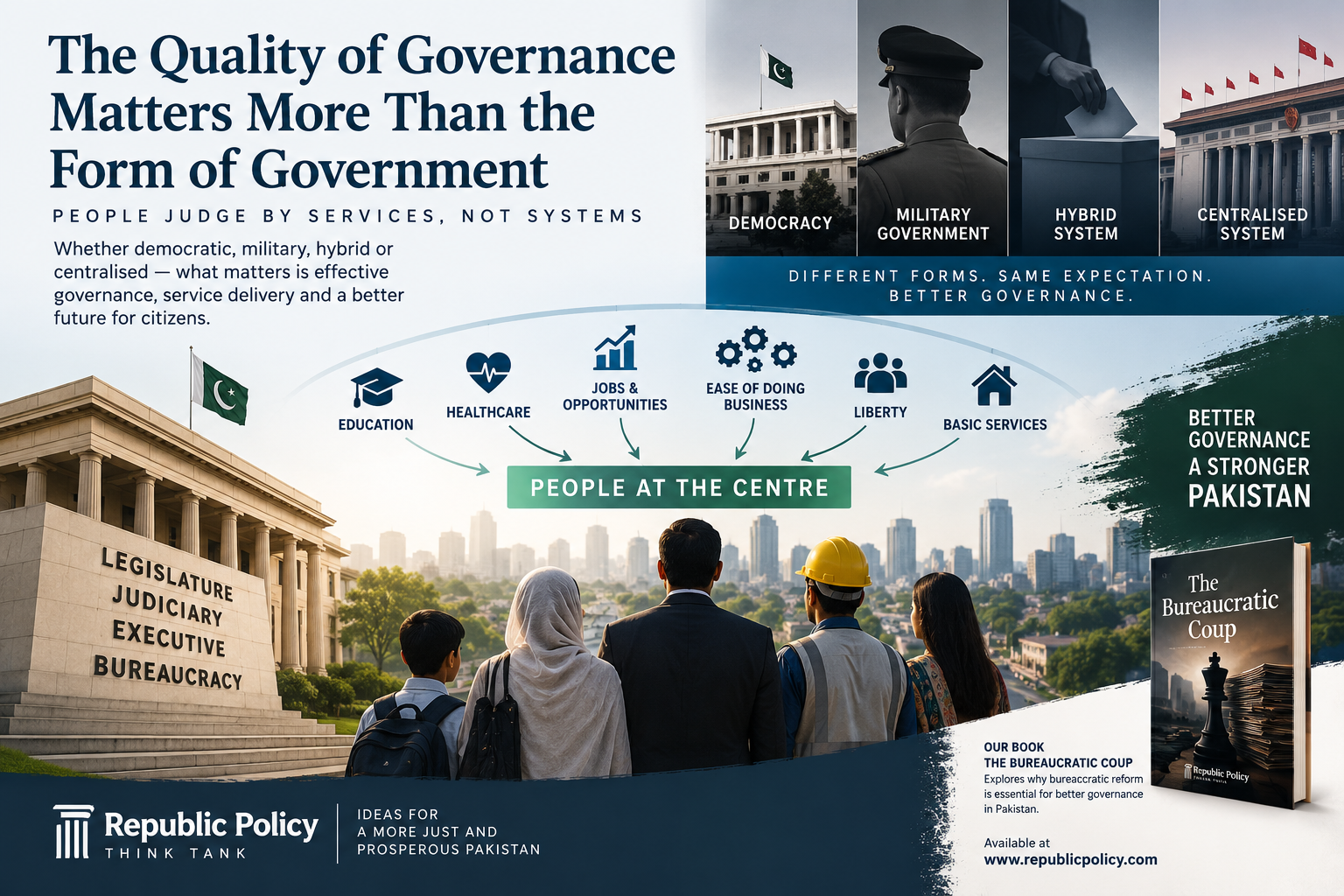

Pakistan’s governance crisis is not a mystery. Its roots are visible, its causes well-documented, and its consequences felt by every citizen who has ever stood at the counter of a government office, waited years for justice, or watched public funds disappear without accountability. What remains missing is not diagnosis but remedy. The Bureaucratic Coup, published by Republic Policy Think Tank, offers precisely that: a serious, structured argument for civil service reform built on five foundational principles that together can transform the way this state operates.
A recent discussion between Republic Policy and its Readers Club, centred on this book, produced a focused and important conversation. The participants examined the core argument of the work: that Pakistan’s governance failure is structural, not incidental, and that sustainable solutions require dismantling and rebuilding the civil service architecture from the ground up. Five principles emerged from that conversation as essential to any meaningful reform.
The first is constitutional alignment. Pakistan’s civil services at the federal, provincial, local, and other tiers must be brought into genuine constitutional harmony with the level of government they serve. At present, federal services occupy provincial space in a manner that the 1973 Constitution neither intended nor permits. The result is a bureaucratic structure that violates the federal character of the state and leaves provincial governments administratively dependent on a cadre that owes its loyalty, career prospects, and institutional identity to the centre. Constitutional alignment means each tier of government is served by a civil service that belongs to it, answers to it, and is accountable within its jurisdiction.
The second principle is structural alignment. Civil services must be structurally integrated with the political executive and legislature they are meant to serve. Governance requires a working relationship between elected authority and administrative capacity. Where that relationship is absent or adversarial, policy either stalls or is captured by bureaucratic interests. A civil service that operates as a parallel power centre rather than a responsive instrument of government produces exactly the kind of unaccountable, self-perpetuating administration that Pakistan has long endured.
The third principle addresses one of the most stubborn features of the inherited colonial system: the generalist cadre. Pakistan continues to staff its most technical and specialised functions with officers trained in nothing particular and considered competent in everything. The result is predictable. Health policy is managed by administrators with no background in health. Education reform is driven by generalists with no knowledge of pedagogy. Infrastructure projects are supervised by officers who rotate before completion. Replacing generalist cadres with specialised ones is not a bureaucratic preference. It is a basic condition for professional governance. State functions must be handled by people who know their field, have built expertise over time, and are evaluated on the basis of that expertise.
The fourth principle calls for comprehensive legal and structural reform of the civil service framework itself. The laws, rules, regulations, and service structures that currently govern Pakistan’s bureaucracy are colonial in origin, selective in application, and resistant to accountability. They protect tenure without demanding performance, reward seniority without measuring contribution, and make it nearly impossible to remove incompetence or promote genuine talent. Reform at this level is difficult precisely because those who administer the system also benefit from its current design. But without legislative and regulatory overhaul, all other changes remain cosmetic.
The fifth principle concerns terms and conditions of service. How a civil servant is recruited, assessed, promoted, and retained determines what kind of institution the civil service becomes over time. If recruitment rewards rote memorisation, if promotion is tied to seniority rather than performance, and if professional growth is a function of political access rather than merit, the system will consistently produce mediocrity and compliance rather than competence and initiative. Terms and conditions must be restructured so that competition, performance, and professional development become the actual operating logic of the service, not aspirational phrases in reform documents.
These five principles are not isolated prescriptions. They form a coherent architecture. Constitutional alignment establishes the rightful jurisdiction of each civil service tier. Structural alignment connects the bureaucracy to democratic authority. Specialisation ensures that governance is carried out by qualified professionals. Legal reform removes the institutional barriers to accountability. And reformed terms of service create the incentive environment in which capable people can thrive and poor performers cannot hide.
The author’s conclusion is direct. Pakistan’s governance crisis will not be resolved through anti-corruption drives, digital portals, or periodic reshuffles. It will be resolved when the civil service itself is reformed at the root. The Bureaucratic Coup makes this case with evidence, constitutional grounding, and a clarity that the reform debate in this country has long needed. The book is available at leading bookstores across Pakistan. For home delivery, contact 0301-4243788.
#CivilServiceReforms #Governance #Pakistan #PublicPolicy #TheBureaucraticCoup