
Editorial
Republic Policy, as a think tank, does not study governance and public policy in isolation. Governance does not operate independently of the society in which it exists. It is shaped by culture, history, social behaviour, institutional traditions and the evolution of society itself. Therefore, understanding governance requires more than studying constitutions, laws, institutions and administrative rules; it also requires understanding the people and social values that give those institutions practical meaning.
Societies evolve. The transition from pre-modern to modern societies changes not only political and economic institutions but also social expectations, individual behaviour and relationships with authority. Systems such as monarchy, bureaucracy, democracy and modern public administration cannot be fully understood without examining the cultural and historical environments in which they developed.
Republic Policy therefore considers governance a composite system rather than a rigid collection of rules and institutions. Laws may establish formal structures, but culture significantly influences how those structures actually function. The same administrative system can produce different outcomes in different societies because institutions ultimately operate through human beings who carry the values, expectations and habits of their societies into public institutions.
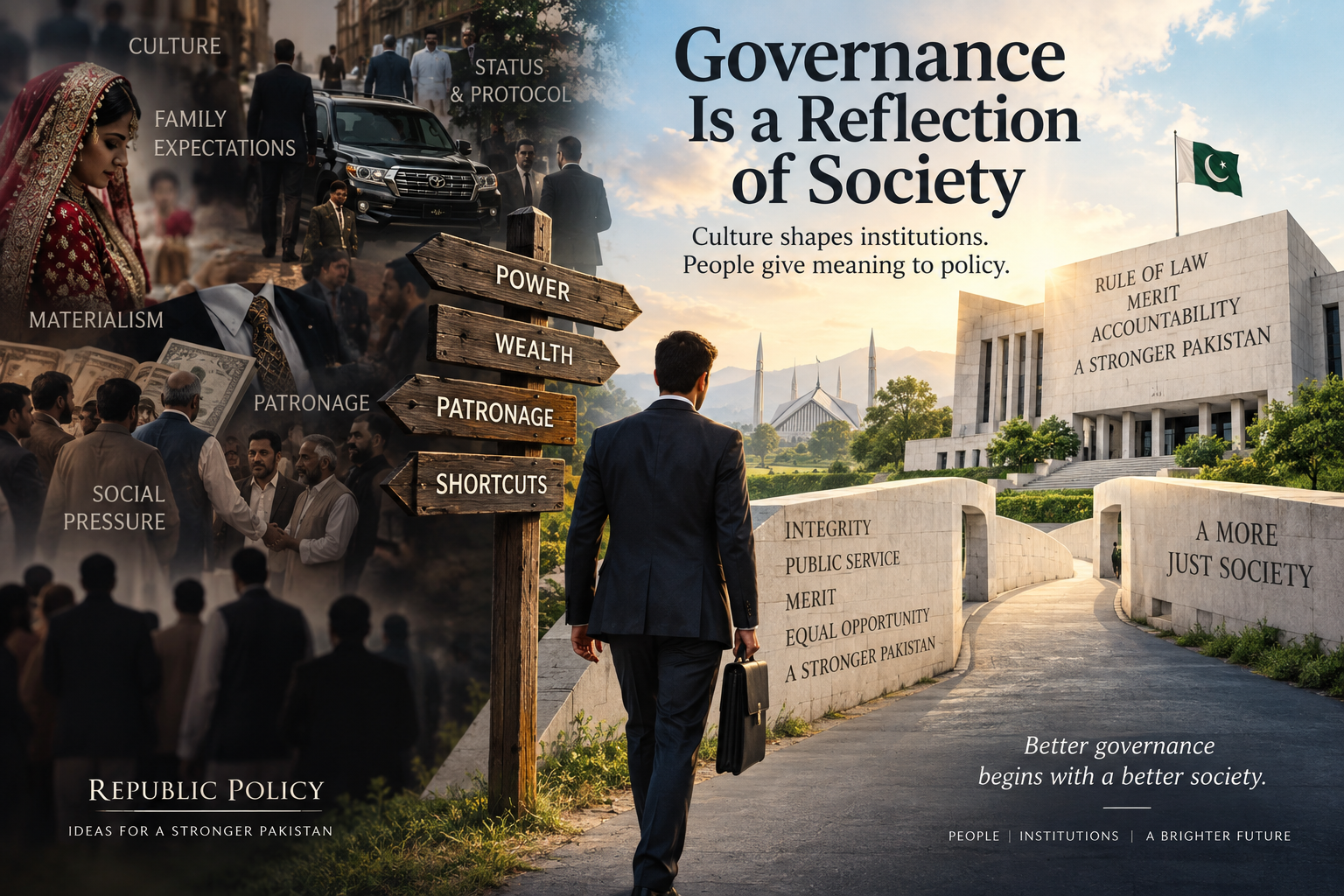
Pakistan provides an important example. Pakistani society has traditionally attached considerable importance to power, status and protocol. Public authority is often valued not merely for the responsibility attached to it but also for the social prestige it provides. The display of power—official vehicles, protocol, influence, access and connections—can become a symbol of personal success. Alongside this attraction to power, material wealth and expensive lifestyles have increasingly become important measures of social status.
These social attitudes inevitably influence public institutions because civil servants do not exist outside society. They come from the same families, communities and social environments as everyone else. When they enter government service, they do not suddenly become detached from the expectations and values surrounding them.
If society celebrates power, patronage, connections and material success, public officials will also experience pressure to demonstrate these qualities. Families, relatives, friends and social networks may expect a civil servant to exercise influence, secure favours, provide access to government institutions or maintain a lifestyle associated with official status. In such circumstances, the distinction between an individual official’s conduct and the wider culture surrounding that official becomes important.
Marriage and family expectations provide a useful illustration. Consider a young civil servant beginning a career in Grade 17. The official may have a legitimate salary and clearly defined financial means, yet family or marital expectations may demand an expensive lifestyle, prestigious housing, costly clothing, vehicles, social status and visible displays of authority that exceed those means. The question then becomes not only whether the individual possesses personal integrity, but also what kinds of incentives and pressures society is creating around that individual.
This relationship can be understood, with appropriate caution, through the economic concept of supply and demand. Social behaviour is not identical to an economic market, but social demand can nevertheless create incentives. If influence, patronage, extraordinary wealth and the misuse of authority are socially rewarded, incentives emerge for officials to supply them. Conversely, if professional competence, integrity, modest living, merit and public service receive greater social recognition, officials face a different set of incentives.
This does not excuse corruption or remove individual responsibility. A civil servant remains responsible for acting within the law and observing professional and ethical standards. However, an effective analysis of corruption must go beyond individual wrongdoing and examine the environment in which such behaviour develops. If society consistently expects public officials to maintain lifestyles beyond their legitimate means or to use public authority for private and familial benefit, administrative reform becomes considerably more difficult.
For this reason, civil service reform cannot be separated entirely from social reform. Improving recruitment procedures, promotion systems, accountability mechanisms and administrative rules is essential, but these measures alone may not transform governance if the surrounding culture continues to reward patronage, excessive displays of status and access to power over merit.
The state itself also carries substantial responsibility. Culture influences institutions, but institutions can equally shape culture. Governments establish rules, determine incentives and communicate through their policies what forms of behaviour are acceptable. A capable state should therefore build institutions that reward professionalism and make corruption, patronage and misuse of authority both difficult and costly.
Pakistan’s political culture has frequently reinforced patronage through highly visible projects, personalisation of public programmes and the distribution of public benefits in ways that can be associated with political personalities. When citizens begin to perceive public resources as favours delivered by powerful individuals rather than as rights administered through impartial institutions, patronage becomes embedded more deeply in the relationship between society and the state.
Governance reform must therefore operate in both directions. Society must reconsider the values it attaches to wealth, protocol, influence and public office, while the state must create institutions that promote merit, professionalism, transparency and equal treatment. Neither institutional reform without cultural change nor cultural change without institutional reform is likely to be sufficient.
The broader lesson is that governance is ultimately a relationship between the state, institutions and society. Bureaucracies reflect social values, but they also influence those values. Political institutions respond to public expectations, but they can also reshape them. Culture affects governance, while governance gradually transforms culture.
Therefore, the quality of governance cannot be understood merely by reading laws or examining organizational charts. To understand why institutions behave as they do, we must also understand the society in which they operate. If Pakistan wants to reform its governance, it must reform institutions and incentives while simultaneously confronting the social culture that surrounds power, patronage, wealth and public office.