
Republic Policy | Economy and Energy Affairs | October 29, 2026
ISLAMABAD: The federal government has increased petrol and high-speed diesel prices by Rs1.85 and Rs1.75 per litre, respectively, pushing diesel close to the Rs400 mark and adding to the financial burden on households, transport operators and businesses already struggling with elevated energy costs.
According to a notification issued by the Petroleum Division on Wednesday, the revised prices take effect on Thursday, October 29, 2026.
Revised fuel prices — October 29, 2026
Petrol
Rs377.91
Rs1.85 per litre
High-speed diesel
Rs399.82
Rs1.75 per litre
Taxes and duties per litre: Rs114 on petrol and Rs100 on diesel, according to the reported government figures.
The latest adjustment comes amid continued uncertainty in international energy markets following the conflict involving the United States and Iran, which has disrupted global oil supplies and contributed to substantial fluctuations in domestic petroleum prices.
Petroleum Taxes Remain a Major Concern
Despite the relatively modest increase in the latest revision, the government’s taxation policy remains a central issue in the debate over fuel affordability.
Federal taxes and duties currently amount to Rs114 per litre on petrol and Rs100 per litre on high-speed diesel.
These charges represent a substantial component of retail fuel prices and provide an important source of government revenue.
However, their continuation has generated political criticism, particularly as consumers face persistent economic pressures and high transportation costs.
On Tuesday, Jamaat-e-Islami chief Hafiz Naeemur Rehman met Prime Minister Shehbaz Sharif in Islamabad to discuss his party’s demand for the abolition of the petroleum levy.
The government and Jamaat-e-Islami agreed to establish a joint committee to examine possible expansion of the existing fuel relief programme.
The scheme, introduced in September, provides targeted assistance to owners of motorcycles, rickshaws and vehicles with engine capacities of up to 800 cubic centimetres.
Hafiz Naeemur Rehman has warned that his party will organise a protest march towards Islamabad in mid-November if the government fails to announce substantial relief.
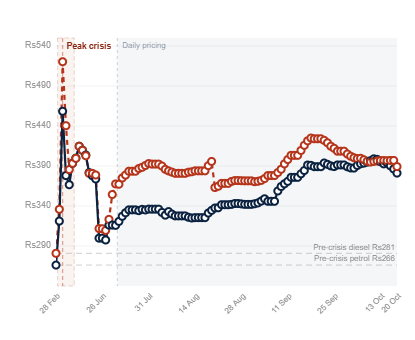
Fuel Prices Remain Far Above Pre-War Levels
Although petrol and diesel prices have declined considerably from their April peaks, they remain substantially higher than levels recorded before the escalation of hostilities in the Middle East.
High-speed diesel reached Rs520.35 per litre on April 3, after rising from approximately Rs281 per litre before the conflict began on February 28.
Petrol similarly increased from around Rs266 per litre in early March to a peak of Rs458.41 on April 3.
Fuel prices before the conflict, at April peaks and on October 29
The latest prices therefore reflect a partial recovery from the most severe phase of the energy shock rather than a return to earlier affordability levels.
For consumers and businesses, the continuing difference between pre-war and current prices remains economically significant.
Government Expands Fuel Conservation Measures
The federal government has introduced several measures aimed at reducing petroleum consumption and managing the economic consequences of high international oil prices.
Under the revised austerity arrangements, markets are required to close by 9 p.m., while fuel allocations for official vehicles have been reduced by 50 per cent for three months.
The government has also introduced targeted relief initiatives for smaller vehicles and motorcycle users, recognising the disproportionate impact of fuel prices on lower-income households.
In July, Petroleum Minister Ali Pervaiz Malik announced that the government would move towards daily fuel-price adjustments in response to international market volatility.
The responsibility for determining daily prices was assigned to the Oil and Gas Regulatory Authority, based on prevailing international market conditions.
Previously, Pakistan had shifted to weekly price revisions in early March as the Middle East conflict intensified.
The more frequent pricing mechanism is intended to reflect international market developments more quickly, although it also exposes domestic consumers to repeated adjustments.
Concerns Over Petroleum Supply
Alongside high prices, questions have emerged about the continuity of petroleum supplies.
During a recent Senate discussion, lawmakers raised concerns about possible shortages in the coming months.
Minister of State for Finance and Revenue Bilal Azhar Kayani maintained that Pakistan was not facing petroleum supply disruptions.
The Pakistan Petroleum Dealers Association also urged consumers to avoid panic buying, warning that unnecessary stockpiling could create artificial market pressures and disrupt normal distribution.
These concerns demonstrate that energy security involves both the affordability of petroleum products and their uninterrupted availability.
Economic Consequences for Transport and Industry
Petrol and high-speed diesel have different but interconnected roles in Pakistan’s economy.
Petrol is predominantly consumed by motorcycles, rickshaws, smaller vehicles and private transport. Price increases therefore directly affect household mobility and the daily expenditure of middle- and lower-middle-income consumers.
Diesel is particularly important for heavy transport, freight operations, electricity generation and large industrial generators.
Higher diesel prices can increase the cost of transporting agricultural produce, manufactured goods and essential commodities, potentially adding to inflationary pressures across the economy.
Petrol and diesel are also the principal revenue-generating petroleum products, with monthly sales of approximately 700,000 to 800,000 tonnes, compared with around 10,000 tonnes of kerosene demand.
Consequently, changes in their prices influence government revenue, commercial activity and household purchasing power.
The Challenge of Balancing Revenue and Public Relief
The latest fuel-price revision highlights the continuing tension between fiscal requirements and consumer affordability.
Petroleum taxation provides revenue to the federal government, but high fuel prices also affect transport costs, industrial competitiveness and household consumption.
Targeted subsidies may offer temporary assistance to vulnerable consumers. However, their effectiveness depends on transparent eligibility arrangements, reliable implementation and adequate fiscal resources.
Pakistan’s longer-term energy challenge also involves reducing dependence on imported petroleum, improving public transport, strengthening energy efficiency and diversifying domestic energy sources.
The central policy question is not simply whether fuel prices should rise or fall with international markets, but how Pakistan can maintain fiscal stability while protecting consumers and reducing the economy’s exposure to recurring external energy shocks.
For now, diesel’s approach towards Rs400 per litre serves as another reminder that international energy volatility continues to shape Pakistan’s domestic economic conditions