
Republic Policy | International Relations and Regional Security | October 29, 2026
NEW YORK: The peaceful resolution of the Jammu and Kashmir dispute remains essential for lasting stability in South Asia, speakers at a seminar in New York have said, calling on the international community to support a settlement consistent with the aspirations of the Kashmiri people and relevant United Nations Security Council resolutions.
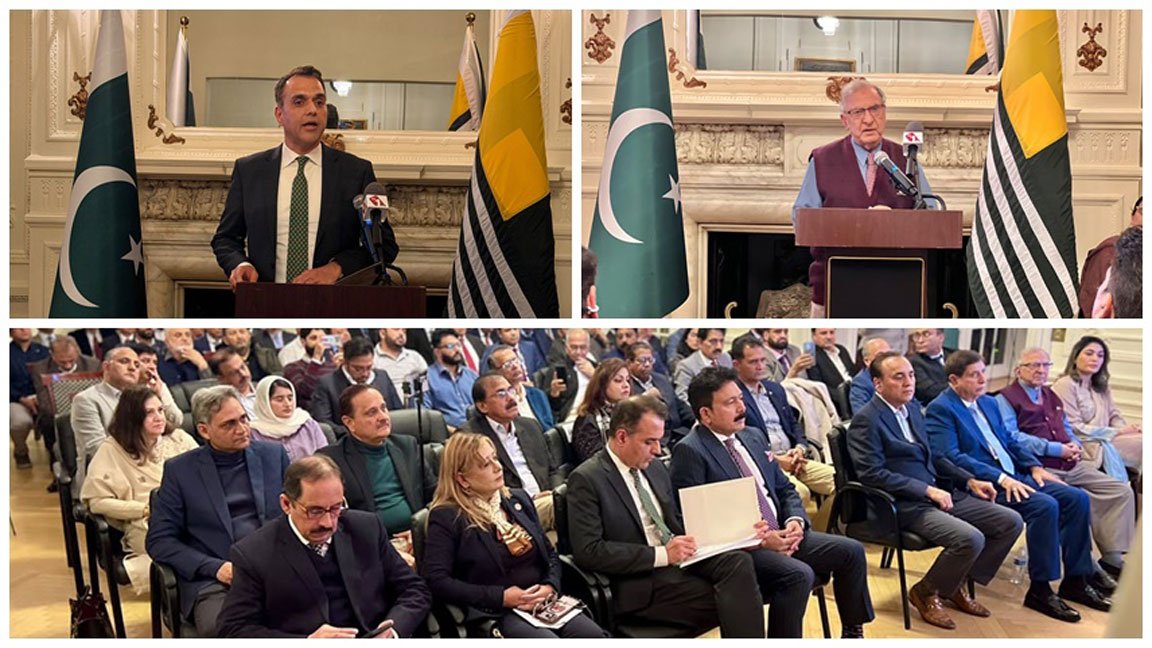
The seminar, organised jointly by Pakistan’s Permanent Mission to the United Nations and its Consulate General in New York, was held in connection with Kashmir Black Day.
Participants discussed the longstanding territorial dispute, the political rights of the Kashmiri people and the responsibilities of international institutions in promoting a peaceful settlement.
The gathering brought together diplomats, Kashmiri political representatives, human rights advocates, students and members of the Pakistani and Kashmiri communities living abroad.
Speakers Emphasise Kashmiri Right to Self-Determination
Addressing the seminar, speakers paid tribute to Kashmiris who, they said, have endured decades of political repression and restrictions under Indian administration.
They characterised the Kashmiri struggle as a demand for justice, human dignity and the right to self-determination.
Participants maintained that the dispute cannot be resolved sustainably without addressing the political aspirations of the people directly affected by it.
They also stressed that the Kashmir issue extends beyond the bilateral relationship between Pakistan and India because it involves questions of international commitments, territorial sovereignty and political representation.
According to the speakers, the continued absence of a mutually acceptable settlement has contributed to longstanding tensions between the two nuclear-armed South Asian neighbours.
Their statements reflected Pakistan’s established diplomatic position on Jammu and Kashmir.
India, by contrast, maintains that Jammu and Kashmir is an integral part of its territory and has consistently opposed international intervention in matters it considers internal or bilateral.
These competing positions remain central to the diplomatic deadlock surrounding the dispute.
United Nations Resolutions Remain Central to Pakistan’s Position
A major focus of the discussion was the role of the United Nations and the Security Council resolutions adopted in the early years of the Kashmir dispute.
Speakers argued that these resolutions remain relevant to determining the territory’s political future and establishing a peaceful settlement.
They referred particularly to the principle that the people of Jammu and Kashmir should be able to express their political preferences through a free and impartial plebiscite.
The historical United Nations framework envisaged a plebiscite subject to specified conditions, including arrangements concerning security and demilitarisation. Those conditions were never fully implemented, and the parties continue to disagree over the resolutions’ interpretation and present applicability.
Participants urged the United Nations to uphold the principles of its Charter and give greater attention to the unresolved dispute.
The discussion highlighted the continuing difference between Pakistan’s emphasis on international resolutions and India’s preference for addressing outstanding matters through bilateral arrangements.
Pakistani Diplomats and Kashmiri Representatives Address Gathering
Acting Permanent Representative of Pakistan to the United Nations Usman Jadoon addressed the seminar alongside Pakistan’s Consul General in New York, Aamer Ahmed Atozai.
Dr Ghulam Nabi Fai, Secretary General of the Kashmir Awareness Forum, also participated as a speaker.
The event provided an opportunity for diplomatic representatives, civil society participants and members of the Kashmiri diaspora to discuss the dispute’s political and humanitarian dimensions.
The participation of overseas Pakistani and Kashmiri communities demonstrated the continued importance of diaspora engagement in raising awareness of the issue internationally.
Such gatherings also provide platforms for presenting political concerns to international audiences and encouraging discussion of possible diplomatic approaches.
Kashmir and Regional Security
The Kashmir dispute has remained a major source of tension between Pakistan and India since the partition of British India in 1947.
The two countries have fought wars and experienced repeated military confrontations, while the Line of Control continues to divide the territory administered by Pakistan and India.
The dispute has implications for regional security, diplomatic relations and the welfare of communities living in affected areas.
For Pakistan, Kashmir remains a central foreign-policy concern. Islamabad has consistently advocated a settlement based on the wishes of the Kashmiri people and relevant United Nations resolutions.
India maintains a different constitutional and territorial position and argues that outstanding issues should be addressed without external intervention.
The competing approaches have complicated efforts to establish a mutually accepted framework for negotiations.
The humanitarian dimension is equally significant. Questions involving civilian security, political participation, fundamental freedoms and economic opportunities continue to influence international discussion of the territory.
Diplomatic Engagement and the Prospects for Peace
The New York seminar underscored the continuing importance of diplomatic engagement in addressing one of South Asia’s longest-running territorial disputes.
While the speakers called for implementation of United Nations resolutions, a durable settlement would also require sustained dialogue, confidence-building measures and arrangements capable of addressing the concerns of the affected population.
The challenge extends beyond identifying a diplomatic framework. Any meaningful peace process would need to confront the longstanding disagreements that have prevented previous initiatives from producing a lasting agreement.
Regional stability also depends on preventing military escalation and protecting civilians from the consequences of renewed confrontation.
The seminar’s central message was that the Kashmir dispute should not disappear from international diplomatic attention simply because progress towards a settlement has remained difficult.
A lasting peace in South Asia will require more than the absence of military confrontation. It will depend on credible political engagement, protection of fundamental rights and a peaceful approach to resolving longstanding disputes.
For the participants in New York, the unresolved status of Jammu and Kashmir remains an important obstacle to achieving that objective.