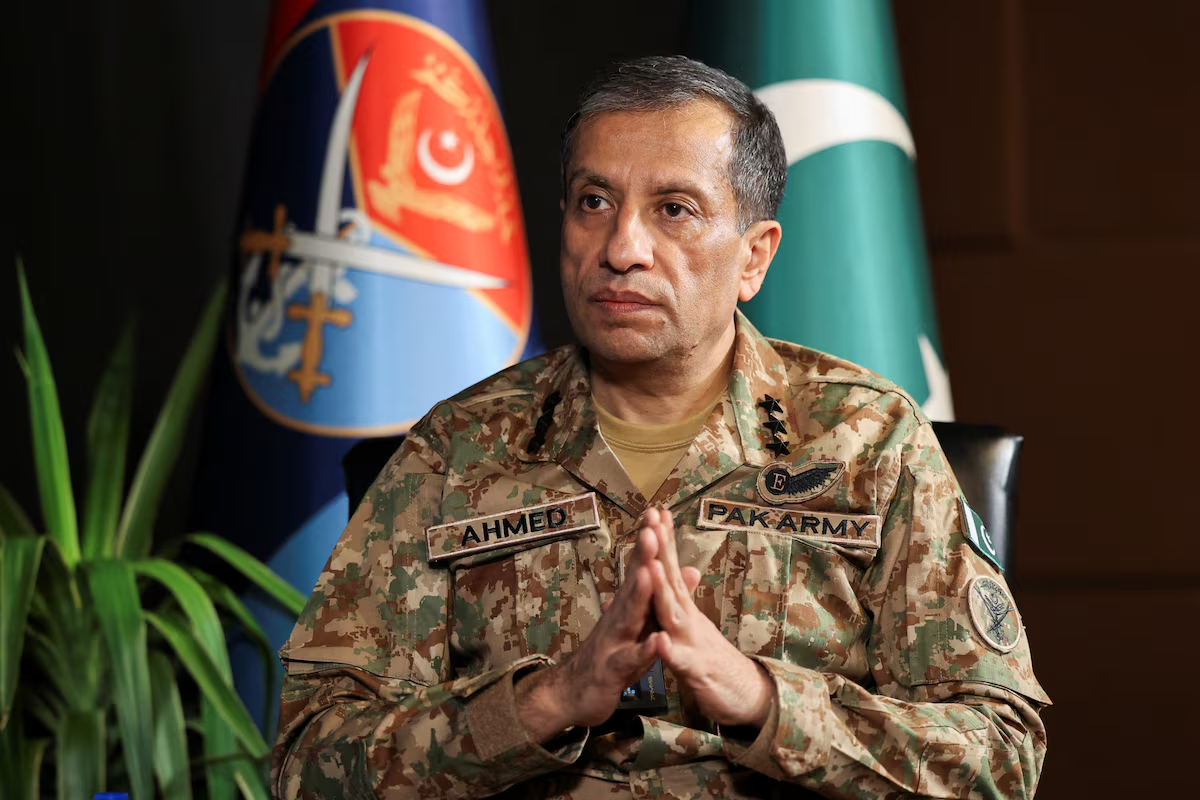

Lieutenant General Ahmed Sharif Chaudhry identifies India as the alleged principal sponsor of terrorism in Pakistan and accuses the Afghan Taliban regime of providing sanctuary, weapons and operational space to militant groups. His remarks come amid continuing security tensions along Pakistan’s western frontier.
ISLAMABAD — Director General Inter-Services Public Relations (DG ISPR), Lieutenant General Ahmed Sharif Chaudhry, has accused India of being the biggest sponsor of terrorism in Pakistan, alleging that the Afghan Taliban regime is acting as a proxy by providing support and sanctuary to militant organisations operating against the country.
In an interview with Reuters, the military spokesperson described India as the alleged principal contractor behind terrorism in Pakistan, while identifying the Tehreek-e-Taliban Pakistan (TTP) and Balochistan Liberation Army (BLA) as its alleged proxies.
He also referred to the presence of the East Turkestan Islamic Movement (ETIM), Islamic Movement of Uzbekistan (IMU), Al-Qaeda and Islamic State Khorasan Province (ISKP) in Afghanistan.
Afghanistan and the Question of Non-State Actors
Responding to a question about the Afghan political and security environment, Lieutenant General Chaudhry said Afghanistan continued to be run by a non-state actor, describing the Taliban administration as a regime rather than a state.
He expressed concern over the use of non-state actors, militias, mercenaries and armed groups to pursue strategic objectives. According to him, multiple intelligence agencies and proxy networks had established a presence in Afghanistan since the Soviet intervention.
The DG ISPR said Pakistan continued to engage with Afghanistan and had made a specific demand: the Afghan authorities should refrain from supporting terrorism inside Pakistan and stop providing sanctuary to militant leaders.
He alleged that Noor Wali Mehsud, Bashir Zeb of the BLA and Gul Bahadur had been given refuge by the Afghan Taliban regime. He further claimed that militant formations crossed into Pakistan from Afghanistan and received weapons from across the border.
Warning of serious consequences, he said the Afghan Taliban regime would have to pay a heavy price if it failed to address Pakistan’s concerns about cross-border terrorism.
Call for International Engagement
Lieutenant General Chaudhry also questioned the Afghan Taliban regime’s international credibility, urging the international community to press the Afghan authorities to operate as a responsible state and end the cultivation and production of narcotics.
He maintained that Pakistan’s armed forces possessed the capability to counter threats emanating from Afghanistan, including those involving drones.
The allegations place the security relationship between Islamabad and Kabul at the centre of regional concerns. Pakistan’s position, as outlined by the DG ISPR, is that the presence and activities of militant groups in Afghanistan pose a direct security challenge. The Afghan Taliban’s response to these allegations is not included in the supplied report.
The issue also raises broader questions about regional security, the responsibilities of the Afghan authorities and the role of international engagement in preventing Afghan territory from being used for attacks beyond its borders.
As tensions persist, the effectiveness of diplomatic engagement, border security and verifiable action against militant networks will remain central to the future of Pakistan-Afghanistan relations.
Republic Policy | Governance. Institutions. Public Policy.
Source: Based on the statement by DG ISPR in an interview with Reuters, as reported by Radio Pakistan. Allegations are attributed to the speaker and have not been independently established in this report.