
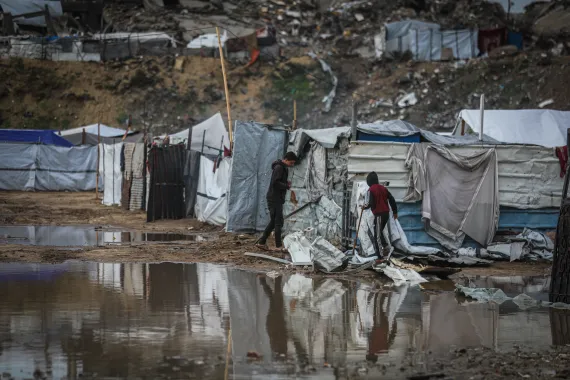

DEIR AL-BALAH: Heavy rainfall has flooded tens of thousands of makeshift tents sheltering displaced Palestinians across the Gaza Strip, deepening an already severe humanitarian crisis as families struggle to find protection from the approaching winter. With many people having lost their homes during the war, the latest flooding has left vulnerable residents exposed to cold, contaminated water and the growing threat of disease.
The scale of the emergency has prompted renewed warnings from humanitarian organisations, with a UNICEF official describing conditions as desperate and saying that almost everyone in Gaza now requires assistance. Aid workers report that families are approaching them directly in the streets, pleading for shelter and basic supplies as the rainwater spreads through temporary settlements.
The Hamas-run government in Gaza estimates that around 70,000 tents have been flooded. It has also reported injuries caused by the collapse of damaged walls and roofs, with some victims said to be in critical condition. For families already displaced repeatedly by the conflict, the destruction of temporary shelters means losing what little protection and stability they have managed to establish.
Flooding exposes the vulnerability of displaced families
The flooding has turned temporary settlements into waterlogged living spaces. Residents have been using household pots and pans to remove water from their tents, while others have found themselves without any usable shelter.
In Deir al-Balah, central Gaza, families are struggling to protect children and personal belongings from the rising water. Many of these shelters are made from thin plastic sheets, tarpaulins and other materials that offer little protection against sustained rainfall. Once water enters, bedding, clothing and essential household items can quickly become unusable.
Maryam Odeh, a 34-year-old mother living with her children in Deir al-Balah, described the uncertainty facing families who have nowhere else to go.
“We no longer know how to protect our children,” she told AFP. Her children, she said, keep asking where they will sleep, but she has no answer.
Khaled al-Najjar, 41, said families feared not only the flooding but also the cold and the spread of disease. His concerns reflect a wider problem facing displaced communities: the combination of inadequate shelter, poor sanitation and limited access to essential services is making ordinary seasonal weather a serious threat to survival.
UNICEF warns of an increasingly desperate situation
Jonathan Veitch, UNICEF’s representative for Palestine, described the conditions as horrific while speaking to the BBC from Deir al-Balah. He said humanitarian workers were being stopped in the streets by residents begging for assistance.
Although aid agencies are providing support, Veitch warned that the scale of need was becoming increasingly difficult to manage. The latest rainfall, he said, meant that nearly everyone required help.
The shortage of shelter materials is adding to the problem. According to Veitch, the availability of tarpaulins, plastic sheeting and tents has declined, partly because of reductions in United Nations budgets. Aid organisations are consequently being forced to make difficult decisions about which families and communities receive the limited supplies available.
This shortage is particularly serious as the rainy season begins. Emergency shelter is not simply a matter of providing temporary comfort. In Gaza’s present circumstances, it is essential to protecting families from exposure, preventing illness and reducing the risk of further displacement.
Veitch also identified restrictions on the entry of heavy machinery and supplies, including engine oil, as obstacles to humanitarian operations. Such equipment is needed to clear debris, repair damaged infrastructure and support emergency response activities.
Israel maintains restrictions on goods entering Gaza that it considers capable of being used for military purposes. However, humanitarian organisations have repeatedly raised concerns about the impact of restrictions on the delivery of essential civilian supplies. The challenge is particularly acute when emergency conditions demand rapid access to equipment and materials.
A population already displaced by war
The latest flooding cannot be understood separately from the wider destruction caused by the Israeli war against Hamas. Around 90 per cent of Gaza’s population has been displaced during the conflict, with many families forced to move multiple times.
Repeated displacement has dismantled the foundations of ordinary civilian life. Homes have been destroyed or rendered uninhabitable, public infrastructure has suffered extensive damage, and access to clean water and sanitation remains severely constrained.
For many displaced families, tents have become the only available alternative to permanent housing. Yet these shelters were never designed to withstand prolonged exposure to heavy rainfall or the harsh conditions of winter. Their limited durability makes residents particularly vulnerable when seasonal weather arrives.
The problem extends beyond the immediate loss of shelter. Floodwater can contaminate living areas and worsen already inadequate sanitation conditions. Where clean water, drainage and medical services are limited, the risk of waterborne and infectious diseases increases. Children, older people and those with existing vulnerabilities face particularly serious dangers.
The humanitarian consequences may therefore extend well beyond the immediate flooding. Without adequate shelter, sanitation and medical support, the combination of cold weather and overcrowded living conditions could produce further preventable illness and deaths.
Winter brings renewed fears of preventable deaths
Humanitarian workers are warning that the coming winter could make conditions considerably worse. Veitch recalled that Gaza experienced deaths from hypothermia during the previous winter and warned that similar outcomes could occur again without urgent intervention.
Hypothermia is a particularly serious risk for children and other vulnerable people who lack dry clothing, adequate bedding and insulated shelter. In ordinary circumstances, families can protect themselves by moving indoors, using heating and seeking medical attention when necessary. Displaced residents in Gaza often lack these basic options.
The problem is compounded by the limited availability of fuel, shelter materials and essential supplies. Even when humanitarian organisations identify families in urgent need, their ability to respond depends on whether assistance can reach them in sufficient quantities and without delay.
The approaching winter therefore places additional pressure on humanitarian agencies already operating under severe financial and logistical constraints. Their ability to distribute assistance is being challenged by the scale of displacement, shortages of essential materials and restrictions affecting the movement of supplies.
A ceasefire has not ended the humanitarian emergency
A ceasefire came into force in October 2025, raising hopes that the population would begin to recover from two years of devastating conflict. However, the humanitarian situation remains precarious, and Israeli air strikes have continued almost daily, according to the report.
Gaza’s Hamas-run Health Ministry says that 1,580 people have been killed since the ceasefire began. The United Nations considers the ministry’s casualty figures reliable. Israel says its operations are directed against Hamas, although civilians have also been killed.
The ceasefire agreement included the release of thousands of Palestinians held by Israel in exchange for the release of the 48 remaining hostages held in Gaza, alongside an agreement intended to end the war. However, a broader peace plan brokered by the Trump administration has stalled, leaving major questions about Gaza’s future unresolved.
The conflict began with the Hamas-led attack on Israel on October 7, 2023, in which around 1,200 people were killed and 251 taken hostage. Israel subsequently launched a military campaign in Gaza that caused widespread destruction and mass displacement.
Although the ceasefire represented an important diplomatic development, the latest flooding demonstrates that an end to large-scale fighting does not automatically restore the conditions necessary for civilian life. People who have lost their homes still need permanent shelter, functioning public services, clean water, healthcare and reliable access to humanitarian assistance.
Humanitarian access must become an immediate priority
The flooding has once again exposed the gap between humanitarian needs and the assistance reaching Gaza’s population. Emergency relief requires more than the delivery of food and basic medical supplies. It also depends on access to shelter materials, drainage equipment, heavy machinery, fuel and the logistical capacity to distribute assistance.
Humanitarian agencies face the additional challenge of operating with reduced resources at a time when demand is increasing. The shortage of tarpaulins, plastic sheeting and tents means that even basic protection against the weather cannot be guaranteed for every displaced family.
An effective response requires the removal of unnecessary obstacles to humanitarian supplies, predictable access for aid organisations and sufficient funding to meet immediate needs. Emergency shelters must be reinforced, damaged drainage systems addressed and vulnerable households prioritised before winter conditions deteriorate further.
The responsibility to protect civilians does not end with the announcement of a ceasefire. International humanitarian principles require the protection of civilian life and the facilitation of relief for populations facing severe hardship. These obligations become particularly urgent when people are exposed to conditions that threaten their health and survival.
Beyond emergency relief
Gaza’s latest humanitarian emergency illustrates a deeper problem: the absence of a credible pathway from temporary relief to sustainable recovery. Tents may provide immediate shelter, but they cannot replace homes. Emergency water distribution cannot substitute for functioning sanitation networks, and short-term medical assistance cannot compensate for a healthcare system operating under severe pressure.
Any lasting recovery will require the restoration of essential infrastructure, the rebuilding of homes and public facilities, reliable access to basic services and a political arrangement capable of preventing renewed destruction. These are not separate concerns. They are interconnected requirements for restoring civilian life.
For now, however, the immediate priority is survival. Thousands of families are trying to protect their children from rainwater, cold and disease while waiting for assistance. The approaching winter leaves little room for delay.
The images of families removing floodwater from their tents with household utensils capture the scale of their vulnerability. For people who have already lost their homes, another night without dry shelter is not merely an inconvenience. It is a reminder that the humanitarian crisis in Gaza remains unresolved.
The international response must move beyond expressions of concern and ensure that essential assistance reaches those who need it. A ceasefire can create an opportunity for peace, but its promise remains incomplete while civilians continue to face preventable suffering.