
Nadeem-ul-Haque
Building Social Capital, a three-part series. Part 1: Part 1: AI Needs the Mohalla — Artificial Intelligence and Social Capital. Part 2: Part 2: Enrolled but Not Learning — Pakistan’s Education Failure. Part 3: the proposal (this article).
The idea the cabinet did not want
Pakistan should build a Mohalla Learning Centre in every urban locality: a seven-storey public building where whole families come to learn, play, read, make things and meet people outside their own circle. I proposed it under the Framework for Economic Growth in 2011-12. The cabinet that heard the framework wanted only the “fat” in its projects, and a building that produced trust rather than contracts held no interest.
Three things have changed since. Part 1 showed that AI has made instruction cheap and that AI tutoring works only in supervised, shared places, while social mobility depends on places that mix classes. Part 2 showed that schooling has failed on its own terms and that most Pakistanis have no library, playground or association outside it. And with local governments returning, there is finally an institution close enough to the mohalla to own such a place.
The premise is simple: a place where the whole family engages in creativity, teamwork and knowledge with neighbours and strangers. Parents and children learning side by side set up currents of knowledge and collaboration that carry children well beyond our deficient schools.
The building, floor by floor
The centre is a flexible seven-storey building with a playground in front, running three shifts: mornings for out-of-school children and adult literacy, afternoons for schoolchildren after class, and evenings for working adults and families. Two full floors are given to the library, because 83% of Pakistanis have no access to one.
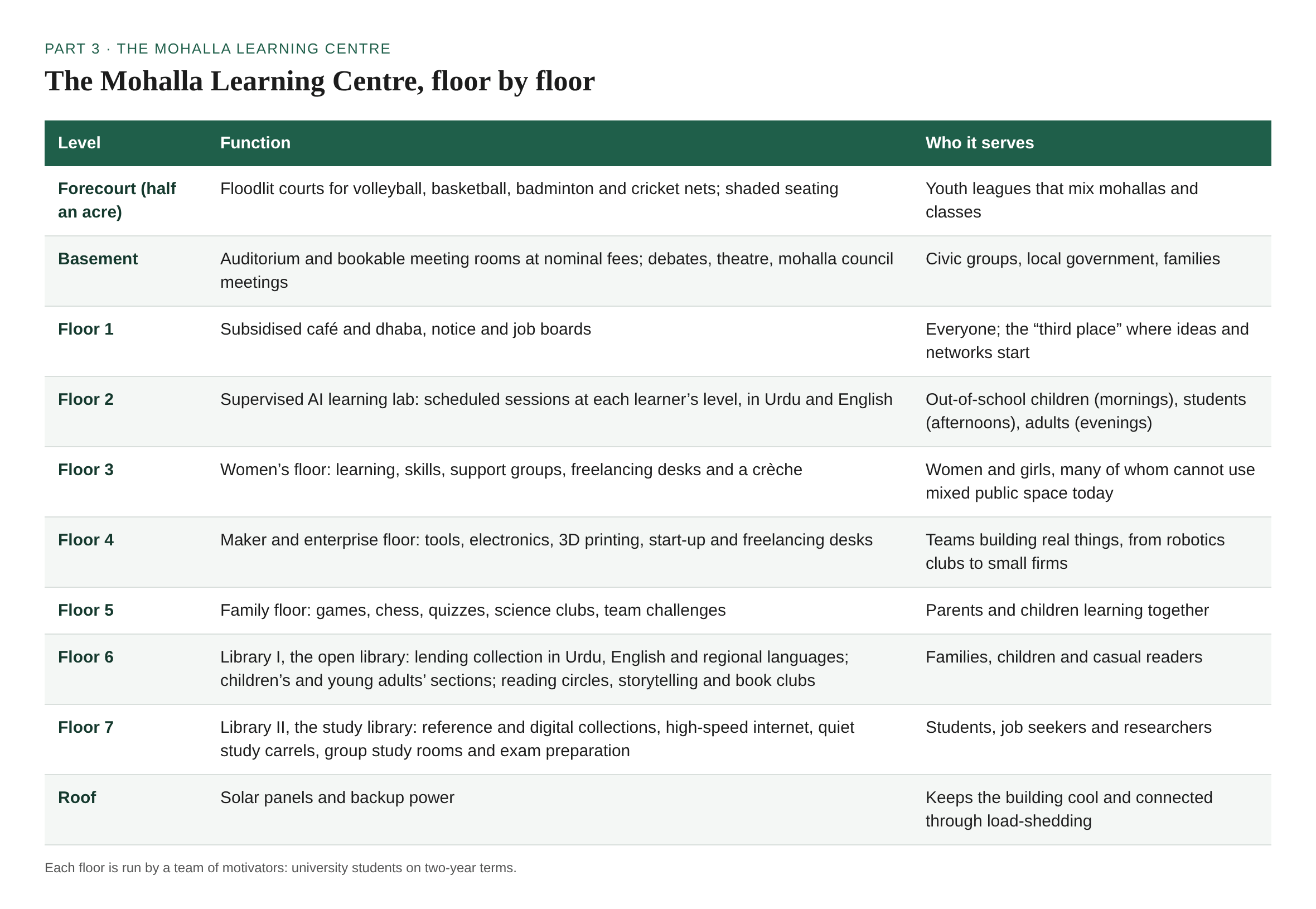
A planning caveat from 2015 still stands: building authorities must allow the height and mixed use. A seven-floor civic building cannot be squeezed into a two-storey bylaw.
The motivators: a national cadre of young builders
The heart of the centre is not the building but its motivators: bright university students recruited for a two-year term, well paid, who design each floor’s activities to create connections and build social capital. AI now does the explaining. The motivator’s job is everything the AI trials and Chetty’s research say machines cannot do: bring people in, keep them coming, form mixed teams, notice who is stuck and make strangers into collaborators.
Who they are. Students and recent graduates from Pakistan’s best universities and from abroad, selected competitively and on merit. Each floor has its own team of motivators, including women motivators for the women’s floor.
What they do. Motivators own their floor’s agenda. They design games, clubs, competitions, reading circles, maker projects and AI study sessions, recruit parents and neighbours, and build teams that cut across class, school and biradari. They are judged on participation, learning measured without AI, and the new ties their floor creates.
How they learn. Motivators meet regularly to set and evaluate agendas: weekly within each centre, monthly across centres in a city. These meetings are a learning device in their own right. Young people from different backgrounds compare what worked, criticise what failed and redesign together. They acquire precisely the skills of collaboration, accountability and leadership that our schools fail to teach.
The annual convention. Once a year, motivators from every centre meet in a national convention to present their best programs, debate ideas and award recognition. Over time this becomes a cultural agenda-setter for the country, a place where a new generation decides what Pakistani community life can look like.
What it leads to. After two years, motivators graduate to better jobs, scholarships and public service. Being a motivator should become a mark of distinction, in the way Teach For America, the Rhodes Scholarship or a Fulbright are elsewhere. Employers, universities and the civil service should give it explicit weight. This is how the program recruits the best: not by salary alone, but by prestige.
The cadre is also the program’s long-run payoff. Every two years, thousands of young Pakistanis leave the centres having led teams across class lines. They carry that network and that habit of trust into firms, government and politics.
Design rules from the evidence
Five rules, each drawn from the research in Part 1, keep the centre from becoming another empty building:
1. Scheduled, supervised AI only. Fixed sessions of 60 to 90 minutes, twice a week or more, with tutors set to ask questions rather than hand over answers, and a motivator in the room. No unsupervised homework-solving; the Türkiye trial shows it harms learning.
2. Start at the learner’s level. Teaching at the Right Level, not the textbook grade.
3. Small mixed teams. Groups of 4 to 8 built across class, school and mohalla lines, working on shared tasks. Chetty found friending bias is lowest in small, activity-based groups.
4. Open, graduated membership. A small fee to signal commitment, waived for the poor, with public subsidy so the centre never becomes another elite club for friends and relatives.
5. Measure what matters. Track attendance, learning tested without AI, and cross-class friendships and trust through regular resident surveys of the PIDE-BASICS kind. Publish centre rankings.
Others built it and grew richer for it
The mohalla centre is not utopian; rich and rising societies built this kind of social infrastructure, usually at moments of crisis.
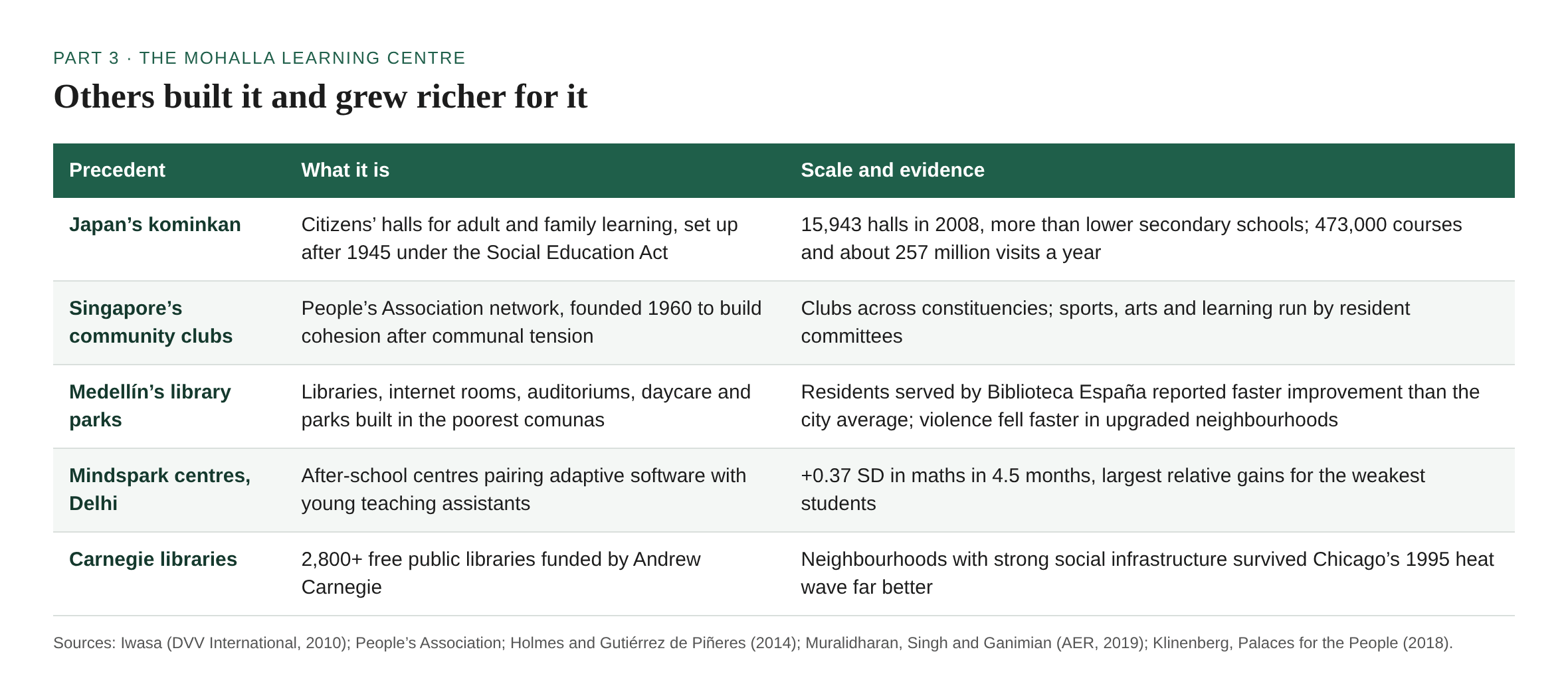
Mindspark is the closest model: a neighbourhood centre, technology at the student’s level, and a young adult guide, which is what our motivators are. Medellín shows that beautiful public buildings in poor areas signal respect and raise use and pride. Japan and Singapore carry warnings. Japanese halls declined to about 13,800 as budgets were cut and programs drifted into hobby classes (Statista/e-Stat), and Singapore’s clubs have been criticised as instruments of the ruling party. A Pakistani version must be protected from both neglect and capture.
Karachi’s deadly June 2015 heat wave, which hit the old and isolated hardest, makes Klinenberg’s point locally. A cool, powered hall where neighbours check on one another is also climate infrastructure.
Who builds it, who runs it, who pays
The centres should belong to elected city governments and be run by independent trusts, not by the provincial secretariat. That is the only way to keep them alive after the ribbon-cutting.
Ownership: the new local governments. Punjab is heading to local polls between 15 December 2026 and 15 January 2027 under the Punjab Local Government Act 2025, its first since 2015 (Express Tribune). Delimitation proposes 10 town corporations for Lahore (Express Tribune). A centre network per town corporation is the right unit: close enough to residents to be accountable, large enough to manage motivators and budgets.
Management: arm’s-length trusts. Each network should be run by a trust with an independent board of residents, universities, women’s groups and donors. By law, as in Japan’s Social Education Act, the centres must not be used for party or commercial purposes.
The motivator program: a national body. Recruitment, training, the annual convention and certification should sit with a national foundation that partners with universities, so that the motivator credential carries the same weight across the country.
Land and buildings: use what the state already owns. Cities are full of underused state land and government property on prime plots. The quickest start costs almost nothing: open public school buildings in the afternoons and evenings, when they stand empty, as Japan does with many kominkan. Purpose-built centres follow once building rules allow the height.
Money: redirect, then blend.
• Redirect AI spending from gadgets to places. Rs 81 crore planned for two showcase AI schools in Lahore (ProPakistani) would reach far more learners as neighbourhood labs open all day.
• Count AI tutoring at full cost. Per-student marginal costs in the trials ran from about US$5 (Ghana) to US$9 (Nigeria), with full six-week cost in Nigeria near US$48 (IZA). Shared devices, power and motivators are most of the bill, and centres spread it across thousands of users.
• Blend revenues. Public subsidy as the base, plus modest membership and booking fees, café income, corporate sponsorship of floors and labs, diaspora and philanthropic giving, and university partnerships that place motivators.
Start with a test, not a mega-project. Open 10 to 20 centres in two or three cities, assign neighbourhoods by lottery, and measure learning, earnings, trust and cross-class ties against comparison areas. Then scale what works.
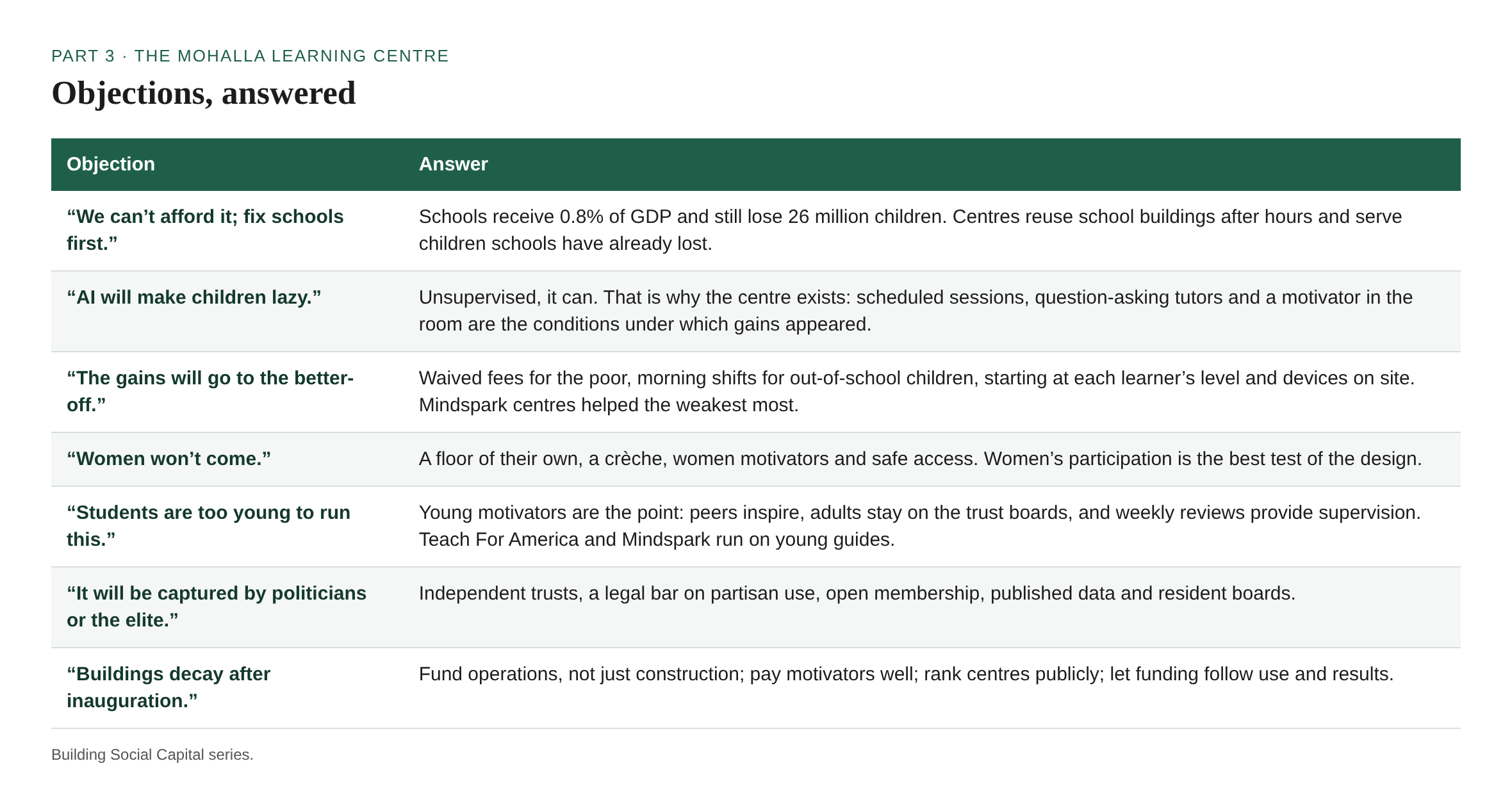
Objections, answered
Each objection points to a design choice rather than a reason to do nothing.
A second chance
In 2015 I ended with a lament: this was not allowed to happen, and it never would. It did not happen, and the cost shows in 26 million children out of school and a generation that cannot read.
The case has changed. AI has made explanation free, so the scarce goods are those only a community can supply: a place, a routine, a mentor and peers worth showing up for. The best research of the decade says those peers, especially across class lines, decide who climbs. And a cadre of young motivators, renewed every two years and meeting in a national convention, could do for Pakistani civic life what the public schools once did for the empire’s administrators: build esprit de corps, this time in the service of our own people.
The question is no longer whether Pakistan can afford community learning centres. It is whether it can afford to spend its AI money on curricula and showcase schools while its children learn alone, or not at all.
Sources
• Making AI Tutoring Work for Poorer Schools, Dang and Do, IZA DP 19025, Oct 2026
• It is time for Japanese kominkan to flower again, Iwasa, DVV International, 2010
• Number of kominkan in Japan, 2002-2021, Statista / e-Stat
• People’s Association Annual Report FY2024/25, Singapore
• Medellín’s Biblioteca España: progress in unlikely places, Holmes and Gutiérrez de Piñeres, 2014
• Infrastructure investment for public safety: lessons from Medellín, Planetizen, 2022
• Palaces for the People, Psychology Today, 2020
• Newsmaker: Eric Klinenberg, American Libraries, 2018
• ECP agrees to hold Punjab local polls between Dec 15 and Jan 15, Express Tribune, Aug 2026
• Punjab completes local govt delimitation, Express Tribune, Aug 2026
• Punjab plans two AI schools in Lahore, ProPakistani, Jun 2026
• Shaping Minds and Bodies: Do We Have the Facilities? (BASICS Notes 6), Durr-e-Nayab, PIDE, 2023