
Nadeem-ul-Haque
Pakistan has abundant bonding capital inside families and biradaris and almost no bridging capital across them. That is the worst possible endowment for the AI age.
Instruction is cheap; community is scarce
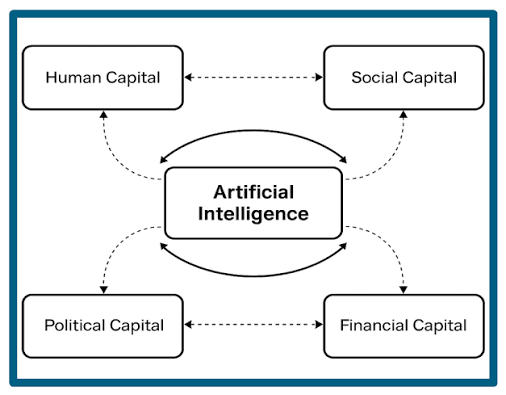
Artificial intelligence has made explanation nearly free, and in doing so it has made the oldest scarcity in development, trust and cooperation among people, the binding constraint on learning. A child in a Lahore katchi abadi can now ask a free AI tutor to explain fractions in Urdu at midnight. Whether she will ask, keep asking, and learn rather than copy is a different question. That question is about motivation, routine, mentors and peers. It is a question about social capital.
In 2011 the Framework for Economic Growth named social capital as a cornerstone of reform. It was ignored then as a soft idea. The AI revolution makes it a hard one. When content is abundant, the returns go to whoever can organise people around it: the families, neighbourhoods and institutions where learning is expected, supervised and shared. Societies rich in that kind of trust will capture the gains from AI. Societies poor in it, like ours, risk widening the gap.
The trials say: the place, the schedule and the adult
Randomised trials of AI tutoring in poor countries agree on one point: the chatbot is not the program. Gains appear only where learners meet on a schedule, at a shared site, with an adult in the room.
A World Bank trial in Benin City, Nigeria gave secondary students two 90-minute after-school sessions a week with an AI tutor for six weeks. It raised a composite score by 0.31 standard deviations, and English by 0.23 SD (De Simone et al., World Bank 2025). Each extra day attended added roughly 0.03 SD. The most careful review to date, by Dang and Do (IZA DP 19025, October 2026), compares five settings:

• Supervision is the active ingredient. Every successful program had scheduled sessions, an adult present and devices at a shared site. In Sierra Leone, three-quarters of the tutor’s messages were questions; only 2% gave answers.
• Unsupervised AI can harm learning. In Türkiye, students who practised with an open chatbot scored worse when the AI was taken away. The machine did the thinking for them.
• Without design, gains go to the advantaged. Where power, devices and connectivity were unreliable, higher achievers and better-off students gained most.
Read together, these results describe an institution, not an app. AI tutoring works when it is embedded in a community of learners that keeps people coming, keeps them honest and notices when they are stuck. That is the work social capital does.
Social capital is now measured, and it predicts mobility
The strongest single predictor of whether a poor child rises is how many better-off people she befriends, and those friendships form in shared institutions. A decade ago the case for social capital rested on history: merchant towns, the Royal Society, the English public school. It now rests on data.
Raj Chetty and colleagues used 21 billion Facebook friendships to map social capital across every US ZIP code. Economic connectedness, the share of high-income friends among low-income people, proved among the strongest predictors of upward mobility ever identified; cohesion and civic engagement mattered far less (Social Capital I, Nature 2022). Poor children raised with the connectedness of the average rich child would earn about 20% more as adults (TechCrunch summary).
The companion paper shows where those ties come from (Social Capital II, NBER 30314):
• Exposure explains half. Cross-class friendships form in shared institutions such as schools and religious groups. People cannot befriend those they never meet.
• Friending bias explains the other half. Even in shared spaces, people befriend their own class. The bias is higher in large, diverse groups and lower in religious and recreational groups (NSF PAR).
• Structure therefore matters. Small, activity-based groups that mix people around a shared task build bridges; big anonymous halls and tracked classrooms do not.
Put this beside the AI evidence and the two literatures converge. AI tutoring needs supervised, shared places. Social mobility needs shared places that mix classes in small groups. The same institution can do both.
Pakistan is bowling alone
Pakistan has abundant bonding capital inside families and biradaris and almost no bridging capital across them. That is the worst possible endowment for the AI age.
In the 2018 World Values Survey, 78% of Pakistanis trust their family completely (IHSN, WVS Wave 7). Only about 23% say most people can be trusted (Integrated Values Surveys via Visual Capitalist).
Durr-e-Nayab’s PIDE-BASICS survey, the most detailed domestic measure we have, shows how thin associational life is. It is nationally representative, drawn on the Pakistan Bureau of Statistics frame, with about 20,548 respondents (BASICS Notes 1; PIDE).

Three things stand out:
• Exposure is close to zero. With 3% in any association, there is almost no organised space where Pakistanis meet outside family, biradari and mosque. Chetty’s first channel is shut.
• What little exists belongs to the educated, the rich and men. Membership nearly triples among the most educated, and women’s rate is a fifth of men’s. Youth, who most need bridges, have the fewest. Associational life has become one more privilege.
• The will to mentor is there. Teaching and mentoring is already the most common form of volunteering. It lacks a place, a schedule and an institution.
The qualitative follow-up by Fahd Zulfiqar and Nayab finds that mistrust extends from neighbours to the state, judiciary, police and army (Business Recorder). A society like this cannot form large firms, partnerships or research teams easily. Hand it AI without the social infrastructure, and the better-connected few will capture the gains.
The machine needs the mohalla
AI does not substitute for social capital; it raises the return on it. The trials show that AI teaches only inside a supervised community. Chetty shows that mobility depends on mixed-class communities. PIDE’s data show that Pakistan has almost no such communities outside the family.
The policy conclusion is direct. Pakistan’s AI strategy should not be measured in curricula approved or laptops distributed, but in places built where people of different classes learn together on a schedule, with a mentor. Part 2 shows why our schools cannot be that place as they are run today. Part 3 sets out the institution that can.
Sources
• From Chalkboards to Chatbots, De Simone et al., World Bank PRWP 11125, 2025
• Making AI Tutoring Work for Poorer Schools, Dang and Do, IZA DP 19025, Oct 2026
• Social capital I: measurement and associations with economic mobility, Chetty et al., Nature, 2022
• Social capital II: determinants of economic connectedness, Chetty et al., NBER WP 30314 / Nature, 2022
• Study of Facebook friendships explores how economic mobility works, TechCrunch, 2022
• Social capital II (abstract), NSF PAR
• World Values Survey Wave 7, Pakistan: trust in family, IHSN, 2018
• Most and least trusting countries (Integrated Values Surveys), Visual Capitalist, 2024
• About the PIDE-BASICS Survey (BASICS Notes 1), Durr-e-Nayab, PIDE, 2022
• Social and Civic Engagement (BASICS Notes 5), Durr-e-Nayab, PIDE, 2023
• Choking Civil Society, PIDE
• PIDE unveils insights into socio-cultural landscape, Business Recorder, Nov 2023