
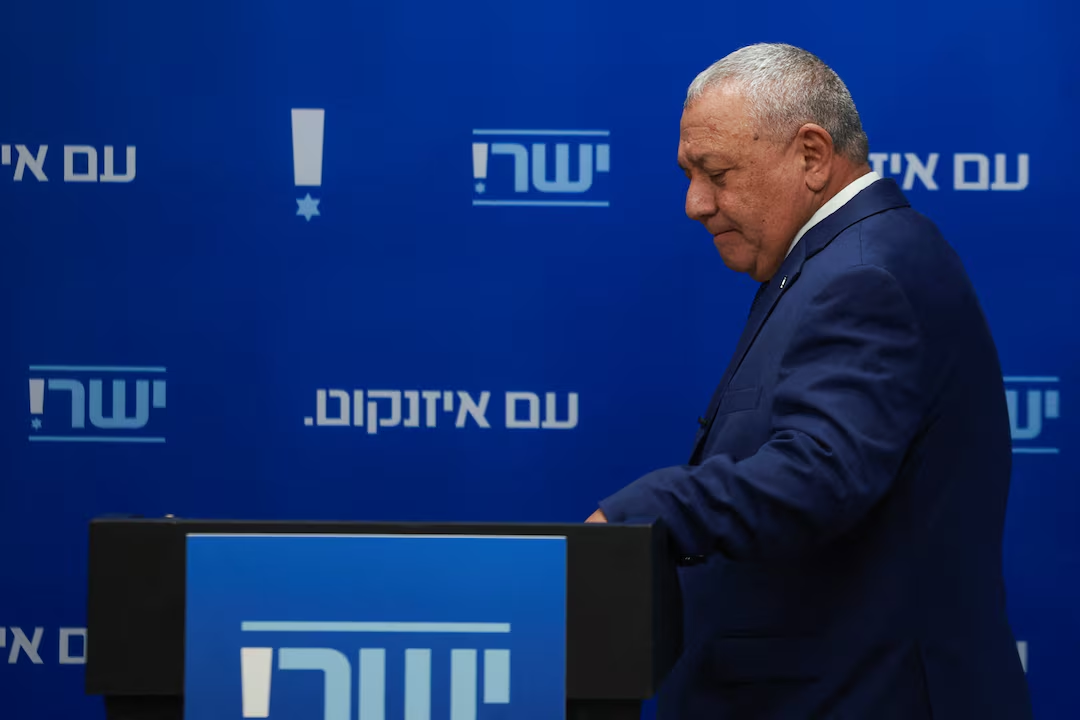

Former military chief Gadi Eisenkot has reached his first coalition agreement with Avigdor Lieberman’s Israel Our Home party, marking an important development in efforts to form a government after Benjamin Netanyahu lost his parliamentary majority in last month’s election.
Israel’s post-election political negotiations gained momentum on Tuesday after Yashar party leader Gadi Eisenkot agreed to a coalition pact with Avigdor Lieberman, head of the Israel Our Home party, in the first formal alliance announced since the October 27 election.
The agreement signals an emerging effort by opposition parties to consolidate their parliamentary strength and challenge Netanyahu’s continued hold on power as caretaker prime minister. The election weakened Netanyahu’s governing position, leaving his right-wing alliance short of the majority required to form a government in the 120-member Knesset.
Yashar announced that Eisenkot met Lieberman earlier on Tuesday and that the two leaders subsequently reached an agreement. The development is particularly significant given Lieberman’s previous opposition to forming a government dependent on Arab parties and his resistance to joining a unity government with Netanyahu.
Eisenkot, whose party secured 21 seats, has been tasked by President Isaac Herzog with forming the next government. Lieberman’s party won seven seats, bringing the combined parliamentary strength of the two parties to 28.
The agreement represents the first concrete coalition arrangement in a complicated political landscape where neither the outgoing governing bloc nor the opposition has yet secured a clear path to a parliamentary majority.
Netanyahu’s alliance loses majority despite election gains
The October 27 election produced a complicated parliamentary outcome, with Netanyahu’s Likud-led alliance of right-wing, far-right and ultra-Orthodox parties performing better than expected but still failing to retain a majority.
The bloc currently holds 53 seats in the Knesset, falling short of the 61 required to command a majority in the 120-member parliament. The result has left Netanyahu politically weakened despite the relative strength of his alliance, opening the door for opposition parties to attempt an alternative government.
Eisenkot’s centre-right Yashar party and its existing coalition partners collectively hold 48 seats. However, the opposition bloc could potentially gain additional support from parties representing Israel’s Arab minority, which hold 19 seats and share a strong opposition to Netanyahu.
The prospect of Arab party support could prove decisive in Eisenkot’s efforts to assemble a parliamentary majority, although political differences within the opposition remain substantial. Lieberman has previously voiced objections to forming a government reliant on Arab parties, making his agreement with Eisenkot an important development in the evolving negotiations.
Lieberman has also repeatedly identified removing Netanyahu from power as his principal political objective, a position that could provide common ground among opposition leaders despite disagreements over the composition and policies of a prospective government.
Coalition negotiations face competing political pressures
Eisenkot’s efforts to form a government are unfolding alongside parallel discussions about a possible unity arrangement with Likud. Negotiations involving Eisenkot, some partners within the so-called change bloc and Likud are continuing, creating uncertainty over whether the eventual government will be built exclusively around opposition parties or include elements of Netanyahu’s political camp.
The possibility of a unity government has already generated resistance among some opposition partners. The left-wing Democrats party, which secured eight seats in the election, announced separately that it was suspending negotiations with Eisenkot.
The party cited progress in talks between Eisenkot and Netanyahu’s Likud over a potential unity government, as well as what it described as a deadlock in negotiations to establish a change government.
Democrats leader Yair Golan has advocated a government without Netanyahu that would include Arab parties, putting him at odds with the possibility of an arrangement involving Likud. The party’s decision to suspend talks adds another complication to Eisenkot’s efforts to bring together parties with differing political priorities.
The disagreement reflects the broader challenge confronting the opposition: while parties share an interest in ending Netanyahu’s leadership, they remain divided over whether to cooperate with Likud, rely on Arab parliamentary support or construct a government exclusively from the opposition’s existing partners.
Eisenkot faces a deadline to secure parliamentary backing
Eisenkot has until December 6 to complete negotiations and present a government under the 28-day mandate granted by President Herzog. He may seek an additional 14-day extension if he needs more time to finalise coalition arrangements.
If Eisenkot fails to form a government, Netanyahu could receive another opportunity to attempt to assemble a governing coalition. Should both efforts fail, Israel would face another election next year, prolonging the political uncertainty.
The immediate challenge for Eisenkot is therefore not simply securing agreements with individual parties but reconciling competing positions within a fragmented parliamentary landscape. His agreement with Lieberman offers an initial breakthrough, but the wider negotiations remain unsettled, particularly over the role of Arab parties and the possibility of a unity government with Likud.
The emerging coalition arrangement illustrates the shifting calculations of Israel’s political leadership following the election. Opposition parties are attempting to convert their collective opposition to Netanyahu into a workable governing majority, while disagreements over coalition partners, ideological differences and the potential inclusion of Likud continue to threaten that effort.
With the government formation deadline approaching, Eisenkot’s first coalition agreement may provide momentum to the opposition, but whether it can translate into a stable government will depend on the outcome of negotiations with parties whose political priorities remain far from aligned.