The Supreme Court (SC) ruled on Wednesday that elections in Khyber Pakhtunkhwa and Punjab should be held within 90 days.
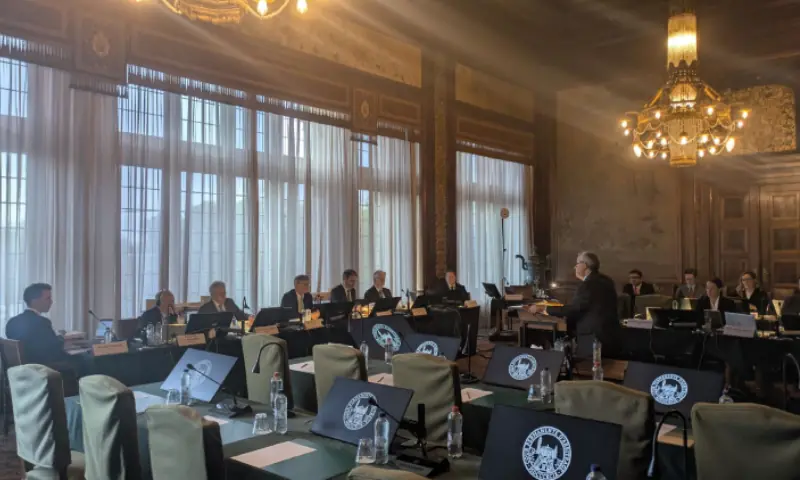
The verdict was announced by a five-member apex court bench headed by Chief Justice of Pakistan (CJP) Umar Ata Bandial and comprising Justice Mansoor Ali Shah, Justice Munib Akhtar, Justice Jamal Khan Mandokhail, and Justice Muhammad Ali Mazhar.
Ahead of the verdict, Room No.1 of the court — where the much-anticipated decision was announced — was packed with journalists, lawyers and politicians.
The court also asked political parties to consult their leaderships during a short break and come back with a consensus date for the elections, but PML-N counsel Mansoor Usman Awan told the court that consultation will take more time since the PDM coalition also has members in Balochistan, while the PML-N will also have to hold internal discussions as well as consult the PPP.
Attorney General for Pakistan Shehzad Ata Elahi contended that the power to fix the election date was vested in the ECP and if the commission had some evidence of any difficulty in holding the elections, it should not shy away from revealing the same. Justice Munib Akhtar observed that it seemed that the ECP was unaware of its constitutional responsibility to fix the election date and today they stand enlightened of their constitutional obligation.
The CJP pointed towards senior counsel Farooq H. Naek — who was representing PPP — and observed that nobody was doubting the bona fide of the government since they have reasons like terrorism or economic conditions, which the country was facing for the first time, but “we should at least decide which authority will announce the date to conduct elections in the provinces of Punjab and Khyber Pakhtunkhwa (KP)”.
The CJP emphasised that Article 254, which legalises any failure to comply with certain requirements within a stipulated period, did not give licence to anybody to overcome the constitutional obligation of holding the elections within 90 days since the elections have to be held even in eventualities like war or other calamities.
If the law is silent, still neither the executive authority nor parliament or any constitutional body has the power to exceed the time limit of 90 days of holding the elections except for the court, but then the court had to be satisfied with the overriding challenges in the way of conducting free and fair elections, the CJP observed.
Naek argued that the PPP did not want the postponement of elections unnecessarily, but rather want to participate in the polls provided they were held in accordance with the law in conducive circumstances. However, the current economic crisis makes it a difficult possibility, he added.
He said April 9 election date fixed by President Arif Alvi without consultation with the prime minister was a nullity in the law and added the discretion, which the president could exercise, was implicit in the constitution.
About the suo motu proceedings under Article 184(3), the counsel reminded that a similar case was pending before the Lahore High Court (LHC) which had even given a direction to the Punjab governor to announce the date in consultation with the ECP.
In KP, the governor has the authority to announce the date for the elections but for Punjab, the statute was silent and therefore ECP had to announce the date, Naek argued. It was not the mandate of the political parties to fix a date for the elections, he added.