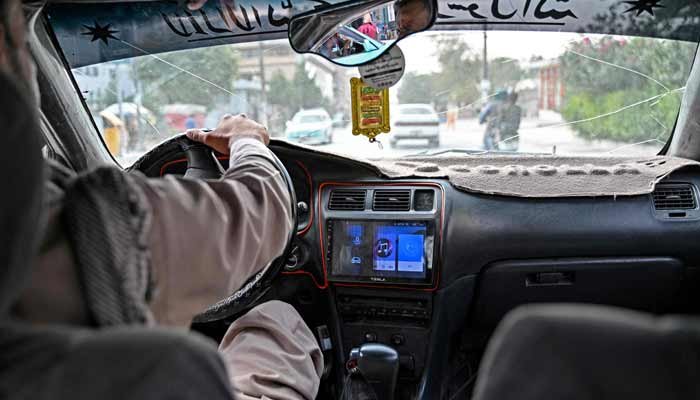

KABUL: Some taxi drivers in Afghanistan are quietly challenging the Taliban government’s restrictions on music by playing Afghan folk songs and regional pop music in their vehicles, despite the possibility of being stopped by morality police.
Music, once a familiar feature of Kabul’s restaurants, cafés, shops and streets, has largely disappeared from public spaces since the Taliban returned to power in 2021. Religious and patriotic songs approved by the authorities have taken its place.
Yet some drivers continue listening to their preferred music, lowering the volume or switching it off whenever they approach security checkpoints.
Music Becomes a Quiet Form of Resistance
Roeen, a 28-year-old taxi driver who shared only his first name for security reasons, said he takes precautions whenever he encounters security personnel.
He explained that drivers often reduce the volume or turn off their music completely at checkpoints to avoid trouble.
The restrictions are enforced by Afghanistan’s Ministry for the Propagation of Virtue and the Prevention of Vice, whose morality police patrol Kabul.
The ministry’s regulations prohibit drivers from playing or listening to music, describing it as forbidden and a source of discomfort for passengers.
Although the ministry did not respond to questions about the penalties specifically imposed for playing music, violations of some of its other regulations can result in imprisonment.
Roeen said the authority exercised by morality police makes drivers reluctant to play music openly.
Nevertheless, the restrictions have strengthened his attachment to it. Driving through Kabul’s congested streets, he said his interest in music has increased considerably since the ban.
For him, listening to music is more than entertainment. In a country where cinema and several other recreational activities are prohibited, it has become a personal expression of resistance.
Drivers Listen in Fear of Checkpoints
Another taxi driver, who requested anonymity, said he listens to music only when travelling alone and when surrounding traffic noise makes it less noticeable.
The 32-year-old recalled that listening to music was previously an ordinary activity that required little thought. Now, he said, it comes with constant anxiety.
He has twice been stopped at checkpoints after officials discovered a USB drive and memory card in his vehicle.
When asked whether the devices contained music, he answered truthfully. According to the driver, officials then destroyed them.
Despite these experiences, he remains determined to preserve a part of Afghan cultural life that he believes should not disappear.
He said music is an important element of Afghanistan’s cultural identity and expressed concern that restrictions could gradually erase that tradition from public life.
Authorities Continue Crackdown on Musical Instruments
The Taliban’s restrictions extend beyond music played in vehicles.
Provincial offices of the Ministry for the Propagation of Virtue and the Prevention of Vice occasionally report burning confiscated musical instruments as part of their enforcement activities.
Ministry spokesman Saiful Islam Khyber said figures were unavailable for the total number of instruments seized.
For taxi drivers who continue playing music, the possibility of confiscation or punishment remains a daily concern.
Their decision to keep listening nevertheless reflects a determination to maintain a familiar part of Afghan life, even when doing so requires secrecy and caution.