Mubashar Nadeem
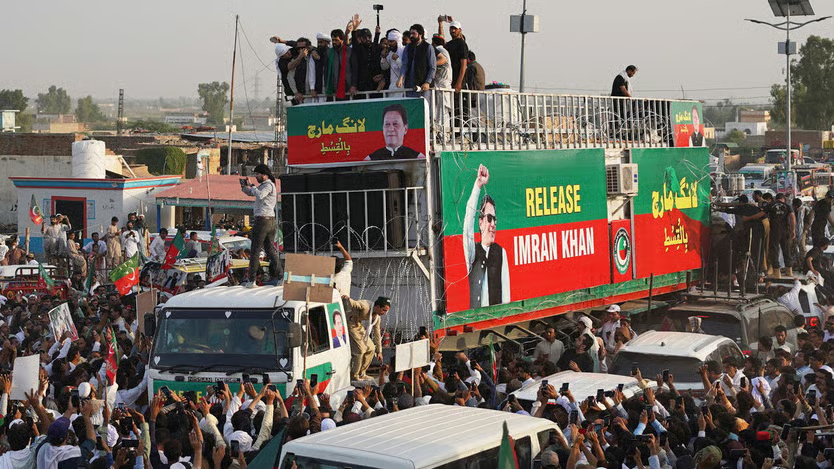
Tension has returned to Azad Jammu and Kashmir at one of the worst possible moments. With general elections scheduled for July 27 and the tourist season at its peak, the regional administration has chosen to ban the Jammu Kashmir Joint Awami Action Committee ahead of a planned protest on June 9. Visitors have been ordered to leave the region, communications have been disrupted and the atmosphere has once again turned volatile. This is not a new pattern. Confrontations between the AJK authorities and the JAAC have become a recurring feature of the region’s political life. The last major eruption came in October, when clashes between protesters and security forces resulted in deaths. That the situation has reached a similar flashpoint so quickly suggests that nothing was genuinely resolved then, and that the underlying grievances remain as raw as ever.
The JAAC began as a civic movement, raising practical concerns about the daily conditions facing ordinary people in Azad Kashmir. Over time it has evolved into something more politically ambitious, now demanding constitutional changes to the structure of representation in the region. Its central demand is the abolition of twelve seats reserved in the AJK legislature for refugees from India-held Kashmir who have settled in the region. This is not a trivial matter. The JAAC argues, with some justification, that these seats have become instruments of political manipulation. Mainstream parties in Pakistan have used refugee representation to assemble and dismantle governments in Muzaffarabad according to their own interests rather than those of the people of Azad Kashmir. Many individuals elected on refugee seats do not reside in the region and pay insufficient attention to its affairs. The grievance is real and deserves serious engagement rather than administrative suppression.
That said, a blanket abolition of refugee seats is not a straightforward solution. The refugees from India-held Kashmir and their descendants have a historical, emotional and political connection to the Kashmir cause that cannot simply be legislated away. Their representation in AJK’s governance structures reflects a broader narrative about the unresolved status of the region and the aspirations of displaced communities. Removing that representation entirely, without careful deliberation and broad consensus, risks creating new injustices while attempting to address existing ones. Constitutional questions of this nature require thoughtful legislative debate, not maximalist street demands or reflexive administrative crackdowns.
The decision to ban the JAAC is the wrong response and should be reversed without delay. The organisation commands genuine popular support in Azad Kashmir. Proscribing a movement that has broad roots among the population does not eliminate dissent. It drives it underground, removes the possibility of structured dialogue and increases the likelihood of more dangerous confrontations. Peaceful protest is a fundamental right. As long as the JAAC remains committed to non-violent activism, banning it serves no legitimate democratic purpose. It only confirms the narrative that the authorities fear accountability more than they value constitutional order.
There is also a broader political context that cannot be ignored. Governments in Azad Kashmir have historically aligned themselves with whichever party holds power in Islamabad, making genuine provincial autonomy difficult to sustain in practice. This pattern of alignment, combined with the influence of refugee seats and the chronic underdevelopment of local political institutions, creates the conditions in which movements like the JAAC acquire their mass appeal. People turn to street politics when they believe that formal institutions will not deliver justice. The solution is not to suppress the street but to make formal institutions more credible and responsive.
The right arena for resolving questions about refugee seat representation, electoral reform and constitutional change is the AJK legislature. These are precisely the kinds of issues that legislatures exist to deliberate on. Political parties, civil society representatives and community leaders can engage with these questions in a structured environment, test competing arguments and arrive at outcomes that carry democratic legitimacy. What cannot produce legitimate constitutional change is either administrative fiat or protest pressure. Both paths lead to outcomes that one side will refuse to accept.
With elections only weeks away, this moment carries particular significance. A political environment defined by bans, disruptions and confrontation will damage the credibility of the electoral process itself. Voters deserve to exercise their rights in a stable and open atmosphere. That requires both sides to step back from the edge. The administration must lift the ban on the JAAC and create space for peaceful political activity. The JAAC’s leadership must ensure that its mobilisation remains disciplined, non-violent and directed toward achievable political goals rather than escalating brinkmanship.
Azad Kashmir is a sensitive region in every sense. Its political stability matters not only to its own people but to the broader national interest. Disturbances here carry costs that extend well beyond the immediate moment. Both the government and the JAAC carry responsibility for what happens next. The choice between dialogue and confrontation remains open. It should not take another tragedy to make the right choice obvious.