
Barrister Nasir Jatala
There is an old truth in diplomacy: wars are easy to start and extraordinarily difficult to stop. Peacemaking demands patience, restraint, and a willingness to sit across from an adversary without reaching for insults. It demands the discipline to say less in public so that more can be achieved in private. By every one of these measures, the current American approach to Iran is failing. And the principal reason for that failure sits not in Tehran, not in any disputed centrifuge facility, but in the social media habits of the President of the United States.
When American and Iranian delegations departed Islamabad on Sunday without an agreement, it was disappointing but not surprising. Resolving one of the world’s most entrenched geopolitical disputes in a single round of talks, within a compressed timeframe, was always an ambitious expectation. Diplomacy of this complexity requires multiple sessions, accumulated trust, and the slow architecture of mutual concession. What it cannot survive is a head of state who treats every stalled negotiation as an opportunity for theatrical aggression.
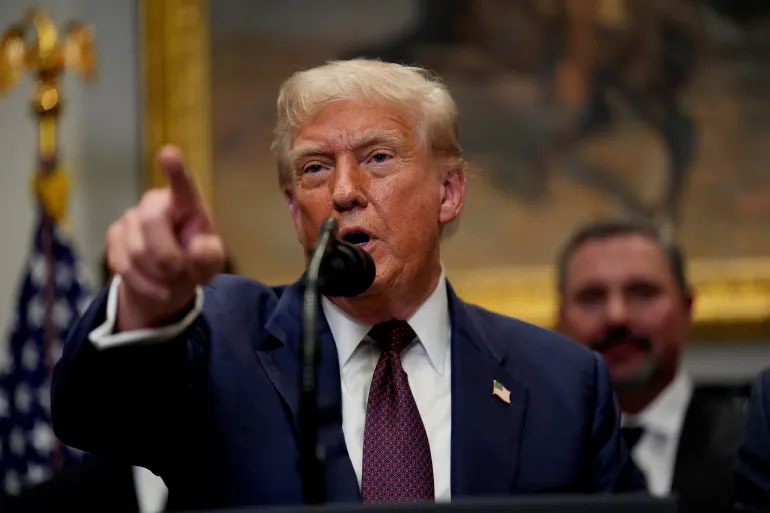
Donald Trump’s response to the Islamabad impasse was, by now, predictable. He took to social media to announce that American forces were locked and loaded, threatened a blockade of the Strait of Hormuz, and declared that vessels using Iranian ports or paying tolls to Tehran would face restrictions. These are not the words of a government trying to reach an agreement. These are the words of a government trying to perform toughness for a domestic audience at the expense of a process that could prevent a catastrophic regional war.
The Strait of Hormuz is not a peripheral concern. It is the artery through which a significant share of the world’s oil supply moves. Any military confrontation in those waters would send shockwaves through global energy markets, destabilise fragile economies across Asia and Africa, and risk an escalation that no party would be able to control once it began. The logic of opening the strait by force, or of stopping Iranian vessels at gunpoint, leads not to resolution but to conflagration. The only real path to a open strait and a stable region is a negotiated settlement. Everything else is theatre with consequences.
Trump’s belligerence has not been limited to Iran. When Pope Leo XIV offered a moral condemnation of war, the American president announced, without apparent embarrassment, that he was not a big fan of the pontiff. The Pope, to his considerable credit, was unmoved, and stated he would continue to denounce war. That an elected leader of a democratic republic would pick a public quarrel with the head of a global faith over the issue of peace tells you something important about the political culture driving American foreign policy at this moment.
Meanwhile, the substance of the talks points in a more hopeful direction than the noise surrounding them. Iranian Foreign Minister Abbas Araghchi stated that both delegations had come within inches of an Islamabad Memorandum of Understanding. The agreement did not materialise, he said, because the American side shifted the goalposts mid-negotiation. If that account is accurate, and there is no serious reason to doubt it, then the obstacle to peace is not Iranian intransigence. It is American inconsistency.
The American position insists that Iran is pursuing nuclear weapons and will not abandon that pursuit. The facts available before the American military strike in February told a different story. Through the Omani-facilitated dialogue process, Tehran had expressed willingness to make substantial concessions to its nuclear programme, stopping short of abandoning enrichment entirely but moving meaningfully toward a verifiable framework. That is not the behaviour of a government committed to weaponisation at all costs. That is the behaviour of a government willing to negotiate if treated as a legitimate party to a negotiation rather than as a target to be humiliated into submission.
Pakistan’s role in this process deserves recognition and must not be wasted. Hosting the talks in Islamabad was a demonstration of diplomatic maturity and regional commitment. Pakistan understands better than most what instability in its western neighbourhood costs: in refugees, in economic disruption, in security burden, and in the cascading pressures that conflict places on an already strained state. Pakistan has credibility with both sides, a genuine interest in a peaceful outcome, and the standing to serve as a committed interlocutor in whatever comes next. A second round of talks is not just possible. It is necessary. And Pakistan must remain at the table.
But for any second round to succeed, certain conditions must be met. American diplomats, the seasoned professionals who actually understand the file and know how to build an agreement, must be allowed to lead the process without the president undermining them on social media every forty-eight hours. The United States must also restrain its proxy relationship with Israel, whose continued aggression across the region creates precisely the kind of chaos that makes Iranian compromise politically impossible at home.
Peace with Iran is achievable. The Islamabad talks proved that the distance between the two sides is not unbridgeable. What is required now is seriousness, consistency, and the elementary recognition that you cannot threaten a country into a deal while simultaneously asking it to trust you.
The Strait of Hormuz will not open through gunfire. It will open through agreement. That agreement is still within reach, but only if Washington decides that it actually wants one.