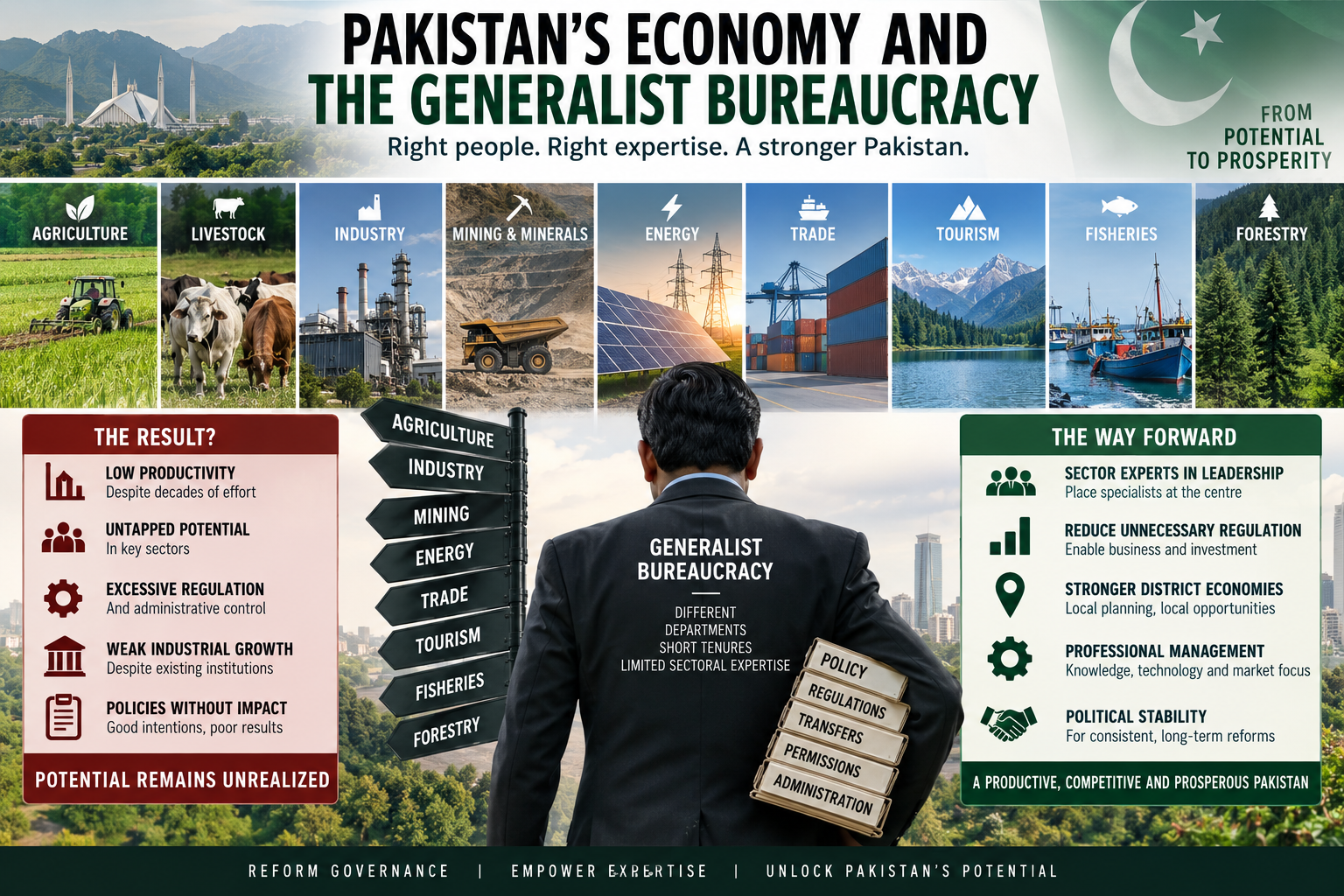

Pakistan has ministries and departments at both the federal and provincial levels for almost every major sector of the economy, as well as their various subsectors. Agriculture, livestock, industry, mining and minerals, energy, trade, tourism, fisheries, forestry, and other productive sectors all have established administrative structures. Yet a fundamental question remains: are these sectors actually being run by specialists in their respective fields, or is their leadership largely in the hands of the generalist bureaucracy?
This is not merely an administrative question. It is directly linked to Pakistan’s economic future.
We need to seriously ask why, despite decades of government involvement in agriculture, Pakistan has not achieved the improvements in agricultural productivity and per-acre yields that its potential should allow. Why has adequate human resource development not taken place in agriculture? Why does the sector continue to face persistent problems despite having a complete government department and an extensive administrative structure dedicated to it?
An even more important question is, who leads the agriculture department?
A generalist officer may be posted to the agriculture department for only a year or two. During that period, the officer takes charge of the department, receives national and international training, develops an understanding of its policy and administrative matters, and is then transferred to another department. As a result, sector-specific knowledge and institutional experience do not accumulate consistently within one field.
Meanwhile, professionals who have spent their entire careers working in agriculture, research, productivity, irrigation, seeds, soil, agricultural technology, and modern farming practices are often absent from the main centers of decision-making.
This is not simply an administrative weakness; it is a problem of institutional design.
The same question arises in relation to industrialization. Why has Pakistan failed to industrialize adequately despite having departments and institutions specifically established for industry? Why has the livestock sector not developed according to the enormous potential Pakistan possesses? Why have the country’s considerable mineral resources not yet been transformed into large-scale economic value? Why have we been unable to turn the potential of tourism, fisheries, forestry, and other productive sectors into sustainable economic activity?
If every sector has a department, a budget, a bureaucracy, policies, rules, and regulations, then why are the results missing?
This is why it would be a serious mistake to understand Pakistan’s economic crisis only as a financial crisis. To a considerable extent, Pakistan’s economic difficulties are also connected to a crisis of governance and bureaucracy.
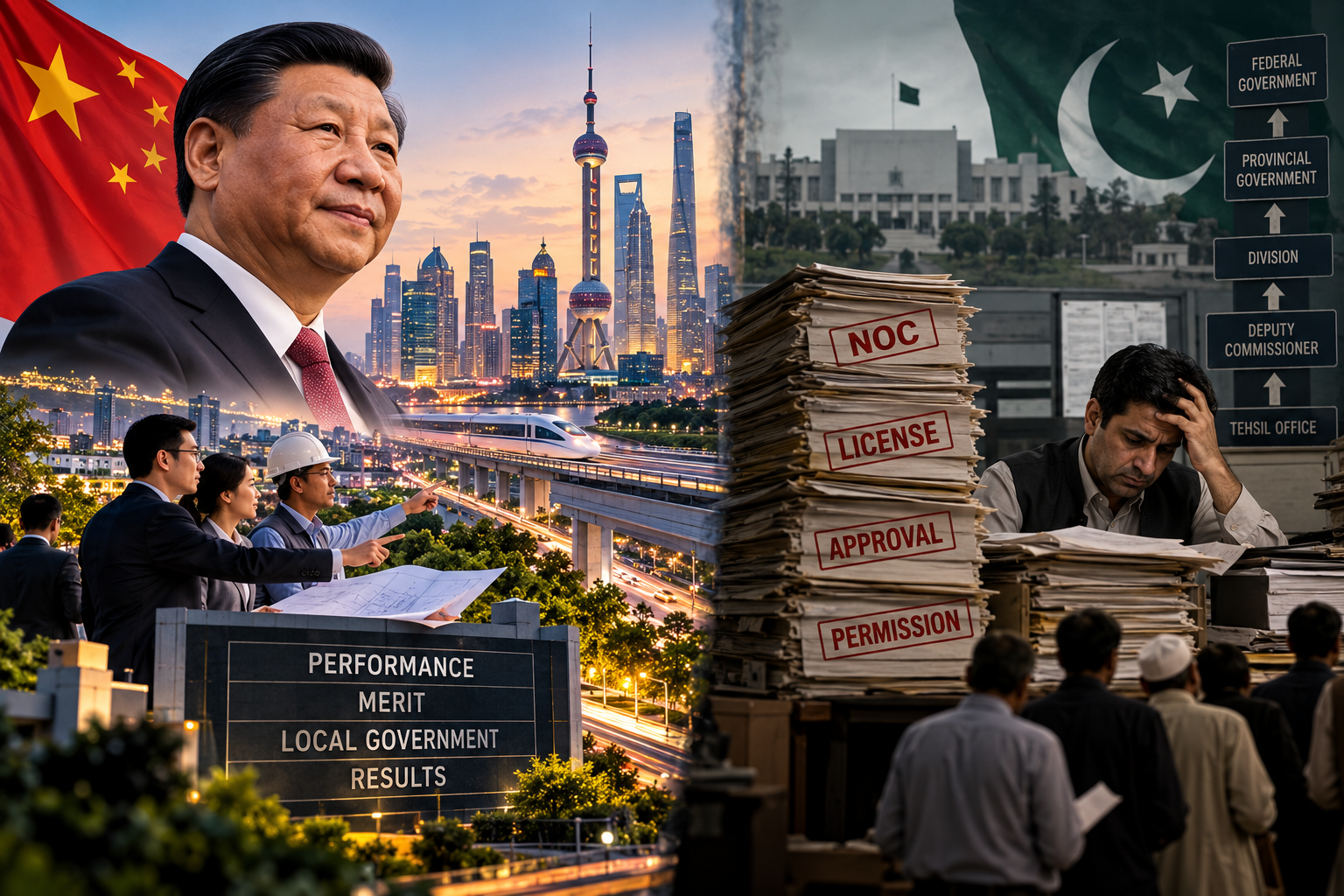
Pakistan’s existing governance model rests on a highly centralized and extractive administrative structure in which the bureaucracy exercises an unusually extensive role—from the collection of state revenues to economic regulation, licensing, policymaking, implementation, and administration. Consequently, almost every productive sector of the economy comes under the influence of an administrative machinery whose primary training is in general administration rather than in the economic and technical complexities of the particular sector concerned.
A fundamental principle must therefore be understood:
General administration and economic management are not the same thing.
A capable general administrator may be able to manage a range of government functions effectively. But that does not necessarily mean that the same person is best equipped to lead complex and specialized economic sectors such as agriculture, industrial production, minerals, energy, livestock, exports, or tourism.
An economy is a system of knowledge, specialization, research, capital, technology, markets, production, and competition. It cannot be managed effectively through files, regulations, transfers, and administrative orders alone.
Pakistan’s problem is also that its economy has not consistently been led by economists, sector specialists, and professional economic managers. Instead, much of its economic administration has remained under the generalist bureaucracy. The consequences are visible. Productive sectors that could have generated employment, exports, and wealth have failed to develop according to their true potential.
We repeatedly speak of Pakistan’s agricultural potential, mineral wealth, livestock potential, tourism opportunities, and other economic possibilities. But the real question is, who will convert this potential into economic output?
If the leadership and decision-making of a sector remain in the hands of officers who are posted there temporarily, whose careers are built around rotation between different departments, and who may not possess deep professional experience in that particular field, then creating another department or issuing another policy will not produce economic transformation.
Pakistan must reconsider this administrative philosophy.
Should the agriculture department not be led by agricultural experts? Should the livestock sector not be led by specialists in veterinary sciences, animal production, and the relevant economic fields? Should industrial policy and development not be led by professionals who understand industry, investment, production, technology, and international markets? Should the minerals sector not be jointly led by geological, mining, financial, and economic specialists?
These questions ultimately challenge Pakistan’s broader model of state administration.
The country needs to place sectoral and economic expertise at the center of state decision-making instead of relying overwhelmingly on the generalist bureaucracy. Where necessary, generalist officials can perform important functions involving administrative coordination, oversight, and interdepartmental cooperation. But specialists from the relevant fields should occupy a central position in the policymaking and administrative leadership of the productive sectors of the economy.
At the same time, Pakistan must significantly reduce unnecessary regulation, licensing requirements, and administrative interference in economic activity. The government’s role should not be to directly manage every economic activity or require official permission at every stage. The state should instead create an environment in which business, investment, production, innovation, and competition can flourish.
The District: The Basic Unit of Pakistan’s Economic Development
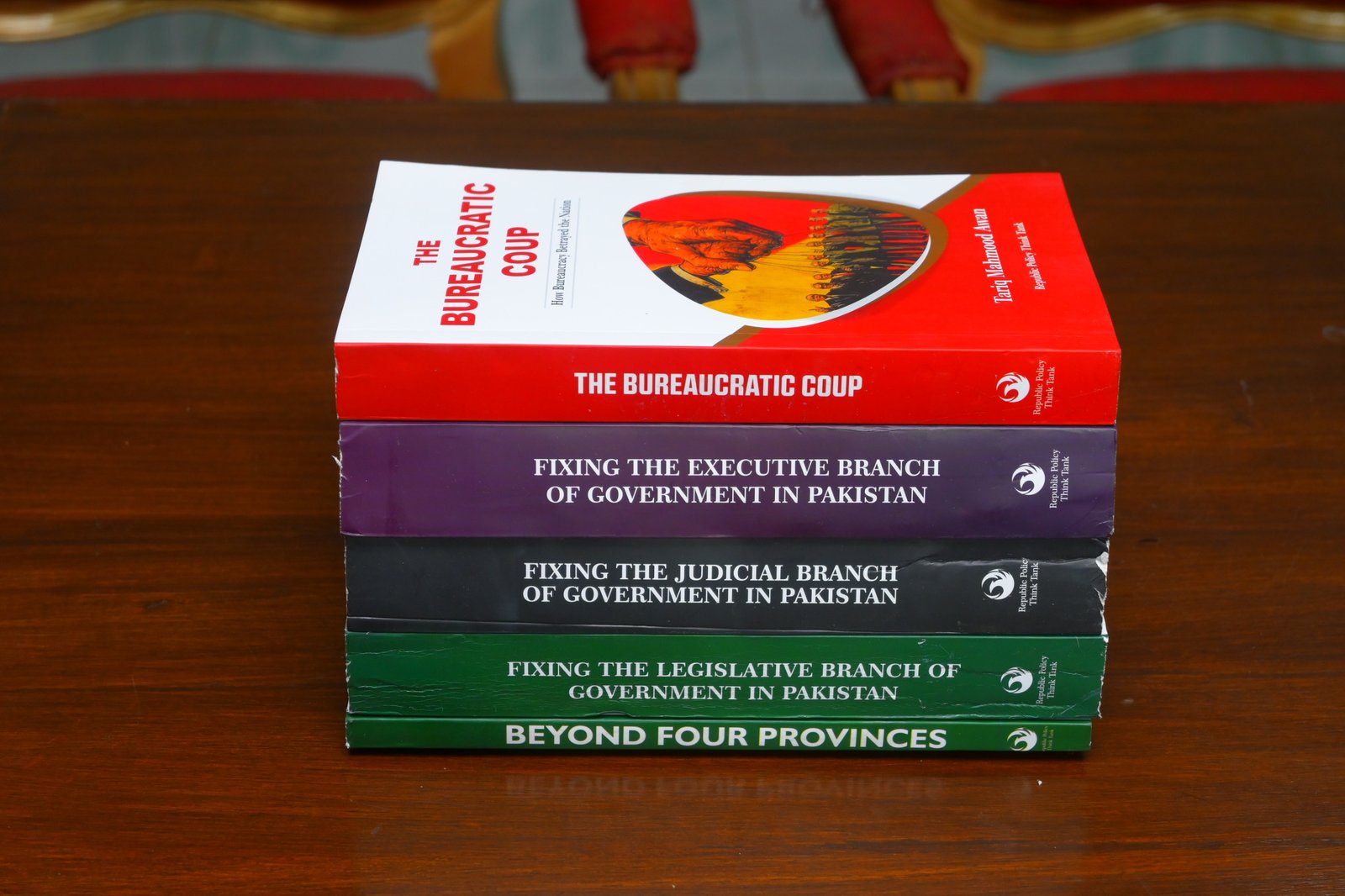
Another important dimension of Pakistan’s economic reform is the concept of the district economy, which I have presented in my book Fixing the Executive.
Pakistan’s districts are not identical. Every district has its own geography, climate, land, water resources, natural resources, human capital, markets, and economic potential.
Consider Rajanpur, which possesses considerable potential in agriculture and livestock. Attock has significant opportunities in mining and minerals. Narowal has considerable scope for agricultural production and industries linked to agriculture. Similarly, coastal regions have their own economic character, as do northern areas, the plains, and mineral-rich regions.
Pakistan’s diversity is one of its greatest economic strengths.
A country stretching from coastal areas to high mountain regions, with such varied geography, climate, resources, and economic possibilities, cannot effectively develop every district through a single centralized administrative formula.
Pakistan, therefore, needs to move towards strong district economies. Each district should identify its own economic strengths and develop its local human resources, investment, industries, agricultural value chains, tourism, minerals, and other sectors accordingly. District-level economic planning should be built around the actual potential of each locality.
Economic Reform Is Also Administrative Reform
The solution to Pakistan’s economic crisis does not lie only in new loans, higher taxes, changes in the budget, or another economic policy. Even the best economic policy cannot produce the desired results if the administrative structure responsible for implementing it remains weak, excessively centralized, and lacking in specialized expertise.
Pakistan’s economic reforms, therefore, cannot be separated from administrative reforms.
The economy will not realize its true potential until its productive sectors are led and managed by relevant specialists and professional economic managers.
Pakistan needs to move its economy away from excessive dependence on the generalist bureaucracy and towards specialization, professional management, economic freedom, local economic authority, and sector-specific leadership.
This is the fundamental debate I have raised in my book Fixing the Executive and in my other writings on state administration and governance.
For Pakistan, fixing the economy is not merely a matter of economic reform. It is also about reforming the country’s model of governance.
Two things are essential for such reform.
First, Pakistan needs a governance model that recognizes the importance of specialization, local authority, and economic freedom.
Second, it needs political stability that allows these reforms to be implemented consistently over time.
The most important reform in this entire process should be to place Pakistan’s economic sectors under the leadership of economists, sector specialists, and professional economic managers rather than relying primarily on the generalist bureaucracy. The objective is not to remove generalist civil servants entirely from economic administration. Rather, it is to end the practice of treating generalist bureaucracy as a substitute for professional leadership and sector-specific decision-making.
If Pakistan wants to improve its economy, it must first change the way the economy is administered. And if it wants to change economic administration, it must reform its model of governance.