
According to a report published in a newspaper, the proposed civil service reforms appear to be largely the same reforms Pakistan has been pursuing for the past eighty years. What surprised me most was that, whenever the federal government establishes such committees, it seems to overlook a fundamental constitutional reality: Pakistan is a federation, not a unitary state.
In my view, one of the principal reasons public policies fail in Pakistan is that unitary policies are introduced within a federal state.
Pakistan’s Constitution establishes a federal system, and the Fourth Schedule determines the subjects over which the federal government exercises legislative authority. Even within the federal sphere, powers are of two kinds: those that fall exclusively within federal jurisdiction and those that relate to the Council of Common Interests (CCI). Matters that do not fall within the federal legislative domain are generally within provincial jurisdiction.
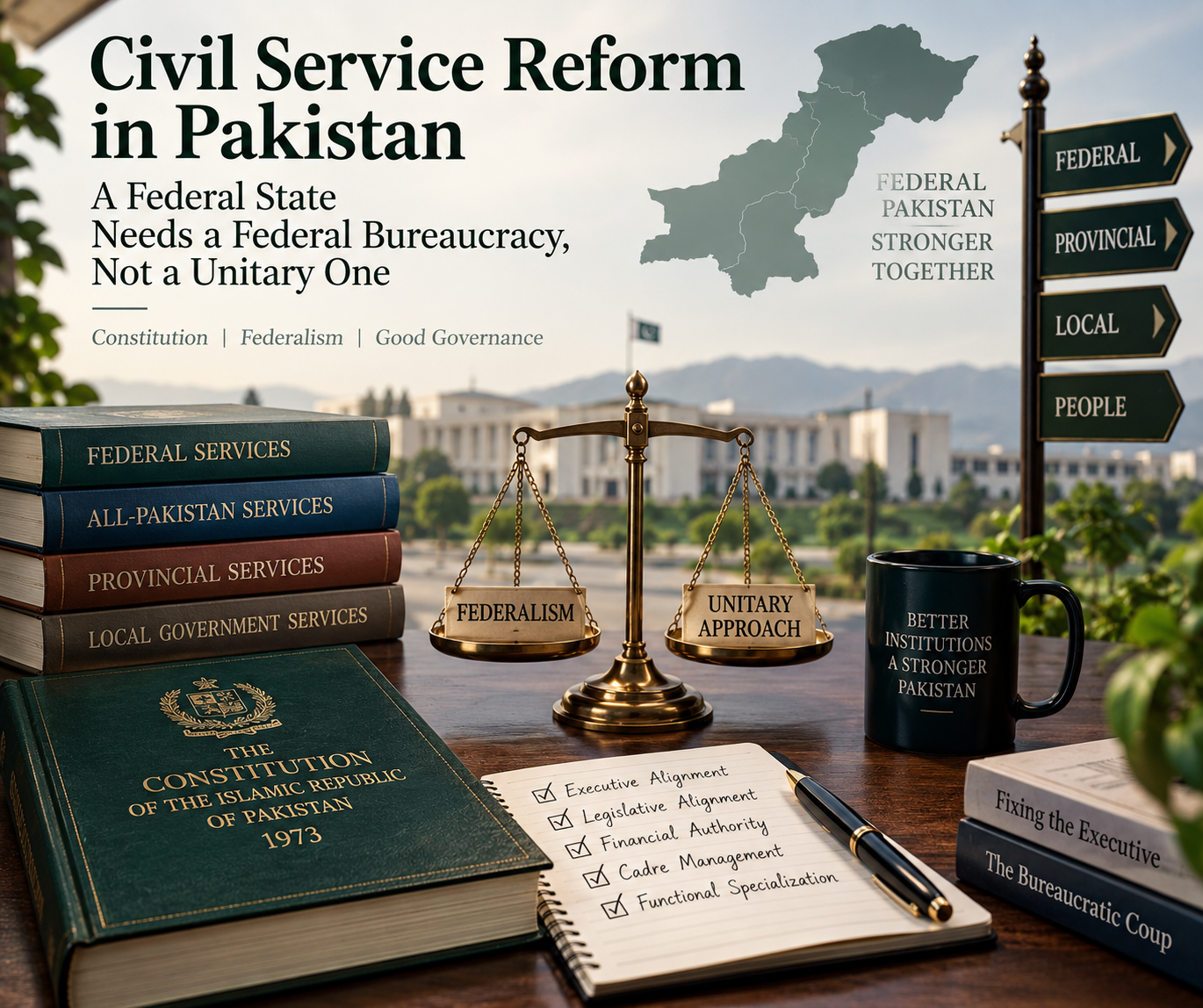
Constitutionally, Pakistan should have four categories of civil services. If Articles 240 and 140A are considered together, the framework points towards federal services, All-Pakistan services, provincial services and local government services.
Similarly, the constitutional structure identifies four corresponding tiers or spheres of governance and administration.
The federal government should have its own federal services. All-Pakistan or common services should serve the shared institutional arrangements involving the federation and the provinces, including the CCI and other joint forums. Provincial governments should have their own provincial services, while local governments should have their own local government services.
Executive Alignment Is Fundamental to Civil Service Reform
The second fundamental issue that our reform committees fail to understand is Executive Alignment.
The political executive and the bureaucratic executive are accountable to the same legislature. This is the essence of Executive Alignment, yet it has been overlooked in the proposed civil service reforms.
I was particularly surprised to see that the proposed professional groups largely concern provincial departments and provincial subjects.
How, then, can the National Executive Service or the federal government recruit officers through the Central Superior Services (CSS) examination for subjects that fall within provincial jurisdiction?
In my view, this would directly conflict with Articles 240 and 242 of the Constitution. Provincial services are matters for provincial legislatures and provincial governments.
If Pakistan is serious about civil service reform, those reforms must be undertaken within the framework of Articles 240 and 242.
They must also address Executive Alignment, Legislative Alignment, Executive Authority, Financial Authority and Legislative Authority.
Without examining these fundamental constitutional and institutional questions, Pakistan cannot resolve the problems of its civil services.
The federation of Pakistan can no longer afford the burden of a unitary bureaucracy.
Reform Committees Continue to Repeat Old Approaches
Another surprising aspect is that the committee was composed primarily of officers from the District Management Group (DMG). The other proposals also appear to repeat ideas that have surfaced periodically since the beginning.
If Pakistan intends to retain a unitary bureaucracy, then it might as well abolish the provinces and local governments altogether.
Pakistan must make a fundamental institutional choice: either operate as a federal state or adopt the administrative structure of a unitary state.
It cannot continue to maintain a federal constitutional structure while operating through a unitary bureaucracy.
Cadre Management Must Be Based on Constitutional Subjects
I also found little clarity in the proposals concerning Cadre Management.
Cadre Management is extremely important because a cadre must operate within its relevant subject.
The Federal Legislative List, Part I, contains 59 entries, which, in my proposed administrative model, can be organised into five ministries. Accordingly, the federal government should have no more than five corresponding services.
Two additional services could be established for matters falling within the jurisdiction of the CCI.
The Railways Group, for example, should be understood as a service concerning the CCI rather than an exclusively federal government service. It should be structured jointly by the federation and the provinces.
Likewise, provinces should have their own services under Article 240(b).
Local government services, however, lack explicit constitutional protection as a distinct category.
Every civil service established in Pakistan must have a legal foundation.
The Legal Basis of Civil Services Requires Examination
The proposed reforms reportedly include amendments to the Federal Civil Servants Act, 1973.
This is another aspect that surprised me.
Pakistan’s civil service structure continues to draw upon the rules introduced in 1954. In my view, the Federal Civil Servants Act, 1973, does not itself establish the civil services as distinct institutional cadres.
Pakistan lacks a comprehensive law governing the civil service structure in the manner required for meaningful reform.
The current proposal appears to follow the same approach that the bureaucracy has repeatedly adopted.
It demonstrates how easily bureaucratic reform exercises can overlook the Constitution, the legislature and Pakistan’s federal scheme.
Implementing such proposals may aggravate the problems of the civil services rather than resolve them.
The Two Fundamental Problems of Pakistan’s Civil Services
Pakistan’s civil services face two fundamental structural problems.
First, a unitary bureaucracy continues to operate within a federal state.
Second, cadres frequently move beyond their designated subjects and assume responsibilities in unrelated fields.
A cadre should remain within the subject for which it has been established.
For example, if Environment is a designated subject, the cadre established for that subject should deal exclusively with environmental administration. It should not extend its authority into unrelated subjects.
This is the principle of subject-based Cadre Management.
Similarly, Functional Specialization means appointing functional or specialized administrators who possess the relevant professional knowledge and administrative expertise.
Civil Service Reform Must Follow Pakistan’s Constitutional Structure
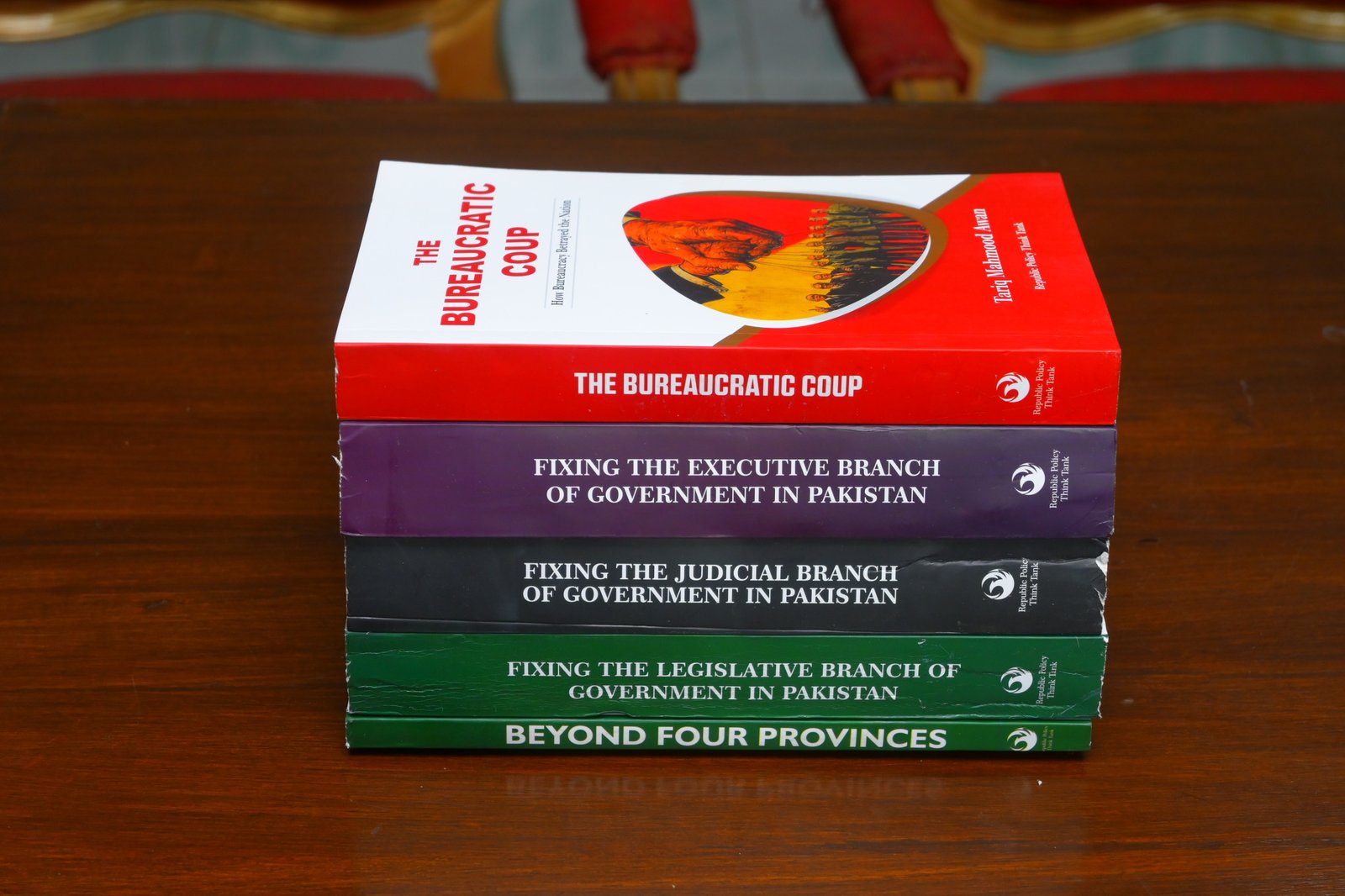
I have discussed these issues extensively in my books, Fixing the Executive and The Bureaucratic Coup.
My book Fixing the Executive is fundamentally concerned with civil service reforms. Across approximately 600 pages, it examines the subject from multiple constitutional, institutional and administrative perspectives.
If Pakistan genuinely intends to reform its civil services, those reforms must be consistent with the Constitution, the country’s parliamentary system of governance, the structure of the executive and the overall organisation of the state.
Civil service reform cannot be accomplished merely through executive orders or administrative decisions taken by the executive alone.
In my assessment, the current approach seeks to preserve Pakistan’s unitary and generalist civil service structure rather than transform it.
Such an approach will not address the underlying problems of public administration. Instead, it risks causing further damage to governance in Pakistan.