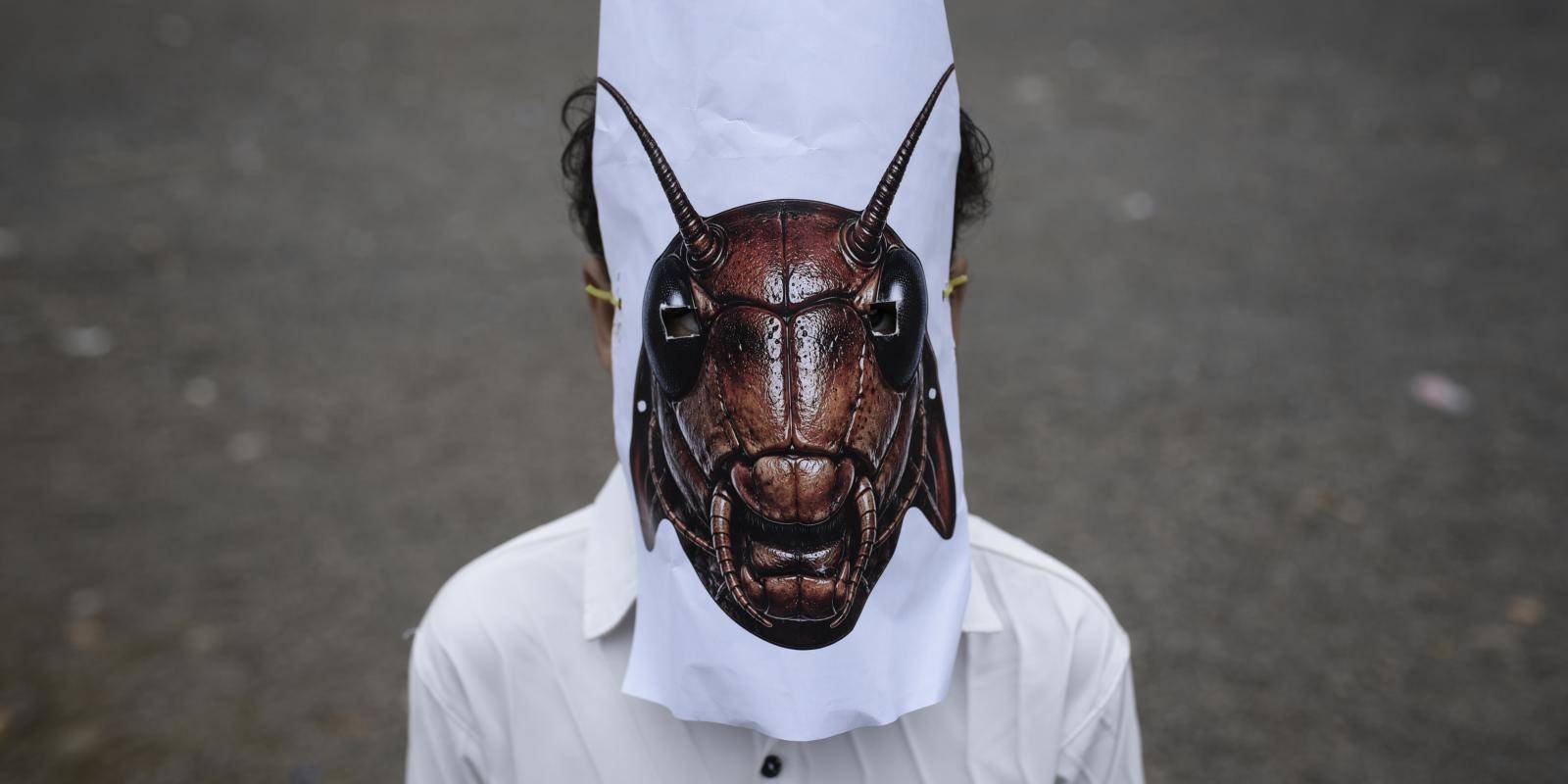

An Indian youth movement led by an organization calling itself the Cockroach Janata Party has called a halt to weeks of protest in India after securing a significant victory: the government has acceded to its key demands, and the education minister has resigned.
The rise of the CJP has been remarkable. It began as an online satirical platform, responding to a remark by India’s chief justice referring to the country’s unemployed youth as “cockroaches.” But since May it has swiftly grown into a real movement for political and social change, tapping into broader dissatisfaction among India’s young people.
The immediate trigger was a leak in the country’s medical examinations, which over 2.2 million students were due to sit in May. There were reports of several suicides associated with the decision to cancel and reschedule the exams. The CJP began protests near India’s Parliament in New Delhi, calling for the education minister’s resignation and compensation for affected families, with protests taking hold elsewhere too. Movement founder Abhijit Dipke returned to India in June to lead the demonstrations, and crowds swelled from hundreds to thousands after veteran activist Sonam Wangchuk, who had gone on hunger strike in support of the CJP, was forcibly removed from a protest on ostensible health grounds. Heavy-handed police tactics against young protesters then went viral, fuelling support among opposition politicians, celebrities, and other sections of society.
With its key demands met, the movement’s demonstrations have died down. But the grievances that produced it have not disappeared.
Fundamental Grievances Remain Unresolved
Disaffection among Indian youth reflects structural problems in the economy, including flaws in the education system and a lack of employment opportunities. The exam leak was only the latest in a string of scandals affecting India’s national examination system, following a major leak in 2024 and additional leaks in tests for police, teachers, and engineers. This points to deeper problems in India’s over-centralized examination system, overseen by the National Testing Agency, an autonomous body within the Ministry of Education. Education remains an emotive issue in India, where the middle class spends heavily on navigating a highly competitive exam system, often through a large private coaching industry.
The broader structural problem is the lack of economic opportunity for young people. A third of India’s working-age population is aged between 15 and 29, and nearly 40 percent of school graduates aged 15 to 25 are unemployed. Even before the latest demonstrations, there were signs of frustration with the government: Prime Minister Narendra Modi’s BJP performed more poorly than expected in the 2024 general election, a result attributed partly to concerns over youth unemployment and inequality, securing a third term but on a weaker mandate more dependent on coalition partners. These concerns have since been compounded by the Iran conflict, which is pressuring India’s economy and weakening the rupee, among the world’s poorest-performing currencies.
Similarities and Differences
South Asia has seen a string of recent “people power” movements, with governments ousted by large-scale unrest in Sri Lanka in 2022, Bangladesh in 2024, and Nepal in 2025, all fuelled by economic distress, political dysfunction, demographic pressures, and social media. There are clear parallels with the CJP: a young, aspirational population, grievances over fairness and administrative failure, and social media-driven mobilization.
But the comparison has limits. India’s youth movement is unlikely to unseat the government the way similar movements did in neighboring countries. Despite its name, the CJP is not, at least not yet, a political party, though several opposition politicians have offered moral and material support. Its objective during the recent demonstrations was narrowly focused on education reform. The Modi government also sits on much stronger footing than its regional peers, having governed nationally since 2014, with the BJP and its allies controlling 22 of India’s 36 states and union territories, and no strong, unified opposition to challenge it.
Grassroots movements face a high barrier to converting protest support into political power in India. That leaves street movements as one of the few available means for expressing opposition, from the 2020-21 farmers’ protests to earlier demonstrations against the Citizenship Amendment Act. Within a day of the CJP halting its protests, a new group calling itself the E20 Janta Party emerged to oppose the government’s ethanol-blended fuel requirements. Precedent also urges caution: the 2011 anti-corruption movement produced the Aam Aadmi Party, once seen as a potential third force in Indian politics, but it now controls only a single state.
Modi, despite his strongman image, has again shown an ability to adapt. After “sticks” failed to quash the CJP protests, his government pivoted to “carrots,” meeting CJP representatives, censuring several people linked to the exam leak, and ultimately dismissing the education minister. Following an initial period of silence, Modi pledged “swift and stringent punishment” for those responsible for the leaks. A bill was tabled in parliament this week to establish fast-track courts for such cases, and a taskforce led by Infosys co-founder Nandan Nilekani has been formed to examine the issue. Modi also said that “nothing is more important than the welfare and future of our youth.”
Outlook
None of this means the CJP has left Indian politics unchanged. The government has been visibly bruised by the demonstrations and is now likely to move more cautiously on other contentious policies, including the Uniform Civil Code and the delimitation of parliamentary constituencies.
While youth-led movements may have limited impact nationally, their influence could grow at the state level, as seen earlier this year when a relatively new party, TVK, defeated Tamil Nadu’s entrenched political establishment with the help of the youth vote. By the time of the next general election in 2029, the BJP will have governed for 15 years, making Modi India’s longest-serving prime minister, and a degree of “Modi fatigue,” combined with economic and governance concerns, could yet erode support for his government. For now, though, movements like the CJP appear more likely to act as a spoiler chipping away at the BJP’s mandate than to coalesce into the kind of unified opposition needed to unseat it.