
Prime Minister Shehbaz Sharif on Wednesday called on all stakeholders to unite under a single national innovation ecosystem, stressing the need to build indigenous knowledge and technological capability in Pakistan.
Addressing the inaugural ceremony of the Indus RAS – Robotics and Autonomous Systems Expo 2026, the prime minister said Pakistan must embrace the technological revolution while ensuring its benefits reach every part of society. “Let our universities, research and development centers, startups, industries, and farmers become part of one national innovation ecosystem, ensuring that the knowledge behind these technologies is indigenous, owned, and continuously advanced in Pakistan,” he said.
He emphasized that the robotics and autonomous systems revolution must not remain confined to advanced economies, large corporations, or major cities but should instead drive inclusive growth by improving the lives of farmers, small businesses, women entrepreneurs, young innovators, and underserved communities across Pakistan and the wider Global South.
Sharif noted that as these technologies grow more powerful, so too does the responsibility of governments and stakeholders to manage them. “We must establish clear regulatory and ethical frameworks to ensure autonomous systems are safe, secure, transparent, and always used for the benefit of mankind,” he said, reaffirming the government’s commitment to responsible and inclusive technological development.
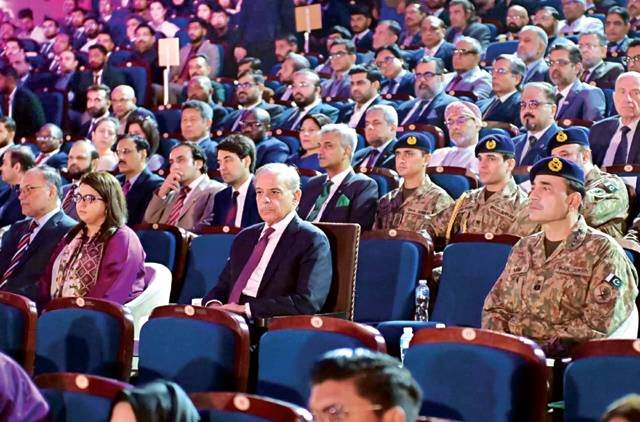
The ceremony was attended by Chief of Defence Forces and Army Chief Field Marshal Syed Asim Munir, along with federal ministers, industry experts, entrepreneurs, foreign delegates, and students.
The prime minister announced two flagship initiatives: the Spark and Elevate programs, aimed at transforming Pakistani research into globally competitive enterprises and high-productivity jobs; and the Pakistan Venture Fund, launched with an initial commitment of $20 million to catalyze investment in the country’s technology ecosystem.
He described the pursuit of robotics and autonomous systems as more than a technological story, calling it the story of 250 million resilient people determined to reimagine and build a better future, driven by the curiosity and ingenuity of the country’s young population. “Pakistan will not be a nation that merely inherits the choices made by others,” he said. “We will shape our own destiny through innovation, enterprise, self-reliance, and untiring efforts, God willing.”
Sharif pointed to agriculture as one sector already transformed by emerging technology, noting that farmers who once worked at the mercy of water scarcity, rising costs, and unpredictable climate patterns have benefited from new tools and that the same technologies have helped save lives during crises when roads and bridges were washed away.
He also highlighted progress in indigenous defense technology under Field Marshal Munir’s leadership, citing simulators fully manufactured in Pakistan and drones that have achieved more than 60 percent indigenization. He credited the armed forces, alongside Air Chief Marshal Zaheer Ahmed Babar Sidhu and Naval Chief Admiral Naveed Ashraf, with using advanced autonomous systems to defend the country’s physical and cyber frontiers during last year’s Marqa-e-Haq, calling the episode proof of Pakistan’s indigenous technological capability alongside its resolve.
IT Minister Shaza Fatima Khawaja, speaking earlier at the event, said countries leading in emerging technologies would define the future economy and that Pakistan intended to own full value chains in robotics and artificial intelligence as a matter of national policy. She said the government’s Digital Nation Pakistan vision treats technology as an engine of productivity and competitiveness rather than a peripheral economic lever, pointing to a nearly 21 percent rise in ICT exports this year, along with gains of 14 places in the E-Governance Development Index and 27 places in the ITU’s ICT Development Index.