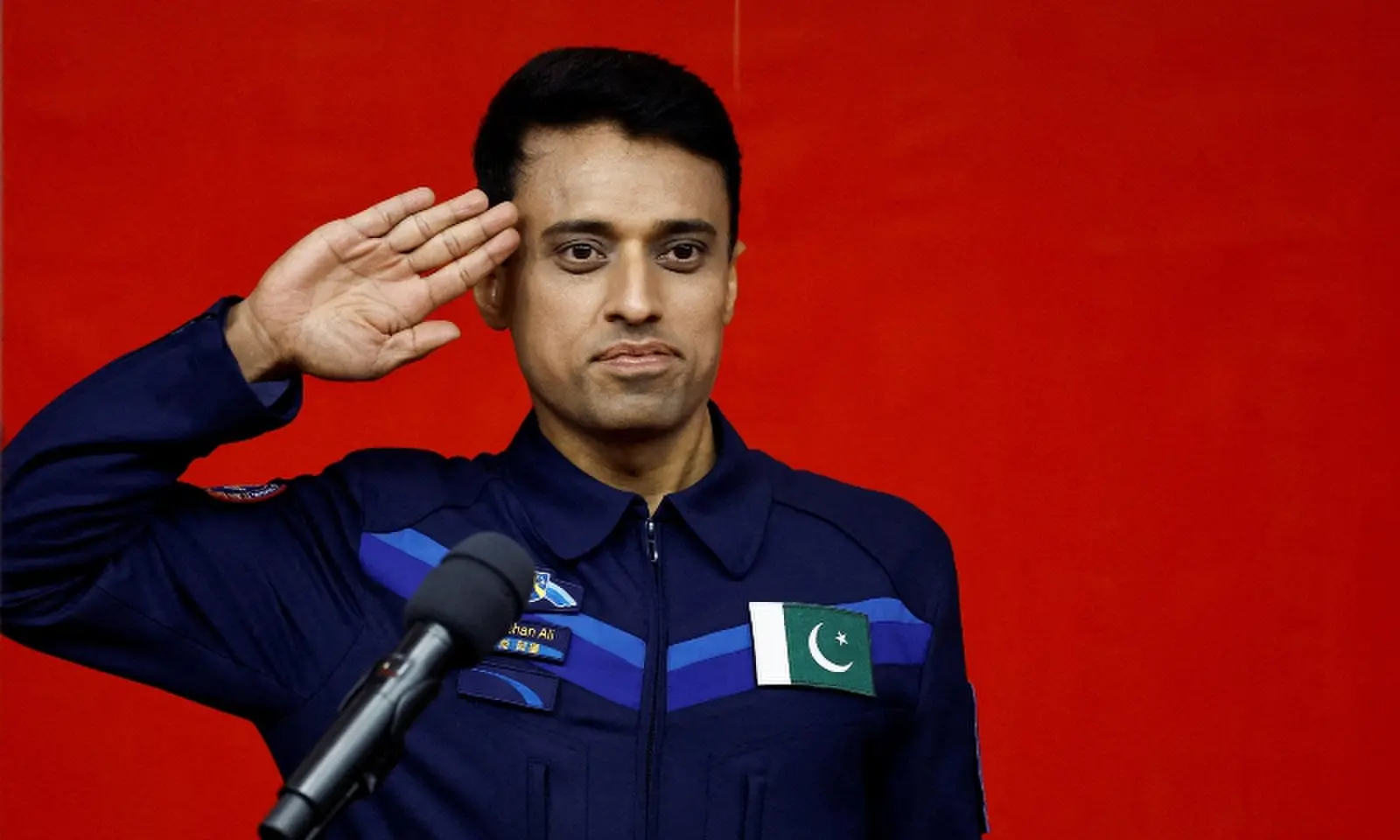

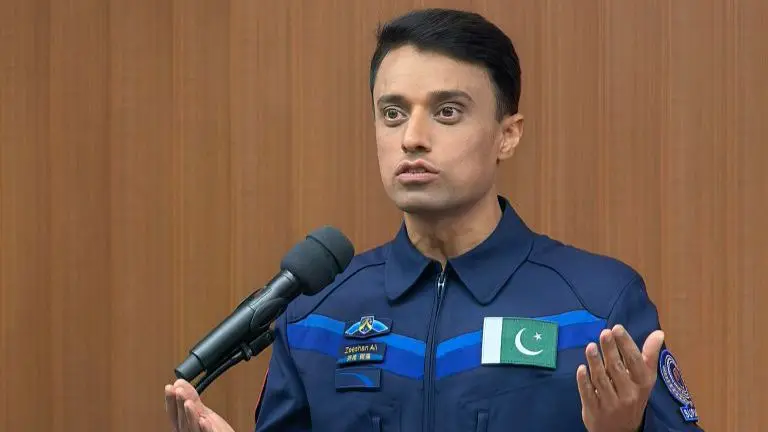

Pakistan has entered a historic chapter in its space journey as Muhammad Zeeshan Ali became the country’s first professionally trained astronaut to travel into space, joining China’s Shenzhou-24 mission aboard the Tiangong space station. The mission marks a significant milestone in Pakistan-China scientific cooperation and places Pakistan among countries participating in human spaceflight through international partnerships.
The Shenzhou-24 spacecraft lifted off on Wednesday from the Jiuquan Satellite Launch Centre in China’s Gobi Desert at 8:18am local time, carrying three astronauts: Chinese mission commander Tang Hongbo, flight engineer Wu Yi and Pakistani payload specialist Muhammad Zeeshan Ali. The launch was followed by a successful journey into orbit, with the spacecraft docking at the Tiangong space station approximately three and a half hours later.
For Pakistan, the mission represents an important achievement in a space programme that has so far lacked the capability to independently send humans into orbit. Ali’s participation became possible through cooperation with Beijing, which has increasingly opened its space programme to international scientific partnerships and selected foreign participants.
The Pakistani astronaut’s journey is particularly significant because he is the first foreign national to board China’s Tiangong space station, reflecting Beijing’s ambition to establish the facility as an international research platform rather than an exclusively Chinese orbital outpost.
A milestone for Pakistan’s space programme
Ali’s achievement carries particular significance for Pakistan, which does not possess an independent spacecraft or human spaceflight infrastructure capable of sending astronauts into orbit. The country has relied on Chinese cooperation for the mission, including astronaut selection, training and preparations for the demanding technical requirements of space travel.
The opportunity emerged from growing cooperation between Pakistan and China in the space sector. The two countries signed a space cooperation agreement last year, strengthening the framework for collaboration and paving the way for Pakistani participation in China’s crewed space programme.
Ali and Khurram Dawood, who also reached the final stage of the astronaut selection process, underwent training in China under the supervision of Chinese space experts. Their preparation involved working within China’s space training system and acquiring the technical knowledge necessary for participation in a crewed mission.
Ali, a former Pakistan Air Force pilot, underwent extensive physical, technical and operational training before being selected for the mission. His preparation included centrifuge exercises, emergency procedures, rescue and survival training, and the demanding process of adapting to the physical conditions associated with spaceflight.
One of his most challenging assignments was mastering the Chinese language. Because spacecraft systems, switches, software, instructions and voice announcements are largely in Mandarin, understanding the language was essential for safely operating within the mission environment.
Ali reportedly underwent seven months of intensive Chinese-language training in Beijing, where he also familiarised himself with Chinese technical terminology and immersed himself in the country’s cultural environment. His preparation included learning Chinese songs and poetry, practising calligraphy and playing table tennis.
Reflecting on the experience, Ali acknowledged that mastering Mandarin had been among the most difficult aspects of his preparation, despite completing demanding physical and emergency training exercises.
Carrying the hopes of millions
Before launch, Ali described the mission as a responsibility extending beyond his personal achievement, presenting himself as a representative of Pakistan and its people.
“I carry the name of Pakistan on my shoulder, the hopes of 250 million Pakistanis,” he said.
Addressing young people watching the mission, he encouraged them to look towards the sky and believe in the possibilities of scientific achievement, saying he was carrying their dreams with him into orbit.
The statement captured the national significance attached to the mission, particularly for a country where space exploration remains largely beyond the reach of domestic technological infrastructure. His journey is expected to inspire students, young scientists and aspiring engineers to pursue careers in science, technology, aerospace and research.
Planning Minister Ahsan Iqbal Chaudhary described the launch as a landmark moment for Pakistan, saying it reflected the longstanding friendship and cooperation between Islamabad and Beijing.
The mission also provides Pakistan an opportunity to participate directly in scientific research conducted in a microgravity environment, strengthening its engagement with international space science.
Scientific experiments aboard Tiangong
The Shenzhou-24 crew will conduct a series of scientific experiments and technological tests during their stay aboard the Tiangong space station. The research will cover areas including space life sciences, aerospace medicine and combustion, helping scientists understand how microgravity and the space environment influence biological and physical processes.
Ali will undertake experiments assigned by Pakistan’s space agency, including research involving photosynthesis in bacteria and the effects of microgravity and space radiation on quinoa seeds. The experiments could contribute to a better understanding of biological processes under space conditions and their potential applications in future scientific research.
The crew’s research will also examine how the space environment affects processes such as vascular ageing, potentially offering insights into prevention and treatment strategies for certain health-related challenges.
Ali’s stay aboard the space station is expected to be relatively short, lasting approximately five days to a week, after which he will return to Earth aboard the Shenzhou-23 spacecraft already docked with Tiangong. The Chinese astronauts, meanwhile, are scheduled to continue their longer-duration mission.
The distinction between Ali’s mission and previous Pakistani space-related achievements is also important. Namira Salim travelled beyond Earth’s atmosphere in 2023 aboard Virgin Galactic’s commercial suborbital flight, becoming the first Pakistani woman to experience spaceflight. However, Ali’s mission marks the first time a professionally trained Pakistani astronaut has travelled into orbit and joined a space station mission.
China’s growing ambitions in space
For China, the mission is equally significant beyond its scientific objectives. Beijing is seeking to strengthen its position in space exploration and establish Tiangong as a credible alternative to other international space platforms. Allowing a Pakistani astronaut to participate in its crewed mission helps demonstrate that China’s space infrastructure can accommodate international scientific cooperation.
China has invested billions of dollars in its space programme and is pursuing ambitious plans for lunar exploration, including sending astronauts to the Moon by 2030. Its achievements, including bringing back samples from the Moon’s far side in 2024, have reinforced its ambitions to compete with the United States in space exploration.
International partnerships also serve China’s diplomatic objectives by expanding its scientific relationships, demonstrating technological capabilities and offering other countries opportunities to participate in space missions.
The Shenzhou-24 mission therefore carries both scientific and geopolitical significance. For Pakistan, it provides an unprecedented opportunity to develop experience in human spaceflight and participate in orbital research. For China, it strengthens the international profile of its space station and supports its ambition to establish itself as a leading space power.
The successful launch and docking of Shenzhou-24 represent a moment of national pride for Pakistan and a significant development in bilateral cooperation. While the mission does not mean Pakistan has independently acquired human spaceflight capabilities, it opens an important avenue for scientific collaboration, technological learning and future participation in international space exploration.
Ali’s journey to Tiangong may last only a few days, but its significance could extend well beyond his return to Earth. It places Pakistan’s scientific ambitions in a new orbit, offering a powerful reminder of how international partnerships can create opportunities that countries cannot yet achieve independently.