
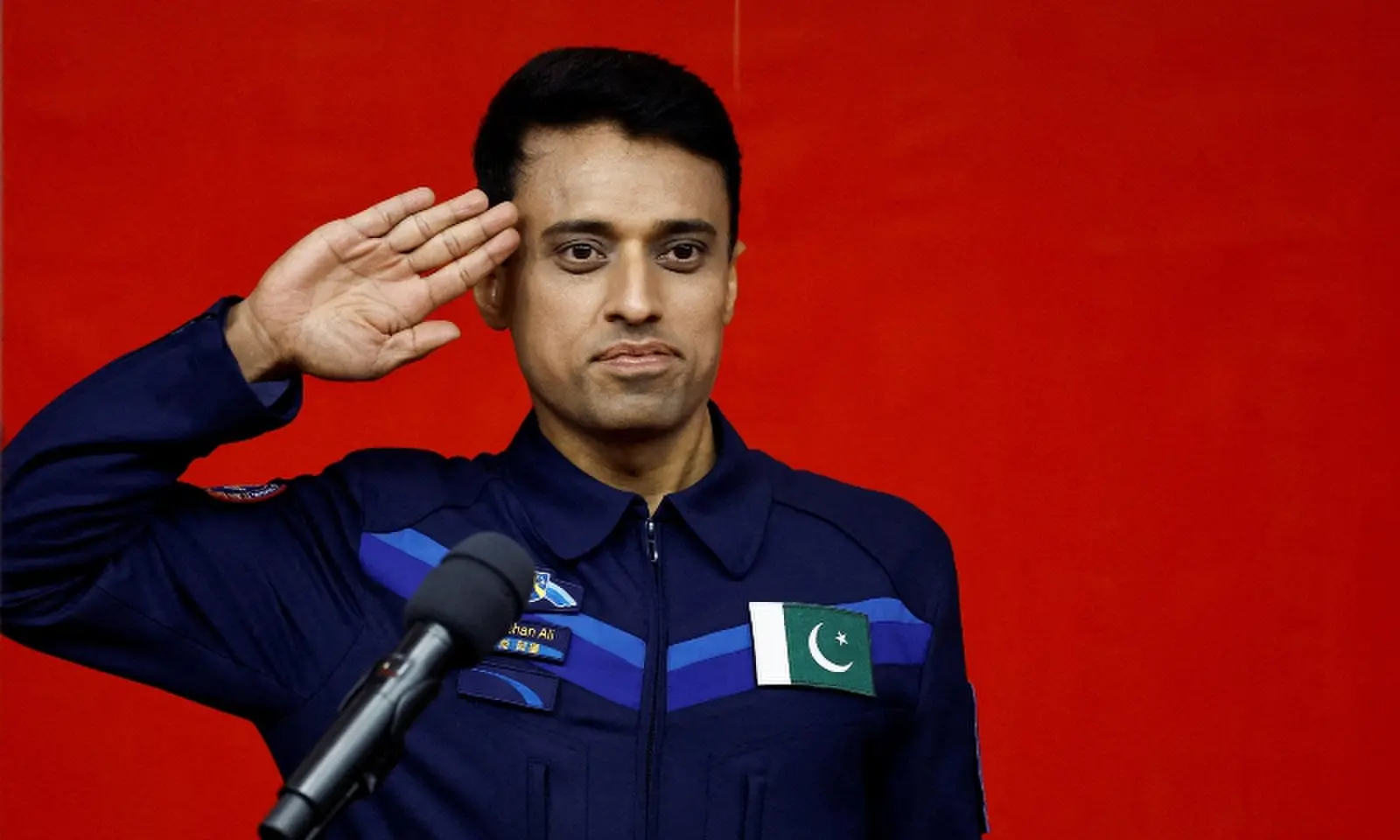

Carrying the hopes of 250 million Pakistanis, Ali is scheduled to join China’s Tiangong space station in a landmark mission that marks a new chapter in Pakistan-China space cooperation.
Pakistan is set to achieve a historic milestone in space exploration as Mohammad Zeeshan Ali prepares to become the first Pakistani to undertake an orbital space mission, joining the crew of China’s Shenzhou-24 spacecraft scheduled for launch on November 25.
Ali’s participation will also make him the first foreign national to visit China’s Tiangong space station, according to the China Manned Space Agency (CMSA). The mission represents a significant development in Pakistan’s emerging space ambitions and reflects the expanding scientific and technological cooperation between Islamabad and Beijing.
Planning Minister Ahsan Iqbal, who is currently visiting China, described Ali as Pakistan’s first astronaut in a message on social media platform X. Information Minister Attaullah Tarar also congratulated him, calling the achievement a moment of pride for the entire nation.
The Shenzhou-24 mission is scheduled to lift off at 8:18am Beijing time, or 5:18am Pakistan time, from the Jiuquan Satellite Launch Centre in northwestern China. The spacecraft will be carried into orbit by a Long March-2F rocket.
CMSA spokesperson Zhang Jingbo confirmed at a press conference that the rocket would soon be filled with propellant and that preparations were proceeding according to schedule. He said the crew was in good condition and the space station was functioning normally, meeting the requirements for the mission.
A Historic First for Pakistan
Ali will serve as a payload specialist during the mission, working alongside Chinese astronauts Tang Hongbo and Wu Yi. Tang will command the mission, while Wu will serve as its pilot.
According to the Chinese space agency, Ali is expected to spend approximately one week in space, participating in scientific activities and experiments with the Chinese crew. Around 90 experiments are planned during the mission, covering different aspects of space science and research.
The Pakistani astronaut is scheduled to return to Earth aboard the Shenzhou-23 spacecraft, which docked with the Tiangong space station in May. He will return alongside Hong Kong astronaut Lai Ka-ying and astronaut Zhang Zhiyuan, who are currently aboard the station.
The mission will also involve an orbital rotation, allowing the incoming crew to take over responsibilities from astronauts completing their stay. Routine maintenance, station operations and continued scientific research will form part of the broader mission objectives.
For Pakistan, however, Ali’s participation carries significance beyond the technical responsibilities of a single spaceflight. It marks the country’s first direct participation in a crewed orbital mission and creates an opportunity to develop its human spaceflight capabilities through international cooperation.
‘Carrying the Hopes of 250 Million Pakistanis’
Speaking at a press briefing in Jiayuguan, Ali expressed gratitude to the Chinese government and the institutions that had helped him prepare for the mission. He said he had arrived at China’s Astronaut Centre only a few months earlier, carrying the hopes and aspirations of 250 million Pakistanis.
Describing his training experience, Ali said the preparation had exceeded his initial expectations. He credited the management, instructors and staff at the Astronaut Centre of China with providing comprehensive training and helping him acquire the skills required for spaceflight.
He also highlighted the personal and cultural experience of preparing alongside Chinese colleagues. Ali said he had learned the Chinese language and developed close friendships with his fellow crew members, enabling him to communicate with them in their own language.
Reflecting on the relationship between the two countries, he described the friendship formed during training as an expression of the wider China-Pakistan relationship.
“We trained side by side, and our friendship embodies the friendship between China and Pakistan: higher than the mountains, deeper than the oceans, sweeter than honey and as vast as outer space,” he said.
Ali also referred to Chinese President Xi Jinping’s vision of developing China’s space industry and expanding human understanding of the universe. He said the ambition of exploring space had become a shared aspiration for him and Pakistan.
Addressing the significance of the mission, he made clear that he viewed the flight not as the conclusion of an achievement but as the beginning of a longer journey.
“This mission is not a finish line; it is a launch pad,” he said, expressing hope that future cooperation between China and Pakistan would expand from one astronaut and one flight to multiple joint missions, potentially extending towards the Moon, Mars and beyond.
From One Mission to a Broader Space Partnership
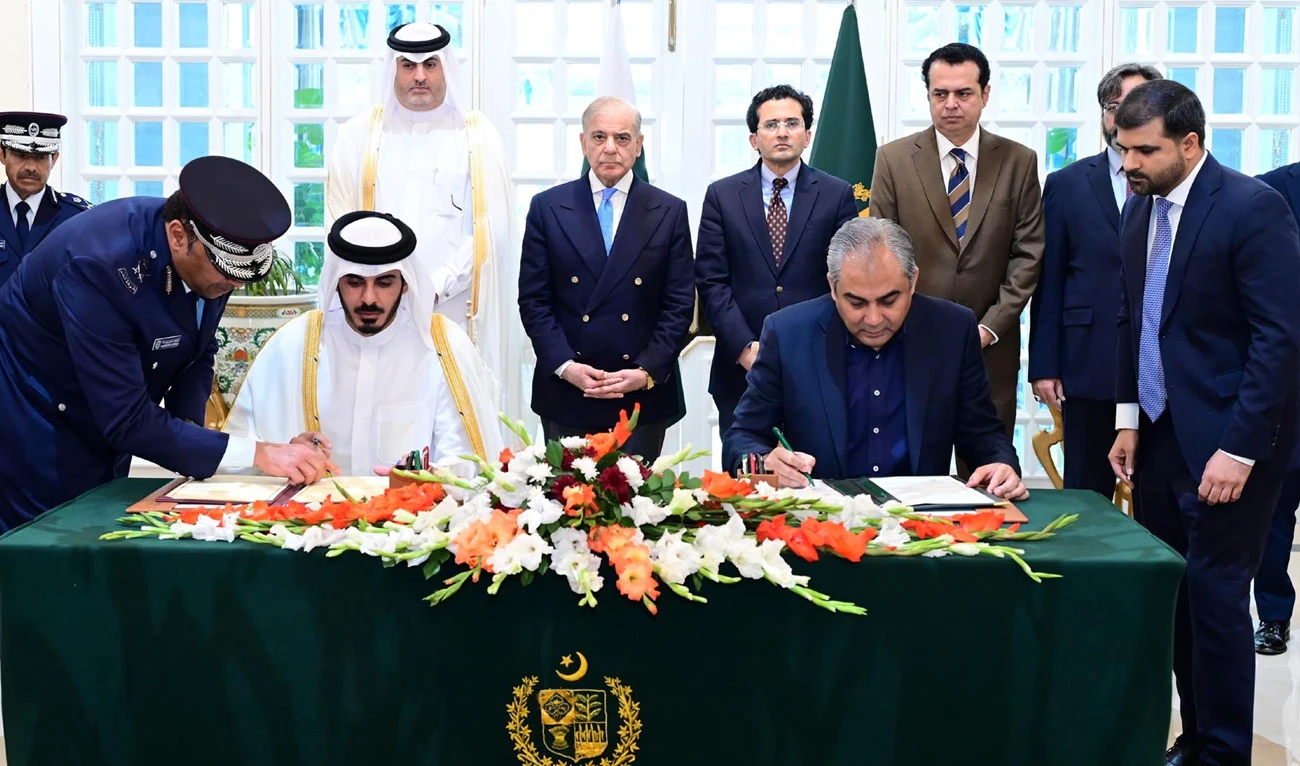
Ali’s remarks underline the potential significance of the mission for Pakistan’s future space programme. His participation is the outcome of a formal cooperation agreement between Pakistan’s Space and Upper Atmosphere Research Commission (Suparco) and the China Manned Space Agency, signed in February 2025.
Under the agreement, two Pakistani candidates were selected to undergo astronaut training in China, with one expected to participate in a mission aboard the Tiangong space station.
Earlier, in April, Zeeshan Ali and Khurram Daud were selected to begin their training in China. Prime Minister Shehbaz Sharif met both candidates following their selection and congratulated them on the opportunity. He described the mission as a matter of national pride and commended their sustained efforts in reaching this stage.
The prime minister also expressed hope that the programme would add new dimensions to the longstanding relationship between Pakistan and China.
The selection of two candidates reflected an institutional commitment to building Pakistan’s participation in human spaceflight rather than treating the mission as an isolated symbolic event. Ali’s upcoming journey is therefore an important first step in a cooperation framework that could create further opportunities for Pakistani scientists and space professionals.
China’s Tiangong Programme and International Cooperation
The mission also comes at a time when China is expanding its position as a major spacefaring nation. Beijing has invested heavily in its space programme over recent years, developing independent human spaceflight capabilities and constructing the Tiangong space station.
China has set an ambitious target of landing astronauts on the Moon by 2030, while continuing research and technological development aboard its orbital station.
The Tiangong programme has also provided Beijing with an opportunity to develop partnerships with other countries. China has been excluded from participation in the International Space Station programme since 2011, when US restrictions prohibited NASA from cooperating with Chinese space agencies. It has consequently pursued alternative international partnerships as its own space infrastructure has expanded.
Pakistan has emerged as one of China’s partners in this effort, building on decades of cooperation in strategic, economic, scientific and technological fields.
The two countries’ collaboration in space is particularly significant because it creates opportunities for Pakistan to gain access to advanced training, scientific facilities and technical expertise that would otherwise require substantial domestic investment and institutional development.
For Pakistan, the challenge will be to translate the experience gained through international cooperation into stronger national research capabilities, scientific education and long-term institutional capacity.
A National Milestone and the Road Ahead
Ali’s mission coincides with the 75th anniversary of diplomatic relations between Pakistan and China in 2026, giving the event additional symbolic importance. He said the flight would demonstrate that the friendship between the two countries extended beyond diplomatic statements and could produce tangible achievements in science and technology.
In his message to Pakistanis, Ali said he was not undertaking the journey for personal recognition alone but was carrying the country’s name and the aspirations of its people.
He also addressed young Pakistanis, particularly children watching the mission, encouraging them to look towards the sky and recognise that their ambitions need not be limited by geographical or institutional boundaries.
His message to his family was equally personal. He acknowledged that the journey would take him farther from home than ever before, but said that when he first looked back at Earth from space, he would search for the light of home.
Ali thanked his fellow trainees, instructors, scientists, engineers, Suparco and the China Manned Space Agency, saying that the achievement was the result of collective effort.
The mission’s importance will ultimately be measured not only by the historic nature of one Pakistani astronaut reaching orbit but also by what follows. Sustained investment in scientific research, technical education and institutional capacity will be essential if Pakistan is to build on this milestone.
As Ali prepares to board Shenzhou-24, Pakistan’s participation in human spaceflight enters a new phase. His journey to Tiangong represents a moment of national pride, but it also presents a larger opportunity: to turn an individual achievement into a lasting foundation for scientific progress and future generations of Pakistani space explorers.