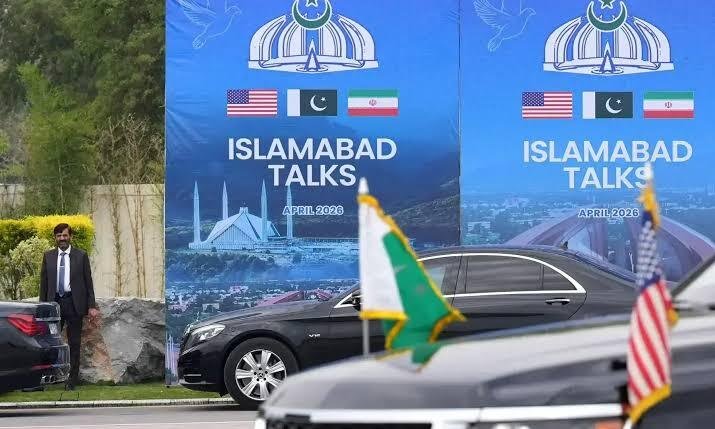

Pakistan continues diplomatic efforts to bring Washington and Tehran back to commitments, as Islamabad pushes regional dialogue, economic stability and a broader peace architecture amid continuing tensions.
ISLAMABAD: Deputy Prime Minister and Foreign Minister Ishaq Dar has expressed optimism about an early peace agreement between the United States and Iran, warning that prolonged conflict in the Middle East could further destabilise energy markets, increase prices and deepen economic hardships for populations across the region and beyond.
In an interview with Euronews, broadcast by PTV News on Saturday, Dar said he remained hopeful that Washington and Tehran would eventually reach an understanding, emphasising that the consequences of continued confrontation were increasingly visible in disrupted energy supplies, rising prices and economic pressure on ordinary people.
“I’m a born optimist. I think I would certainly expect that sooner or later, I hope it’s sooner, that we will achieve that objective,” he said.
Dar pointed to the disruptions in the global energy supply chain and the resulting price increases, saying the economic consequences of regional hostilities were affecting people in multiple countries, including Pakistan. He maintained that Islamabad had continued its diplomatic engagement with both sides despite subsequent violations of the June 18 agreement, urging Washington and Tehran to honour their commitments and return to the path of negotiations.
Pakistan’s Mediation and the Islamabad Agreement
Dar outlined Pakistan’s diplomatic role in facilitating direct engagement between the United States and Iran, describing dialogue as the only viable mechanism for resolving the confrontation. He said Islamabad had consistently advocated peaceful dispute resolution, respect for sovereignty and a multilateral approach to international conflicts.
Recalling the outbreak of hostilities on February 28, Dar said Pakistan was among the first countries to condemn the Israeli attack on Iran. He said he had subsequently contacted Iranian Foreign Minister Abbas Araghchi, urging restraint and advising Tehran against extending the conflict to Gulf and other Middle Eastern states. Iran later carried out strikes against US military bases in the region, further escalating tensions.
Pakistan’s diplomatic engagement, according to Dar, culminated in direct negotiations between American and Iranian delegations in Islamabad on April 10 and 11. The talks continued for approximately 21 hours, bringing the two sides close to an agreement before one delegation paused proceedings to consult its leadership.
He said continued mediation efforts eventually resulted in the Islamabad Memorandum of Understanding signed on June 18. According to Dar, the framework was endorsed remotely by US President Donald Trump, who was in France following the G7 summit, and the Iranian president.
The deputy prime minister also referred to a five-point Middle East peace initiative developed during his March 31 visit to China, where he held discussions with Chinese Foreign Minister Wang Yi. He said Pakistan’s diplomatic efforts were aimed at building consensus among regional and international stakeholders to prevent further escalation.
Islamabad Calls for a Regional Security Architecture
Dar stressed that the Middle East required a new regional security framework capable of protecting economic interests, ensuring stability and preventing future conflicts. He argued that military confrontation could not produce sustainable peace and that regional security arrangements needed to be built around diplomacy, restraint and collective responsibility.
He referred to a consensus statement issued by 12 Islamic countries in Riyadh in March, followed by the diplomatic engagement of the Regional Four, comprising Pakistan, Saudi Arabia, Turkiye and Egypt.
The initiative subsequently expanded through discussions held in Istanbul on October 23 involving the European Four — the United Kingdom, France, Germany and Italy. Dar said Germany had invited both regional and European groupings for further discussions in December, signalling continued efforts to coordinate international diplomacy.
“This is a combined responsibility to keep both parties cool and make them understand that there is no solution through kinetic actions — it has to be through dialogue and diplomacy,” he said.
Dar also highlighted Pakistan’s relations with Washington and Beijing, describing Islamabad’s current engagement with the United States as proactive while reaffirming the country’s longstanding strategic partnership with China. He said Pakistan maintained independent relationships with major powers, including the United States, China, Europe and Middle Eastern countries, and rejected the notion that its foreign policy should be confined to competing geopolitical blocs.
He further called for reform of international institutions, including the United Nations, World Bank and International Monetary Fund, arguing that their structures needed to evolve to better support global peace, economic development and prosperity.
Afghanistan Must Take Verifiable Action Against Terrorism
On Afghanistan, Dar said Pakistan wanted a stable, peaceful and economically prosperous neighbour, recalling his three visits to Kabul during 2025 aimed at ending a prolonged diplomatic stalemate.
He said Islamabad had responded to Afghan requests concerning trade, economic cooperation and refugees within eight weeks and had also approached the World Bank regarding the revival of the CASA-1000 electricity project.
However, he said Pakistan’s central security concern remained unresolved: the use of Afghan territory by terrorist organisations targeting Pakistan.
Dar said Islamabad needed concrete and verifiable action against militant groups rather than assurances, arguing that rebuilding trust required tangible measures to prevent cross-border terrorism.
He cited Pakistan’s heavy human and economic losses in the fight against terrorism, claiming the country had sacrificed approximately 100,000 lives and suffered economic losses of around $150 billion. He said these costs made it imperative for Afghanistan to demonstrate a clear commitment to preventing militant activity from its territory.
Dialogue With India Depends on New Delhi
Dar said the resumption of dialogue between Pakistan and India depended on New Delhi, referring to India’s constitutional changes in Jammu and Kashmir on August 5, 2019, which Islamabad maintains are contrary to United Nations Security Council resolutions.
He also referred to the military confrontation between the two nuclear-armed neighbours in May 2025 following the Pahalgam attack. Dar said Prime Minister Shehbaz Sharif had offered an international investigation into the incident, but India had declined the proposal.
The foreign minister also criticised India’s decision to place the Indus Waters Treaty of 1960 in abeyance, arguing that international agreements could not be unilaterally suspended. He referred to a Court of Arbitration ruling affirming the treaty’s validity and warned that water security remained fundamental to Pakistan’s agriculture, livelihoods and food supply.
Dar said water resources served the needs of approximately 260 million people in Pakistan and rejected any alteration of treaty arrangements without lawful agreement.
“Weaponising water is not desirable,” he said, calling for respect for international agreements and established legal frameworks.
Economic Diplomacy, CPEC 2.0 and European Relations
Turning to economic matters, Dar said Pakistan’s external debt stood at approximately $130 billion, while the country’s untapped mineral and rare-earth resources represented substantial potential. He cited estimates of between $6 trillion and $10 trillion in mineral wealth, referring to international interest demonstrated at the Pakistan Minerals Investment Forum, which attracted participants from around 60 countries.
He said Pakistan had entered the second phase of the China-Pakistan Economic Corridor, known as CPEC 2.0, with cooperation expected to extend beyond infrastructure towards technology, artificial intelligence, agriculture and livelihood development.
Dar also welcomed progress in relations with the European Union and the United Kingdom, citing strategic dialogues and bilateral trade approaching $9 billion. He urged European institutions to continue Pakistan’s GSP+ trade preferences, saying Islamabad was prepared to meet the requirements of the revised framework, including its 32 conventions.
Pakistan’s current GSP framework is due to expire at the end of 2026, with transitional arrangements extending preferences through December 2028, while the revised framework for beneficiaries is expected to take effect from January 2029.
Addressing concerns about security risks for European investors, Dar rejected the characterisation of Pakistan as a high-risk investment destination, describing it as a matter of perception and pointing to dedicated security arrangements for foreign investors.
His remarks reflect Islamabad’s broader effort to position diplomacy, regional stability, economic cooperation and international engagement as interconnected priorities, as Pakistan seeks to navigate Middle Eastern tensions while strengthening its strategic and economic relationships.