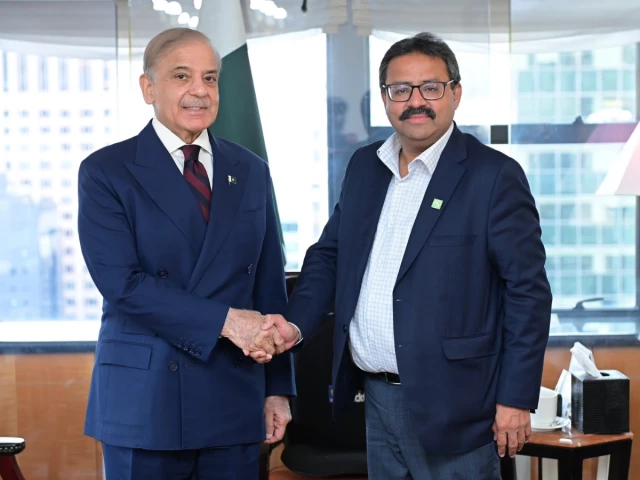

NEW YORK: Prime Minister Shehbaz Sharif has described Pakistan’s diplomatic engagements on the sidelines of the United Nations General Assembly as a major success, pointing to talks with Iran and consultations with Saudi Arabia and Turkiye on regional security and implementation of the Makkah Joint Defence Agreement.
Speaking to The Express Tribune, the prime minister identified his meeting with Iranian President Masoud Pezeshkian and discussions involving Saudi Arabia and Turkiye as some of the most significant engagements during his New York visit.
Pakistan, Saudi Arabia and Turkiye signed the Makkah Joint Defence Agreement on August 7, formalising their strategic security cooperation through a trilateral framework. Supporters of the agreement describe it as a defensive mechanism intended to strengthen collective deterrence, deepen military coordination and contribute to regional stability.
According to PM Shehbaz, discussions during the UNGA focused particularly on putting the agreement into practice and improving coordination among its three members.
Pakistan, Saudi Arabia and Turkiye Discuss Makkah Pact Implementation
Deputy Prime Minister and Foreign Minister Ishaq Dar separately met his Saudi and Turkish counterparts in New York to assess progress towards establishing the institutional mechanisms required under the defence agreement.
The discussions covered the formation and functioning of the pact’s secretariat, committees and working groups, alongside broader regional and international security developments.
The consultations took place against the backdrop of heightened regional tensions involving Iran, the United States and Israel, as well as attacks directed at Saudi Arabia.
The Makkah agreement consequently remained a prominent element of Pakistan’s security diplomacy throughout the visit.
Shehbaz, Pezeshkian Discuss Regional Situation
PM Shehbaz also met Iranian President Masoud Pezeshkian, while Iranian Foreign Minister Abbas Araghchi held separate discussions with Pakistani officials.
Their talks focused on developments across the region and possible efforts to encourage dialogue.
Defence Minister Khawaja Asif described the meeting with the Iranian president as open and candid, adding that Pezeshkian had assured the Pakistani delegation that further discussions would be held.
Pakistan also communicated its position regarding the continuing regional attacks. Islamabad expressed understanding of Iranian concerns and condemned US and Israeli attacks on Iran.
At the same time, Pakistani officials condemned Iranian attacks on what they described as US military bases located in Gulf countries, maintaining that such actions should not occur.
Pakistan Raises Houthi Attacks With Iran
The discussions also addressed attacks carried out by the Houthis. Pakistani officials asked Tehran to use its influence to encourage the group to step back from further escalation.
According to the account of the discussions, Pakistan was described as being “in a sense, operationally involved” in efforts aimed at addressing the situation.
The talks reflected Islamabad’s broader diplomatic engagement with different regional actors as tensions continued to intensify.
Military Leadership Moves Towards Operationalising Defence Pact
The implementation of the Makkah Joint Defence Agreement also advanced at the military level.
Chief of Defence Forces and Chief of Army Staff Field Marshal Asim Munir met his Saudi and Turkish counterparts as the three countries continued efforts to transform the agreement into an operational security framework.
A secretariat has been established under the pact to facilitate future coordination among the participating countries.
The three countries’ military chiefs subsequently met in Riyadh, where they reviewed security threats and discussed intelligence sharing, military coordination and the integration of capabilities.
The diplomatic and military engagements indicate that Pakistan, Saudi Arabia and Turkiye are now concentrating on developing the institutional and operational mechanisms required to implement their trilateral defence agreement.