
The spring of 1988 felt like a period of rapid historical transition. The presidency of Ronald Reagan was drawing to a close, while George H.W. Bush was poised to succeed him. Having just secured admission to Princeton University, I harbored a newfound conviction that happiness was finally within reach—a future in which I would be fully integrated into mainstream American society, liberated from the baggage of my background. (Within our community, as well as in my writing, we refer to ourselves as “Indian” rather than “Native American.”) Up to that moment, I viewed my life as thoroughly defined by mediocrity, an outcome I largely attributed to my heritage. That perception was about to change. My mother was scheduled to drive me and my possessions to New Jersey in the fall, marking what I believed would be the true beginning of my life. I was eager to distance myself from my family, who I felt completely lacked an understanding of my ambitions. I equally sought to break free from the low expectations set by my teachers, whose assessments were shaped not by my actual abilities or efforts, but by their narrow perceptions of what an Indian student could achieve.
Furthermore, I wanted to sever ties with my peers from the reservation. Growing up on the Leech Lake Reservation in Minnesota, I felt largely unnoticed. I suspect my identity as an Indian was not entirely recognized within the community, partly because I inherited my physical features from my white father. Lacking a darker complexion or the conventional characteristics associated with the community, I was often viewed as an outsider who did not truly belong there.
This detachment was mutual. In my assessment, the Leech Lake Reservation offered little of significance. It was neither the largest nor the most populous Ojibwe community, distinguishing itself primarily by its economic hardship. The reservation appeared discarded by the federal government, surrounding communities, and historical progress. It seemed trapped in a relentless cycle of adversity—where the prevailing realities were poverty, substance abuse, and the lingering impacts of boarding school policies designed for forced assimilation. To me, it was an isolated location that remained largely unknown to the wider world.
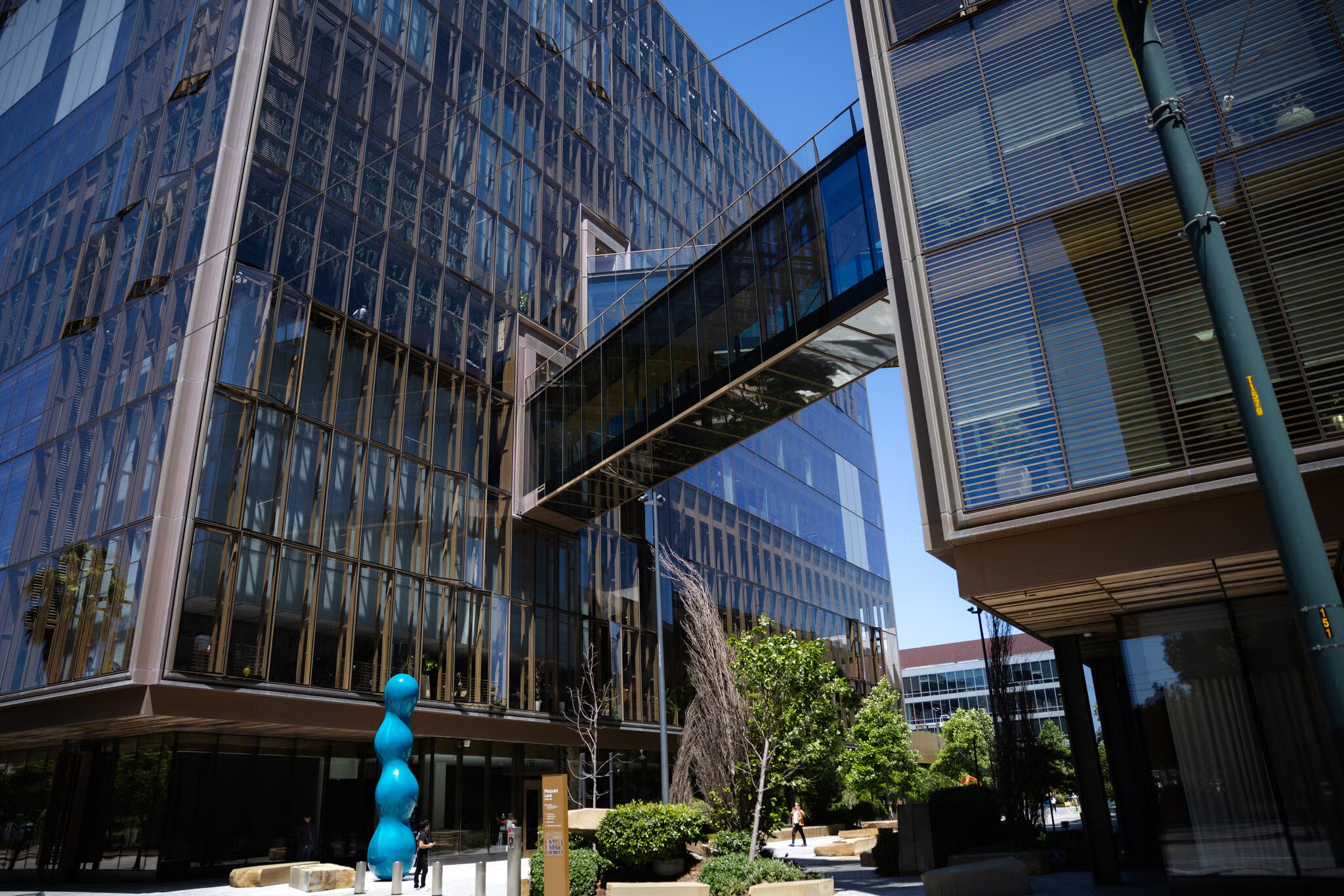
Arriving at Princeton felt like a transition into the center of American life. I had moved from an environment where I felt out of place to an institution that offered a sense of inclusion. Its historic stone architecture, formal brick structures, and ivy-covered walls conveyed an atmosphere where significant events unfolded.
Both in the institution’s self-perception and in my own view, Princeton represented a realm of opportunity where one could actively engage with history. The university reinforced this perspective. During orientation, our freshman class was shown an impact mark on Nassau Hall dating back to the Battle of Princeton in 1777, resulting from a cannonball strike attributed to Alexander Hamilton’s artillery unit that damaged a portrait of King George II. We were reminded of Princeton’s motto, “in the nation’s service,” alongside its history of educating over seventy U.S. senators, two presidents, and Aaron Burr. We were encouraged to view ourselves as exceptionally fortunate. Although unstated, the underlying expectation was clear: downplay socio-economic hardship, adopt the understated collegiate aesthetic, and assimilate into the culture. The implicit message was that the nation’s leadership was forged here, rendering our places of origin far less consequential.
However, I had not entirely left the reservation behind; its influence accompanied me unawares. At Princeton, situated among a predominantly non-Indian student body, my background became strikingly distinct. This distinction was heightened by the contrast with my surroundings, as both peers and faculty appeared noticeably surprised by my presence at the university.