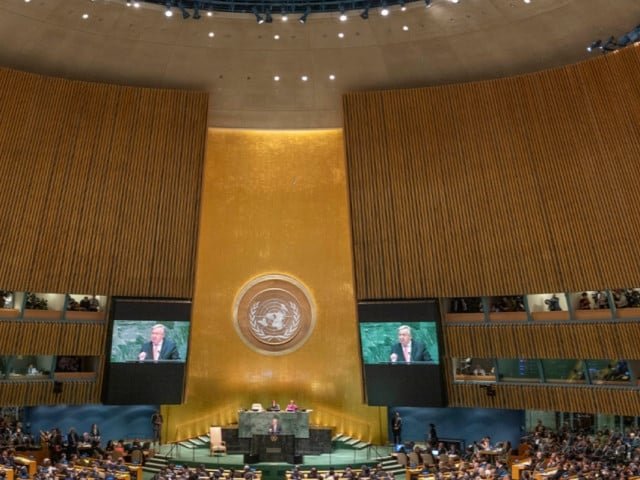

The United Nations General Assembly has voted in favour of replacing the traditional world map with a projection that more accurately represents the size of Africa and other continents.
The “Correct the Map” resolution, introduced by Togo and supported by members of the African Union, received backing from 164 countries, including France and the United Kingdom. The United States was the only country to vote against the measure, while six nations abstained.
Although the resolution is not legally binding, it is expected to encourage institutions around the world to reconsider their use of the centuries-old Mercator projection.
The Mercator map was developed in 1569 by Flemish cartographer Gerardus Mercator, primarily to assist European sailors with navigation. Its design, however, significantly distorts the relative sizes of land masses. Countries and regions closer to the poles appear much larger, while those nearer the equator appear smaller than they actually are.
Africa is perhaps the most striking example. On a Mercator map, Greenland can appear comparable in size to Africa, even though Africa is roughly 14 times larger.
Critics argue that such distortion is more than a technical cartographic issue. They say consistently depicting Africa as smaller than its actual geographical scale can influence perceptions of the continent, including its population, natural resources, economic potential and development needs.
In 2018, cartographers developed the Equal Earth projection as an alternative. Unlike the Mercator projection, it seeks to preserve the relative areas of continents and countries more accurately while still presenting the world on a two-dimensional surface.
The African Union’s 54 member states adopted the Equal Earth projection in February, saying it provides a more accurate representation of the sizes of continents, particularly Africa.
Campaigners supporting the change have sought to demonstrate Africa’s enormous geographical scale. The “Correct the Map” campaign noted that the United States, China, India, Japan, Mexico and much of Europe could collectively fit within Africa, with land still remaining.
Ahead of the UN vote, Togolese Foreign Minister Robert Dussey argued that maps influence far more than geography.
“A fair world begins with a fair map,” he said.
He also told a UN briefing that maps are not neutral because they shape perceptions and influence how people understand the position of different continents and populations in the world.
France supported the initiative, with Foreign Minister Jean-Noël Barrot announcing that his ministry would stop using the Mercator projection. He argued that changing a map would not change the world itself, but correcting a distorted representation was nevertheless an act of truth.
The United States strongly disagreed with the initiative.
US representative Yaryna Ferencevych argued that the resolution distracted the General Assembly from more pressing questions involving international peace, prosperity and relations among nations. She criticised the chamber for debating a mapping system dating from the 16th century and linking the issue with concepts such as reparations and “cognitive justice.”
Supporters of the campaign, however, maintain that the issue is fundamentally about how Africa is represented.
Lerato Mogoatlhe of Africa No Filter described Africa’s distorted appearance on conventional maps as not merely a cartographic problem but also a problem of narrative. Kenyan geographer Kioko Muendo similarly argued that the Mercator projection has contributed to perceptions that understate Africa’s vast territory, resources, population and investment potential.
The debate ultimately reflects an unavoidable reality of cartography: a spherical planet cannot be reproduced perfectly on a flat surface. Every world map involves compromises.
The question raised by the UN vote is therefore not whether maps can be completely free of distortion, but which distortions the world is prepared to accept — and what those distortions make us believe about the world around us.