
Washington and Tehran hold separate talks with intermediaries as negotiations turn to a revised Iranian proposal linking an end to hostilities with the reopening of the Strait of Hormuz
NEW YORK/WASHINGTON: The United States and Iran have reopened indirect diplomatic contacts through mediators in a fresh attempt to end seven months of war, with negotiations expected to centre on a revised version of Tehran’s latest ceasefire proposal.
Officials from both countries held separate discussions with mediators on Monday, signalling another effort to find a diplomatic route out of a conflict that has caused thousands of deaths, disrupted crucial energy routes and unsettled global markets.
According to an official briefed on the negotiations, any further discussions are expected to focus on an amended version of the seven-day proposal presented by Iran last week on the sidelines of the United Nations General Assembly.
The renewed diplomatic activity comes after two previous mediated ceasefire arrangements, reached in April and June, failed to produce a lasting end to the conflict.
Araqchi Remains in New York as Iran Awaits US Response
Iranian Foreign Minister Abbas Araqchi remained in New York following the UN General Assembly as diplomatic contacts continued.
According to Iran’s state news agency IRNA, Tehran is waiting for Washington’s response to its latest ceasefire proposals as well as its conditions for restoring maritime traffic through the Strait of Hormuz.
Araqchi maintained that Iran had already presented what it considered a pathway towards a peaceful settlement.
“If the Americans claim they are seeking an agreement or a peaceful solution, we have presented that solution,” he said.
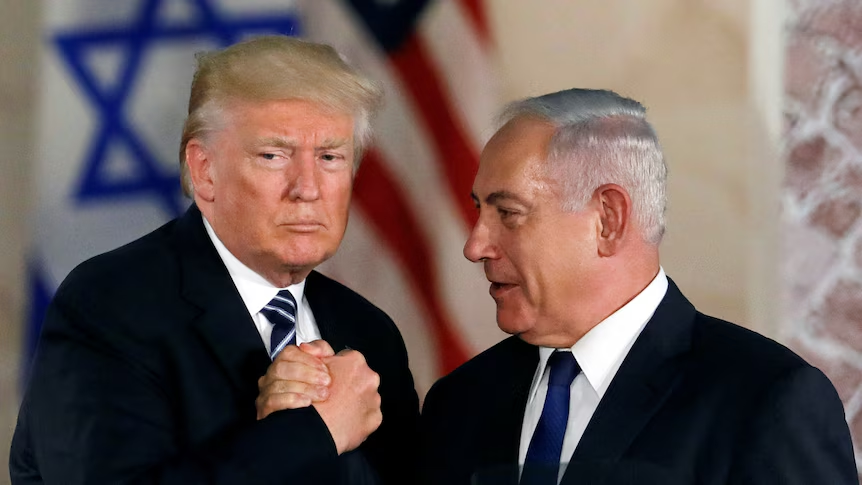
US officials also held separate discussions with mediators on Monday, President Donald Trump told reporters at the White House, although he did not disclose details of the exchanges.
Trump has indicated that further diplomatic discussions could take place this week.
Iran Links Hormuz Reopening to End of US Blockade
At the centre of the negotiations is Tehran’s seven-day proposal, which connects the reopening of the Strait of Hormuz with a broader package of political, economic and military measures.
Under the proposal, hostilities involving Iran and Lebanon would end, while the United States would lift its blockade of Iranian ports.
Tehran is also seeking the unfreezing of billions of dollars in Iranian assets and an end to restrictions affecting Iranian oil exports.
In return, Iran would permit the reopening of the Strait of Hormuz, one of the world’s most strategically important energy corridors.
The waterway has become a central element of the conflict because of its importance to international oil and gas shipments. Disruption to maritime traffic has intensified the economic consequences of the war far beyond the immediate region.
Nuclear Negotiations Could Resume
Iran’s proposal also envisages a return to negotiations over its nuclear programme.
One of the most difficult issues would be the future of Iran’s highly enriched uranium. Trump has sought the removal or elimination of those stocks, making the nuclear question a potentially decisive element of any broader settlement.
The negotiations therefore extend well beyond a temporary suspension of military operations. Any comprehensive arrangement would have to address sanctions, frozen Iranian assets, maritime access, the US blockade, regional hostilities and the nuclear dispute.
That breadth could make reaching a durable agreement considerably more difficult.
Previous Ceasefires Failed to Hold
The latest diplomatic initiative follows two earlier attempts to stop the fighting.
Washington and Tehran reached mediated ceasefire agreements in April and again in June, but both arrangements quickly collapsed.
That history is likely to shape the latest negotiations. A new agreement would need not only to secure acceptance from both sides but also to establish conditions capable of preventing another rapid return to hostilities.
The conflict began in late February with US and Israeli attacks on Iran. Seven months of fighting have since killed thousands and disrupted international markets, particularly as restrictions on strategically important maritime routes affected energy transportation.
Diplomacy Returns, but Major Differences Remain
The separate talks with mediators do not yet amount to direct US-Iran negotiations or a new ceasefire agreement. They do, however, indicate that both sides remain engaged with diplomatic channels despite continuing hostilities.
The immediate question is whether revisions to Iran’s seven-day proposal can narrow the differences sufficiently for another round of negotiations.
For Tehran, the reopening of Hormuz is tied to an end to the blockade, relief for its oil exports, access to frozen assets and an end to hostilities. Washington, meanwhile, is expected to press its own security and nuclear demands.
After two previous ceasefire efforts failed, the significance of the latest diplomatic push will ultimately depend not simply on whether another agreement can be reached, but whether the two sides can establish terms capable of surviving beyond the initial seven-day framework.
For now, Washington and Tehran remain separated at the negotiating table, but the return of mediated diplomacy has opened another possible route towards ending the war.