
Hafeez Ahmed
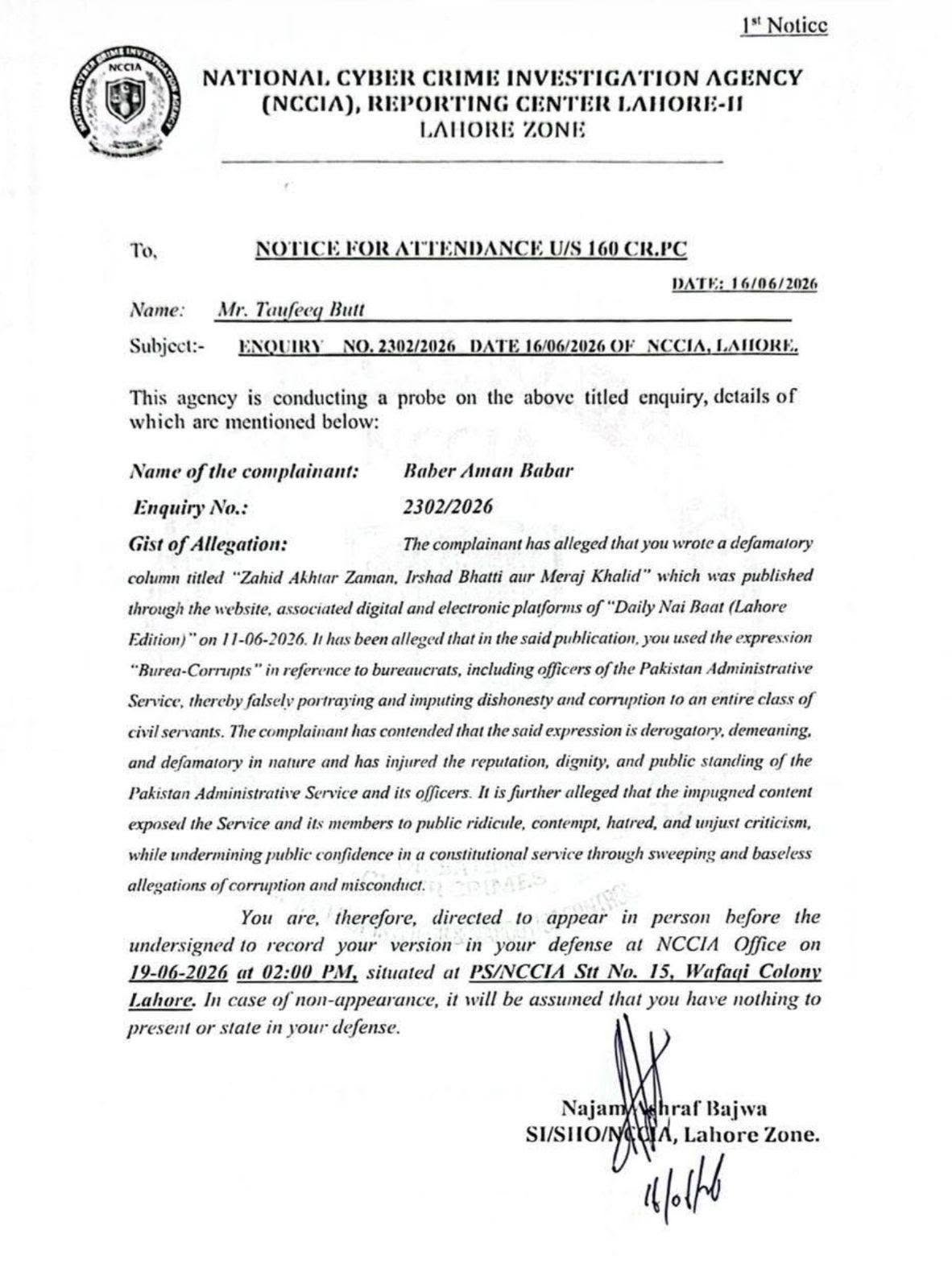
A quiet but telling standoff has been building in Punjab over the past few weeks, and it says as much about the state of Pakistani journalism as it does about the temperament of the province’s senior bureaucracy. Several well-known journalists and columnists, among them Anwar Hussain Samra, Irshad Bhatti, and Toufiq Butt, published reports and opinion pieces examining the official expenditures and government residence of the Chief Secretary Punjab. What followed was not a public rebuttal or a press statement clarifying the record, but legal notices and demands for explanation directed at the writers themselves. The episode has reopened an old and uncomfortable question in Pakistani public life: where exactly does the right to free expression end and the machinery of public accountability begin.
Pakistan’s constitution treats freedom of expression as a fundamental right, and nobody seriously disputes that. The right is not absolute, of course, and it sits alongside reasonable restrictions written into law. But in any functioning democracy, scrutiny of public institutions, government officials, and the spending of taxpayer money is not an indulgence granted to the press; it is one of the basic mechanisms by which accountability happens at all. The entire architecture of press freedom around the world rests on the assumption that public affairs deserve open debate and that criticism of those who hold public office is part of the deal.
That said, the obligation does not run in only one direction. Journalists, columnists, and other shapers of public opinion carry a responsibility of their own, namely to ground their criticism in facts, evidence, and documented material rather than sweeping accusations or personal attacks. Loose generalisations and ad hominem jabs do real damage, not just to the credibility of the press but to the broader cause of accountability itself, because they give institutions an easy excuse to dismiss legitimate scrutiny along with the illegitimate kind. Good criticism, the sort that actually moves institutions to reform, tends to be objective rather than emotional, rooted in verifiable detail rather than vague suspicion.
Pakistan is not without tools for this kind of scrutiny. Right to information laws exist precisely so that journalists, researchers, and ordinary citizens can examine government spending, perks attached to public office, administrative decisions, and potential conflicts of interest through legitimate, documented channels. Using those channels, rather than relying purely on anonymous tips or hearsay, is what ultimately strengthens institutional transparency and gives criticism the kind of evidentiary weight that is hard to brush aside.
At the same time, the Pakistan Administrative Service and other representative bodies of the civil bureaucracy would do well to respond to criticism with patience and institutional composure rather than reaching first for legal notices. Public officeholders in any democracy have to develop a thicker skin, because scrutiny comes with the territory. Pakistani politicians face blistering public and media criticism on a near-daily basis, and more often than not, they answer it in the political arena and in public statements rather than through the courts. That is a pattern worth the bureaucracy’s attention, because the instinct to litigate every uncomfortable question sends a very different signal than the instinct to explain.
There is also a harder truth lurking underneath all of this. Public perception of Pakistan’s bureaucracy is not particularly warm to begin with, and that perception is not improved when every critical question or investigative report is met with the threat of legal consequence rather than a substantive answer. If anything, that pattern erodes public trust further. Transparency, timely disclosure of information, and a willingness to respond to hard questions tend to build trust; legal intimidation tends to corrode it, even when the institution doing the intimidating believes it is simply defending its reputation.
Institutions that are genuinely secure in their own standing do not flinch at criticism. They treat it as an opening for correction and accountability rather than a threat to be neutralised. That is really the heart of the matter here. Both journalism and bureaucracy have obligations within their own spheres, the press to report responsibly and with evidence, the bureaucracy to respond with transparency and restraint rather than legal pressure, and meeting those obligations is what ultimately deepens public confidence in state institutions and strengthens the democratic character of governance itself.
Anyone trying to understand the deeper structure of Pakistan’s bureaucracy, the powers and privileges built into it, and how the administrative system actually functions on the ground would find Republic Policy Think Tank’s landmark study, The Bureaucratic Coup, a useful place to start. The book lays out, in considerable documented detail, exactly the kind of institutional dynamics that disputes like this one bring into public view.
The writer is a advocate and chairman of Human Rights Committee, Multan Bar.
The best-selling books of Republic Policy Think Tank, including the landmark book The Bureaucratic Coup, are available at Vanguard Books, Liberty Books, Readings, Kitab Sarai, Sang-e-Meel, Saeed Book Stores, and others across Pakistan. Contact for home delivery: 0300 9552542.