
Hafeez Ahmed
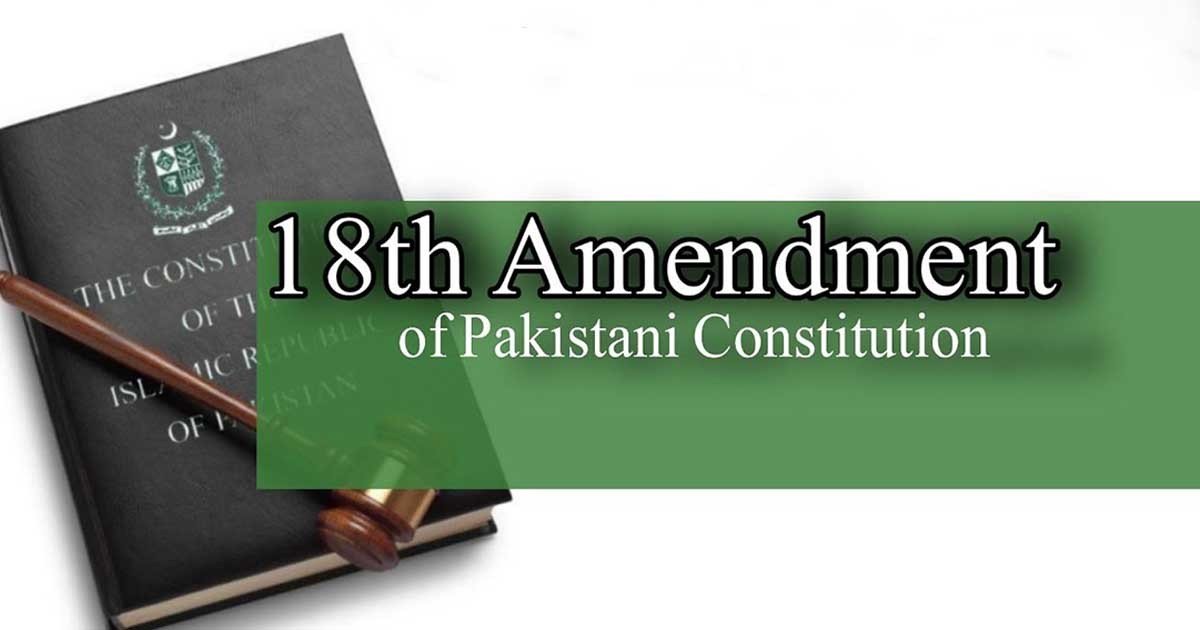
The Eighteenth Amendment to Pakistan’s Constitution is frequently misread. Critics frame it as an act of decentralisation gone too far, a constitutional concession that weakened the federation by stripping the centre of powers it needed to govern effectively. This reading is historically shallow and politically dangerous. To understand what the amendment actually accomplished, one must return to the circumstances that made it necessary and ask what Pakistan looked like in the years before 2010.
The answer is not comfortable. Pakistan’s three major provinces — Balochistan, Sindh, and Khyber Pakhtunkhwa — were all, in varying degrees, in a condition of political estrangement from the federation. In Balochistan, armed insurgency had reached one of its most intense phases in decades. In Sindh, serious and organised reservations about federal arrangements had become a defining feature of provincial politics. In Khyber Pakhtunkhwa, the relationship with the centre was strained and contested. Across all three provinces, the central demand was the same: genuine devolution. The provinces wanted real political and administrative autonomy, not the token consultation of a centralised state that retained all meaningful power in Islamabad. The federation was fraying, and everyone could see it.
The Eighteenth Amendment was the political response to that crisis. By transferring significant powers from the centre to the provinces, it addressed the core grievance that was driving provincial alienation. It gave the federal units a genuine stake in the federation’s survival and deepened their sense of belonging to a shared constitutional order. This is why serious constitutional scholars and political analysts describe the amendment as nothing less than the political contract of the federation. It carried a message the provinces had been waiting decades to receive: that Pakistan acknowledged itself as a multi-ethnic, multilingual state in which power must be shared if unity is to mean anything.
Pakistan’s own history had already delivered this lesson in the most devastating possible terms. The centralised governance model of the 1960s, and the relentless concentration of power at the top, produced not stability but rupture. The separation of East Pakistan in 1971 was the direct consequence of denying a federal unit its political, economic, and administrative rights. A federation that refuses to share power does not grow stronger. It grows brittle, and eventually it breaks. The founders of this country, including Quaid-e-Azam Muhammad Ali Jinnah himself, understood that the ideological basis of Pakistan rested on power-sharing and federal balance. Centralisation was never the vision. It was the deviation.
Those who argue that the Eighteenth Amendment left the federation weak would do well to examine the actual distribution of powers that exists today. The Federal Legislative List Part I contains 59 important subjects that remain exclusively under federal control. An additional 18 concurrent sectors managed through the Council of Common Interests have effectively been retained by the federal government. Taken together, the federation controls 77 major subject areas. That figure is not a sign of a weakened centre. It is, in fact, considerably larger than the share of central power in many of the world’s established federations. In India, a country frequently described as a relatively centralised federation, the states hold substantial autonomous authority. In the United States, the states exercise powers that no federal government in Washington can override. Pakistan’s centre, even after the Eighteenth Amendment, remains among the more powerful federal governments in comparative terms.
The provinces, by contrast, were left with a comparatively limited portfolio: health, education, agriculture, and law and order form the core of what the provinces actually administer. This is not a picture of provincial overreach. It is a picture of a federation that moved in the right direction but still has considerable distance to travel before genuine balance is achieved. The narrative that the Eighteenth Amendment gave too much away is simply not supported by the facts of the current constitutional structure.
What should genuinely concern those invested in Pakistan’s federal health is not that powers have gone too far down but that devolution stopped halfway. The transfer of authority from Islamabad to Lahore, Karachi, Peshawar, and Quetta is meaningful. But it is incomplete so long as those provincial capitals replicate the same centralising instincts that they once resented in the federal government. True devolution reaches the district. It reaches the union council. It reaches the citizen who needs a birth certificate, a water connection, or a school for their child, and who should be able to obtain these through a local institution with real power and real accountability. Pakistan lacks a strong, constitutionally protected, and consistently functional local government system. Until that gap is closed, devolution remains a project begun but not completed.
Any attempt to reverse the Eighteenth Amendment or meaningfully dilute its provisions would not be a technocratic adjustment. It would be a political decision with serious historical consequences. It would tell the provinces that the constitutional compact of 2010 was temporary, conditional, and ultimately revocable at the centre’s discretion. That message would not be received quietly. It would reignite the very grievances the amendment was designed to resolve, and in regions like Balochistan, where those grievances have historically taken the form of armed resistance, the consequences could be severe. The federation’s endurance is not guaranteed by constitutional text alone. It is maintained by the sustained belief of its component units that the arrangement is fair and that their voices matter.
Economic recovery must accompany political devolution if federal stability is to be durable. A growing economy makes the difficult conversations around the National Finance Commission Award and resource distribution more manageable. Improving provincial revenue systems, expanding local financial capacity, and building genuine fiscal autonomy for sub-national governments are not peripheral concerns. They are central to the reform agenda Pakistan needs.
The Eighteenth Amendment did not weaken the Federation of Pakistan. It saved it. It transformed alienated provinces into empowered partners within a shared constitutional framework. The task ahead is not to roll back what was achieved but to build on it honestly and with full commitment. Pakistan’s strength lies downward, in its districts, its communities, and its people. That is where democratic energy must be directed, and that is where the federation’s future will ultimately be won or lost.