
Zafar Iqbal
Pakistan’s fiscal crisis has many authors, but one of the most stubborn is a failure that sits squarely in plain sight. The federal government has formally pressed the provincial governments to raise their own resources and, specifically, to collect agriculture income tax in meaningful amounts. The pressure is not rhetorical. The IMF had set a time-bound benchmark requiring the provinces to legislate and implement this tax, and all four provinces duly passed the necessary legislation through their finance bills in 2025. Yet the collections that followed were so negligible that they were not even disclosed in the consolidated fiscal operations report covering July to March 2026. When a government chooses not to report a number, it is usually because the number is indefensible.
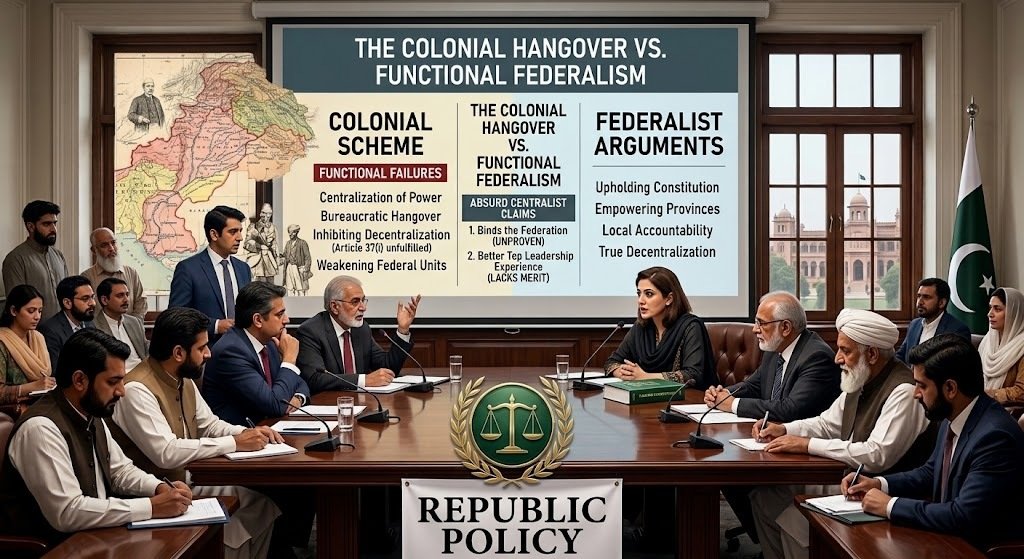
The reason for this failure is not administrative. It is political. Pakistan’s farm lobby is one of the most entrenched power blocs in the country. It is represented across both the federal and provincial assemblies, cutting through party lines and ideological divides with a unity of purpose that most political coalitions would envy. Agriculture income tax is a provincial subject under the Constitution, and that constitutional clause has survived intact through twenty-seven amendments, each of which required a two-thirds parliamentary majority to pass. Governments that could muster the numbers to amend some of the most fundamental provisions of the state have never once found the will to touch the farm tax clause. That is not coincidence. That is the farm lobby at work.
The irony deepens when one considers what was passed alongside those amendments. The twenty-seventh amendment moved through the assembly despite notable opposition to several of its provisions. Notably, the IMF itself had flagged concerns in its Governance and Corruption Diagnostic Report, uploaded as a second review prior condition, which identified systemic weaknesses across core state functions as a macroeconomic constraint costing the country approximately six to six and a half percent of GDP. That report named structural governance failures as a serious drag on the economy. Yet even with that context, the amendment passed. A legislature capable of doing that could legislate agriculture income tax collection. It chooses not to.
The fiscal data tells the rest of the story. The consolidated figures for July to March 2026 show the degree to which provincial governments remain dependent on federal transfers rather than their own revenue base. Balochistan drew eighty-five percent of its revenues from federal transfers. Punjab followed at eighty-four percent. Khyber Pakhtunkhwa stood at eighty percent and Sindh at sixty-six percent. These are not figures that reflect financially autonomous governments. They reflect administrations that have chosen to remain dependent on the centre rather than tax their own constituencies, particularly those constituencies with the greatest capacity to pay.
When one isolates the category described as other taxes in provincial accounts, which excludes sales tax on services, excise duties, stamp duties and motor vehicle tax, and which would include whatever was collected under agriculture income tax, the numbers are telling. In Punjab, this category amounted to only eight percent of own resources. More damaging still is that this figure actually declined in absolute terms. Collections in this category fell from 32,798 million rupees during July to December 2025 to 28,581 million rupees during the extended period of July to March 2026. A longer period produced fewer collections. No comparable decline appeared in the other three provinces. Sindh reported thirty-two percent of own resources from this category, Khyber Pakhtunkhwa thirty-six percent and Balochistan twenty-seven percent. Punjab, the province with by far the largest agricultural economy and the wealthiest landed class, performed the worst.
The federal government has now delivered a pointed message. If the provinces continue to protect wealthy landowners from income tax, the centre may have no option but to raise other taxes to close the revenue gap. The burden of those taxes will fall overwhelmingly on consumers, particularly the poor. Federal taxation in Pakistan is already heavily weighted toward indirect taxes, which by their nature take a proportionally greater share from low-income households than from the wealthy. A rise in indirect taxation to compensate for provincial failure on agriculture income tax would be a policy of the poor subsidising the rich, formalised through the budget.
This is not an abstract concern. Current poverty estimates based on the Food Energy Intake method, which measures the expenditure required to meet a minimum daily intake of 2,350 calories per adult, place poverty incidence at 43.5 percent according to independent researchers and between 42 and 45 percent according to the World Bank. Nearly half the population is already living at or near the edge of nutritional sufficiency. Any further pressure on consumer prices or on indirect taxation will push more households below that line. The provinces need to understand that their reluctance to tax the landlord class is not a neutral administrative position. It is a choice with direct human consequences.
The path forward is clear. Provincial budgets for the coming year must include serious, enforceable provisions for taxing agricultural income. The benchmark should not be some concessional rate invented to satisfy a formal requirement while protecting wealthy landowners in practice. Agricultural income must be taxed at least at the rate applied to the salaried class, which is itself not an especially high standard. Salaried workers in Pakistan are taxed at source with no ability to negotiate, minimise or avoid. Landlords with incomes many times larger have enjoyed statutory protection from equivalent treatment for decades. That asymmetry is morally indefensible and fiscally catastrophic.
If the provinces fail again, the federal government may move to bring agriculture income taxation within the federal ambit. That outcome would represent both a political embarrassment for the provinces and a constitutional reckoning that the farm lobby has long managed to avoid. The provinces should not wait for that moment. They should act now, in the budget, with real numbers and real enforcement. The alternative is to keep asking the poorest citizens of this country to pay for the comfort of its richest.