
Editorial
Pakistan’s middle class is not shrinking. It is vanishing. There is a critical difference between the two. Shrinkage implies a temporary contraction, a reversible wound. Vanishing implies erasure, the quiet disappearance of an entire social stratum that once anchored the country’s economic stability, professional institutions, and civic conscience. What is happening today is the latter, and no one in power appears sufficiently alarmed.
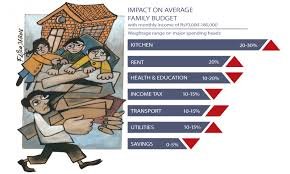
Petrol hikes arrive with bureaucratic regularity, each one absorbing whatever small financial cushion a salaried household had managed to preserve. Inflation does not merely raise prices. It restructures life. It forces choices between school fees and medicine, between utility bills and groceries, between dignity and survival. Governance failure compounds every blow. When the state cannot deliver reliable electricity, functional public services, or basic regulatory predictability, the cost of living does not merely rise. It becomes punishing for those who cannot buy their way out of it. The privileged can. The desperate cannot. The middle class, once the bridge between these two worlds, is being pushed irreversibly toward the second.
This did not begin yesterday. Decades of elite capture laid the groundwork. Land, capital, institutional access, and political protection were systematically concentrated among a narrow class that designed the rules of the economy to serve its own perpetuation. The middle class survived despite this arrangement, not because of it. Now, with inflation entrenched, energy costs spiralling, and governance hollow, even that survival is no longer possible for millions.
Pakistan is ceasing to be a country of three classes. It is becoming a country of the privileged and the desperate, with an ever-narrowing corridor between them. When the middle disappears, so does the social contract. What replaces it is not stability. It is pressure, accumulating without release, until the structure itself can no longer hold.