
Masood Khalid Khan
There is a particular kind of national failure that stings more than most: the kind that arrives exactly as predicted, by people who said so for decades, and is ignored anyway. Pakistan’s water crisis belongs squarely in that category. Few catastrophes in this country’s history have been forecast with such precision and met with such indifference. Generation after generation of policymakers received the same warning. Rapid population growth, insufficient storage capacity, mismanaged irrigation, and chronic under-investment would one day push Pakistan from water abundance into water scarcity. That day has arrived. The latest United Nations reports do not announce a surprise. They simply put numbers to a decline that has been visible in plain sight for decades. At Independence, Pakistan enjoyed more than 5,000 cubic metres of water per capita. Today, that figure has collapsed to below 1,000 cubic metres.
Sit with that number for a moment, because its weight is easy to skim past. Pakistan has not merely slipped into water stress. It is edging toward conditions the world associates with severe scarcity, the kind of scarcity that reshapes how a nation eats, farms, and survives. And this collapse has occurred at the worst possible moment, just as Pakistan’s population has swelled to become the fifth largest on earth. Demand for water has climbed relentlessly, year after year, while the systems meant to secure, store, manage, and distribute it have fallen further and further behind.
What makes this story especially maddening is that nobody can claim ignorance. The warning signs were never hidden. Successive governments commissioned study after study. Committees convened, listened to experts, and filed their findings. International institutions sounded the alarm repeatedly. Environmental specialists warned, in plain language, about groundwater depletion accelerating beneath the country’s feet. Agricultural experts pleaded for more efficient irrigation systems. And still, the national response remained fragmented, inconsistent, and routinely sacrificed to short-term political convenience. Pakistan did not fail to see the crisis coming. Pakistan simply chose, year after year, not to act on what it saw.
A Crisis Written Into Daily Life
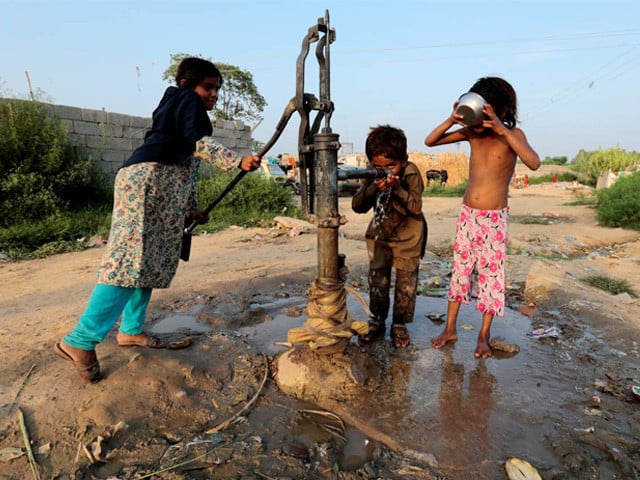
Walk through any town or village in Pakistan today, and the consequences of this neglect are not abstract. They are immediate and human. According to the latest UN assessments, 55 percent of Pakistanis still lack access to safely managed drinking water. In rural areas, the picture grows darker still: more than 58 percent of the rural population remains without safely managed sanitation services. These figures are not bureaucratic development metrics destined for a forgotten report. They are daily realities. They shape which children fall sick and which stay healthy. They determine which students make it to school and which cannot. They quietly drag down economic productivity in ways that rarely make headlines but accumulate, year after year, into a heavier national burden.
The crisis reaches well beyond what flows from a household tap. Agriculture, the backbone of Pakistan’s economy and food security, consumes the overwhelming share of the country’s available water, much of it through irrigation practices that waste extraordinary quantities in the process. Meanwhile, Pakistan’s cities continue expanding at a pace that urban infrastructure simply cannot match. As surface water grows scarcer, communities turn increasingly to groundwater extraction, often without meaningful regulation or any serious plan for replenishment. And despite decades of talk, debate, and promised reform, the country’s water storage capacity remains stubbornly insufficient. Pakistan has discussed building new reservoirs and modernizing its water infrastructure for so long that the conversation itself has become a kind of national ritual, repeated endlessly, acted upon rarely.
Climate Change Has Raised the Stakes
As if scarcity alone were not challenge enough, climate change has made the entire situation considerably more dangerous. Pakistan now finds itself exposed on both extremes: greater vulnerability to devastating floods on one side, and deepening drought and erratic rainfall patterns on the other. This is not theoretical. The country has already lived through catastrophic floods that displaced millions of people and inflicted staggering economic damage. Now it faces the equally serious threat of water running out. Floods and droughts may look like opposite problems, but together they expose the same underlying truth: a national water system that has failed to adapt to a rapidly changing climate.
There is, too, a profound economic dimension that deserves far more attention than it typically receives. Water insecurity threatens agricultural output. It threatens industrial activity. It threatens energy generation, much of which depends on reliable water flows. It drives up the cost of development at precisely the moment when public resources are already stretched thin. Most economic crises can eventually be addressed through policy reform and financial adjustment. Water shortages are a different breed of problem entirely. Once they take root, they are extraordinarily difficult to reverse.
The Solutions Were Never the Mystery
Here is the part that should trouble Pakistanis most: none of the necessary solutions are particularly mysterious or undiscovered. The country clearly needs greater investment in water infrastructure. It needs improved storage capacity, modernized irrigation techniques, stronger regulation of groundwater extraction, and far more effective management of urban water systems. Public awareness around conservation needs to improve substantially. And the institutions responsible for water governance need real coordination and genuine accountability, not the fragmented, overlapping mandates that have defined the sector for decades.
What has been missing, consistently and unmistakably, is not knowledge. It is political will. Pakistan has never lacked the technical understanding required to address this crisis. It has lacked the sustained national commitment to treat water security as the existential priority it has always been.
The latest UN findings, then, should not be read as merely another warning to file away alongside the others. They should be understood as documented evidence of what decades of neglect, inefficiency, and weak governance ultimately produce. Pakistan still has a window to change course. But that window narrows with every year that passes without serious action.
Pakistan’s water crisis is no longer some distant threat hovering on the horizon. It is here now, today, shaping the lives of millions. The alarm has been ringing for decades. The only question left is whether, after all this time, anyone in a position to act is finally prepared to listen.
The best-selling books of Republic Policy Think Tank, including the landmark book The Bureaucratic Coup, are available at Vanguard Books, Liberty Books, Readings, Kitab Sarai, Sang-e-Meel, Saeed Book Stores, and others across Pakistan. Contact for home delivery: 0300 9552542.