Dr Bilawal Kamran
Pakistan rarely suffers from a shortage of reform proposals. What it lacks is the political will to implement the reforms that matter most. Interior Minister Mohsin Naqvi’s recent observation that the country’s governance system has effectively collapsed is one of those rare statements that reflects a reality visible to almost every citizen. From delayed public services and administrative inefficiency to weak local institutions and poor accountability, the evidence is difficult to dispute. His accompanying suggestion that Pakistan should consider creating new provinces has once again revived a constitutional and political debate that has surfaced repeatedly over the past several decades.
The debate itself is legitimate. Every federation must periodically assess whether its administrative arrangements continue to meet the needs of a growing population. Yet Pakistan must avoid treating provincial reorganisation as a shortcut to solving problems that are rooted much deeper. Before asking how many provinces the country should have, it must first answer a far more important question: why have the existing institutions failed to deliver effective governance?
There is nothing inherently wrong with the idea of creating additional provinces. Around the world, governments have reorganised administrative boundaries to improve efficiency, strengthen representation and bring public institutions closer to the people. Population growth, urbanisation and changing economic realities often make administrative restructuring both necessary and practical. Pakistan’s provinces have expanded enormously in terms of population and administrative responsibilities since independence. In that context, discussing new provinces should not be viewed as controversial. Mature democracies continuously review their administrative structures to ensure that governance remains effective.
However, the assumption that smaller provinces will automatically produce better governance is neither supported by Pakistan’s own experience nor by international evidence. Administrative boundaries do not govern people; institutions do. Without capable institutions, accountable leadership and effective public administration, even the smallest province can become as dysfunctional as the largest one.
Pakistan’s governance crisis did not emerge because Punjab, Sindh, Khyber Pakhtunkhwa or Balochistan became too large. It developed because institutions gradually weakened while political and administrative power became increasingly concentrated. Citizens today encounter delays, inefficiency and corruption not because they live in large provinces, but because governance structures have become disconnected from the people they are supposed to serve.
The most significant missed opportunity came after the Eighteenth Constitutional Amendment. The amendment fundamentally reshaped Pakistan’s federal structure by transferring numerous responsibilities from the federation to the provinces. It represented one of the most important constitutional reforms in the country’s history and promised to deepen democracy through decentralisation. Yet one crucial part of that vision remains largely unfinished.
While powers moved from Islamabad to provincial capitals, they largely stopped there. Provincial governments became stronger, but district governments, municipal administrations and village-level institutions remained weak. Genuine political, financial and administrative authority was seldom transferred to local governments. Instead of completing the process of decentralisation, provincial governments became new centres of centralised authority.
This outcome contradicts the very philosophy behind devolution. The purpose of decentralisation is not merely to relocate power from one capital to another. Its real objective is to ensure that decisions affecting people’s daily lives are made as close to citizens as possible. Schools, hospitals, sanitation, water supply, municipal planning and local infrastructure are services that are best managed by responsive local institutions rather than distant provincial bureaucracies.
Unfortunately, successive provincial governments have shown limited enthusiasm for empowering local governments. Local body elections are frequently delayed. Municipal institutions often lack financial independence. Development budgets remain tightly controlled by provincial departments, while local representatives are left with responsibility but very little authority. The result is a governance system where citizens struggle to identify who is actually accountable for public services.
The reasons behind this reluctance are not difficult to understand. Real decentralisation requires provincial governments to surrender significant political influence, financial control and administrative authority. Budgets that currently flow through provincial departments would instead be managed by elected local institutions. Political patronage would become more dispersed. Decision-making would shift closer to communities rather than remaining concentrated in provincial capitals. For many political actors, such a transfer of authority offers few immediate incentives.
This is precisely why creating additional provinces alone is unlikely to transform governance. If current provinces are unwilling to decentralise authority to districts and municipalities, there is little reason to assume that newly created provinces would behave differently. Instead of one centralised provincial government, Pakistan may simply end up with several smaller centralised governments.
An uncomfortable historical comparison also deserves attention. During General Pervez Musharraf’s administration, Pakistan experienced perhaps its most empowered local government system. Whatever one’s assessment of military rule, district governments during that period exercised considerably greater administrative and financial authority than they have under many elected governments that followed. Local administrations had wider control over development planning, budgeting and service delivery.
This observation should not be interpreted as an endorsement of authoritarian governance. Rather, it highlights an important contradiction. Democratic governments frequently champion decentralisation in principle but often hesitate to implement it in practice. Democracy cannot be measured solely through national or provincial elections. Its strength is equally reflected in whether citizens have meaningful influence over decisions affecting their communities.
Meanwhile, Pakistan’s broader governance problems continue to accumulate. Bureaucratic inefficiency slows decision-making across every level of government. Political interference undermines administrative professionalism. Weak accountability allows poor performance to continue without consequences. Corruption diverts public resources away from development. Complex procedures discourage investment while frustrating ordinary citizens seeking basic services.
None of these challenges disappears simply because provincial boundaries change. The same administrative culture, bureaucratic incentives and governance practices would likely continue unless comprehensive institutional reforms accompany any constitutional restructuring.
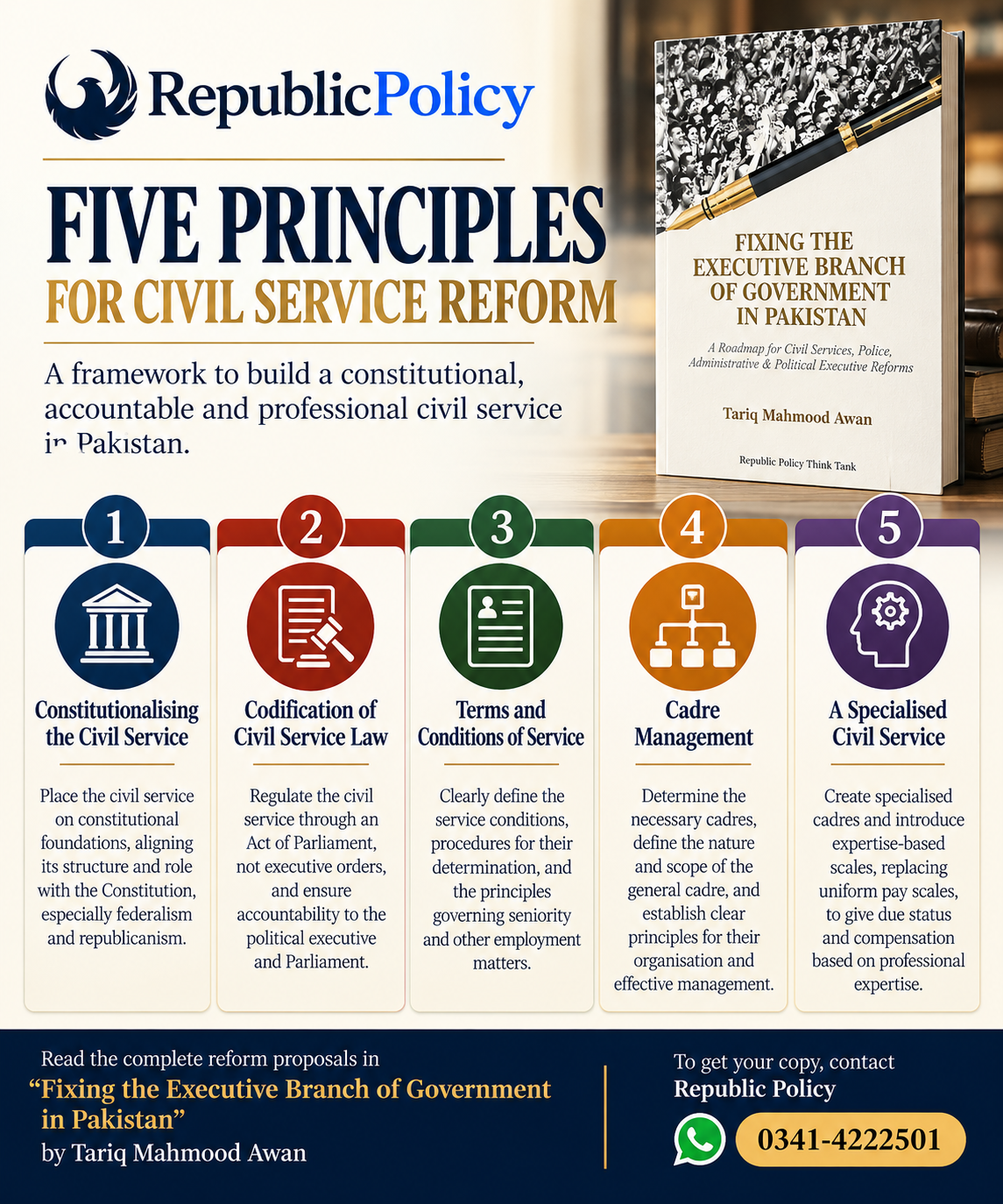
Civil service reform therefore deserves equal attention. Pakistan requires a professional, merit-based and specialised bureaucracy capable of delivering modern public administration. Recruitment, training, performance evaluation and career progression should reward competence rather than personal connections or political influence. Public officials must be given both professional autonomy and clear accountability for results.
Equally important is the strengthening of local administrative capacity. Decentralisation cannot succeed if local institutions lack trained personnel, financial resources and technical expertise. Empowering municipalities means more than conducting elections. It requires building capable institutions that can plan, implement and monitor development programmes effectively.
Fiscal decentralisation must accompany administrative decentralisation. Local governments cannot provide quality public services if they remain entirely dependent on provincial transfers. They require predictable revenue streams, transparent financial management and sufficient authority to address local priorities. International experience consistently demonstrates that decentralisation succeeds when political authority is matched by financial capacity.
The proposal to create new provinces also raises significant constitutional and administrative questions. Such a transformation would require constitutional amendments, broad political consensus and negotiations over boundaries, public assets, civil services, financial obligations and revenue-sharing arrangements. Establishing entirely new provincial administrations would involve enormous financial costs at a time when Pakistan already faces persistent fiscal pressures.
These practical challenges do not make new provinces impossible. They simply reinforce the need for careful sequencing. Constitutional restructuring should follow successful institutional reform, not replace it. If the machinery of governance remains broken, changing the administrative map alone will not produce better outcomes.
Pakistan’s immediate priorities are already well known. Local governments need genuine constitutional protection and meaningful authority. Provincial administrations require stronger accountability mechanisms. Bureaucratic reforms must improve professionalism and service delivery. Digital governance should reduce opportunities for corruption while making public services faster and more accessible. Public institutions must become responsive to citizens rather than administrative hierarchies.
Once these reforms are implemented, Pakistan will be in a far better position to evaluate whether additional provinces remain necessary. At that stage, the debate can be guided by administrative efficiency, demographic realities and regional development rather than expectations that new boundaries alone will solve long-standing governance failures.
Minister Mohsin Naqvi deserves credit for acknowledging that Pakistan’s governance system requires serious reform. Recognising the problem is an important first step. The larger challenge, however, is correctly identifying its source. Pakistan’s greatest governance deficit lies not in the size of its provinces but in the weakness of its institutions. Unless the country completes the unfinished journey of decentralisation and rebuilds the machinery of governance from the ground up, creating new provinces may change the map, but it will not change the lives of the people who live within it.